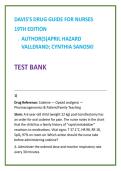
DAVIS'S DRUG GUIDE FOR NURSES
19TH EDITION
• AUTHOR(S)APRIL HAZARD
VALLERAND; CYNTHIA SANOSKI
TEST BANK
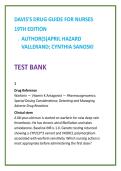
1
Drug Reference
Warfarin — Vitamin K antagonist — Pharmacogenomics
Clinical stem
A 68-year-old man with atrial fibrillation is admitted for
anticoagulation management. The electronic health record
shows a new genotyping result: CYP2C9 *3/*3 and VKORC1
variant associated with increased sensitivity to warfarin. A
morning order appears for warfarin 5 mg PO daily and baseline
INR is 1.1. Which action should the nurse take before
administering the first dose?
,A. Give the 5 mg dose as ordered; genotyping rarely changes
initial dosing.
B. Hold the dose and notify the prescriber to recommend a
lower starting dose and more frequent INR monitoring.
C. Split the tablet and give 2.5 mg because genotypes always
require 50% dose reduction.
D. Administer the dose and schedule INR in 7 days to assess
effect.
Correct answer
B
Rationale — Correct (B)
The CYP2C9 and VKORC1 variants predict increased warfarin
sensitivity and higher bleeding risk. Holding the standard 5 mg
dose and notifying the prescriber to order a lower starting dose
and closer INR monitoring (e.g., within 2–3 days) is the safest
action. This matches pharmacogenomic nursing implications:
genotype-guided dosing reduces adverse events.
Rationale — Incorrect
A. Unsafe — ignoring genotype risks overdose/bleeding
because these variants reduce warfarin clearance and
sensitivity.
C. Inaccurate — arbitrarily halving without
prescriber/consultation and without evidence-based protocol is
unsafe.
D. Risky — waiting 7 days delays detection of supratherapeutic
,INR; early monitoring is required when genotype indicates
sensitivity.
Teaching point
Genotype-guided warfarin dosing: hold standard dose; consult
prescriber; monitor INR early.
Citation
Vallerand, A. H., & Sanoski, C. (2025). Davis's Drug Guide for
Nurses (19th ed.). [Warfarin — Pharmacogenomics].
2
Drug Reference
Clopidogrel — P2Y₁₂ ADP receptor inhibitor (prodrug) —
Cytochrome P450 System: What Is It and Why Should I Care? /
Drug Interactions
Clinical stem
A 59-year-old woman with recent PCI is to receive clopidogrel
300 mg loading dose in the ED. Home meds include omeprazole
40 mg daily for GERD. The nurse notes omeprazole on
medication reconciliation. What is the best nursing action?
A. Administer both clopidogrel and omeprazole as scheduled;
interactions are clinically insignificant.
B. Hold clopidogrel and give aspirin only because PPIs prevent
clopidogrel activation.
C. Administer clopidogrel now and document the omeprazole
interaction; inform prescriber to consider switching
, omeprazole.
D. Crush the clopidogrel and give via NG tube to increase
absorption and override interaction.
Correct answer
C
Rationale — Correct (C)
Clopidogrel is a CYP2C19-dependent prodrug; omeprazole
inhibits CYP2C19 and can reduce clopidogrel activation and
antiplatelet effect. The nurse should administer the prescribed
clopidogrel loading dose (time-sensitive after PCI), document
the interaction, and notify the prescriber to consider an
alternative acid-reducing agent or PPI with less CYP2C19
inhibition. This balances urgent antiplatelet therapy with safety.
Rationale — Incorrect
A. Incorrect — interaction is clinically relevant and can reduce
clopidogrel efficacy.
B. Not appropriate — holding clopidogrel without prescriber
order jeopardizes post-PCI antiplatelet therapy.
D. Crushing does not prevent CYP-mediated interaction and is
unnecessary and potentially unsafe.
Teaching point
Clopidogrel requires CYP2C19 activation; avoid/adjust strong
CYP2C19 inhibitors like omeprazole.
Citation
Vallerand, A. H., & Sanoski, C. (2025). Davis's Drug Guide for
19TH EDITION
• AUTHOR(S)APRIL HAZARD
VALLERAND; CYNTHIA SANOSKI
TEST BANK
1
Drug Reference
Warfarin — Vitamin K antagonist — Pharmacogenomics
Clinical stem
A 68-year-old man with atrial fibrillation is admitted for
anticoagulation management. The electronic health record
shows a new genotyping result: CYP2C9 *3/*3 and VKORC1
variant associated with increased sensitivity to warfarin. A
morning order appears for warfarin 5 mg PO daily and baseline
INR is 1.1. Which action should the nurse take before
administering the first dose?
,A. Give the 5 mg dose as ordered; genotyping rarely changes
initial dosing.
B. Hold the dose and notify the prescriber to recommend a
lower starting dose and more frequent INR monitoring.
C. Split the tablet and give 2.5 mg because genotypes always
require 50% dose reduction.
D. Administer the dose and schedule INR in 7 days to assess
effect.
Correct answer
B
Rationale — Correct (B)
The CYP2C9 and VKORC1 variants predict increased warfarin
sensitivity and higher bleeding risk. Holding the standard 5 mg
dose and notifying the prescriber to order a lower starting dose
and closer INR monitoring (e.g., within 2–3 days) is the safest
action. This matches pharmacogenomic nursing implications:
genotype-guided dosing reduces adverse events.
Rationale — Incorrect
A. Unsafe — ignoring genotype risks overdose/bleeding
because these variants reduce warfarin clearance and
sensitivity.
C. Inaccurate — arbitrarily halving without
prescriber/consultation and without evidence-based protocol is
unsafe.
D. Risky — waiting 7 days delays detection of supratherapeutic
,INR; early monitoring is required when genotype indicates
sensitivity.
Teaching point
Genotype-guided warfarin dosing: hold standard dose; consult
prescriber; monitor INR early.
Citation
Vallerand, A. H., & Sanoski, C. (2025). Davis's Drug Guide for
Nurses (19th ed.). [Warfarin — Pharmacogenomics].
2
Drug Reference
Clopidogrel — P2Y₁₂ ADP receptor inhibitor (prodrug) —
Cytochrome P450 System: What Is It and Why Should I Care? /
Drug Interactions
Clinical stem
A 59-year-old woman with recent PCI is to receive clopidogrel
300 mg loading dose in the ED. Home meds include omeprazole
40 mg daily for GERD. The nurse notes omeprazole on
medication reconciliation. What is the best nursing action?
A. Administer both clopidogrel and omeprazole as scheduled;
interactions are clinically insignificant.
B. Hold clopidogrel and give aspirin only because PPIs prevent
clopidogrel activation.
C. Administer clopidogrel now and document the omeprazole
interaction; inform prescriber to consider switching
, omeprazole.
D. Crush the clopidogrel and give via NG tube to increase
absorption and override interaction.
Correct answer
C
Rationale — Correct (C)
Clopidogrel is a CYP2C19-dependent prodrug; omeprazole
inhibits CYP2C19 and can reduce clopidogrel activation and
antiplatelet effect. The nurse should administer the prescribed
clopidogrel loading dose (time-sensitive after PCI), document
the interaction, and notify the prescriber to consider an
alternative acid-reducing agent or PPI with less CYP2C19
inhibition. This balances urgent antiplatelet therapy with safety.
Rationale — Incorrect
A. Incorrect — interaction is clinically relevant and can reduce
clopidogrel efficacy.
B. Not appropriate — holding clopidogrel without prescriber
order jeopardizes post-PCI antiplatelet therapy.
D. Crushing does not prevent CYP-mediated interaction and is
unnecessary and potentially unsafe.
Teaching point
Clopidogrel requires CYP2C19 activation; avoid/adjust strong
CYP2C19 inhibitors like omeprazole.
Citation
Vallerand, A. H., & Sanoski, C. (2025). Davis's Drug Guide for