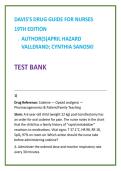
DAVIS'S DRUG GUIDE FOR NURSES
19TH EDITION
• AUTHOR(S)APRIL HAZARD
VALLERAND; CYNTHIA SANOSKI
TEST BANK
1
Drug Reference: Warfarin — Vitamin K Antagonist —
Pharmacogenomics; Special Dosing Considerations
Clinical stem: A 68-year-old man with atrial fibrillation is started
on warfarin 5 mg PO nightly. His baseline INR is 1.0. He reports
a strong family history of bleeding after starting "blood
thinners." The prescriber asks you to give the first dose now.
Which action is best?
A. Administer the full 5 mg dose and obtain INR in 3 days.
B. Hold the dose and ask whether the patient has had genetic
testing for CYP2C9/VKORC1 variants.
C. Administer 2.5 mg instead and schedule INR in 2 days.
D. Give 5 mg and add vitamin K 1 mg PO daily as prophylaxis.
,Correct answer: C
Rationale — Correct (C): Starting at a lower initial dose (2.5 mg)
is appropriate when concern exists for increased sensitivity
(older age, possible genetic variants). Early INR check in 2 days
helps detect rapid anticoagulant effect and prevents over
anticoagulation. This balances safety and timely
anticoagulation.
Rationale — Incorrect (A): Full 5 mg without earlier INR for an
older patient with possible sensitivity risks may cause excessive
INR and bleeding.
Rationale — Incorrect (B): Holding therapy while awaiting
genetic testing delays needed anticoagulation; testing can
inform dosing but is not required before first dose.
Rationale — Incorrect (D): Prophylactic vitamin K undermines
warfarin efficacy and is not recommended as routine
prevention of bleeding.
Teaching point: Consider lower initial warfarin doses and early
INR checks for older or genetically at-risk patients.
Citation: Vallerand, A. H., & Sanoski, C. (2025). Davis's Drug
Guide for Nurses (19th ed.). [Warfarin — Pharmacogenomics].
2
Drug Reference: Clopidogrel — P2Y12 ADP Receptor Antagonist
— Pharmacogenomics; Drug Interactions
Clinical stem: A 52-year-old woman with recent percutaneous
coronary intervention is prescribed clopidogrel 75 mg daily. She
,takes omeprazole daily for GERD and asks why her cardiologist
didn’t prescribe a different P2Y12 inhibitor. What is the most
appropriate nursing explanation/action?
A. Tell her omeprazole increases bleeding risk with clopidogrel;
recommend stopping omeprazole immediately.
B. Explain that PPIs can reduce clopidogrel activation
(CYP2C19); discuss switching omeprazole to famotidine with
prescriber.
C. Advise taking omeprazole and clopidogrel at different times
of day to prevent interaction.
D. Reassure her there is no interaction; continue both as
ordered.
Correct answer: B
Rationale — Correct (B): Omeprazole inhibits CYP2C19, which
converts clopidogrel to its active metabolite; this reduces
antiplatelet effect and increases thrombotic risk. Discussing PPI
alternatives (e.g., H2 blocker) or choosing a different
antiplatelet with the prescriber is appropriate.
Rationale — Incorrect (A): Omeprazole increases risk of
reduced clopidogrel efficacy, not bleeding; stopping omeprazole
without prescriber input may worsen GERD.
Rationale — Incorrect (C): Separating dosing does not reliably
prevent the CYP-mediated interaction.
Rationale — Incorrect (D): There is a clinically relevant
interaction; doing nothing may risk stent thrombosis.
Teaching point: PPIs (omeprazole) can reduce clopidogrel
, activation via CYP2C19 — consider alternatives.
Citation: Vallerand, A. H., & Sanoski, C. (2025). Davis's Drug
Guide for Nurses (19th ed.). [Clopidogrel — Drug Interactions;
Pharmacogenomics].
3
Drug Reference: Isotretinoin — Retinoid — Overview of REMS;
Females of Reproductive Potential; Patient/Family Teaching
Clinical stem: A 22-year-old woman of reproductive potential is
to start isotretinoin 0.5 mg/kg daily for severe acne. She uses
condoms inconsistently and refuses reliable contraception.
Pregnancy test in clinic is negative. Which action should the
nurse take?
A. Proceed with the first dose after counseling about
abstinence.
B. Administer the first dose and schedule monthly pregnancy
tests.
C. Hold the prescription and notify the prescriber that required
contraception criteria are not met.
D. Give the medication but prescribe folic acid to reduce
teratogenic risk.
Correct answer: C
Rationale — Correct (C): Isotretinoin is highly teratogenic and
its REMS program requires documented, reliable contraception
and negative pregnancy testing before dispensing. If the patient
19TH EDITION
• AUTHOR(S)APRIL HAZARD
VALLERAND; CYNTHIA SANOSKI
TEST BANK
1
Drug Reference: Warfarin — Vitamin K Antagonist —
Pharmacogenomics; Special Dosing Considerations
Clinical stem: A 68-year-old man with atrial fibrillation is started
on warfarin 5 mg PO nightly. His baseline INR is 1.0. He reports
a strong family history of bleeding after starting "blood
thinners." The prescriber asks you to give the first dose now.
Which action is best?
A. Administer the full 5 mg dose and obtain INR in 3 days.
B. Hold the dose and ask whether the patient has had genetic
testing for CYP2C9/VKORC1 variants.
C. Administer 2.5 mg instead and schedule INR in 2 days.
D. Give 5 mg and add vitamin K 1 mg PO daily as prophylaxis.
,Correct answer: C
Rationale — Correct (C): Starting at a lower initial dose (2.5 mg)
is appropriate when concern exists for increased sensitivity
(older age, possible genetic variants). Early INR check in 2 days
helps detect rapid anticoagulant effect and prevents over
anticoagulation. This balances safety and timely
anticoagulation.
Rationale — Incorrect (A): Full 5 mg without earlier INR for an
older patient with possible sensitivity risks may cause excessive
INR and bleeding.
Rationale — Incorrect (B): Holding therapy while awaiting
genetic testing delays needed anticoagulation; testing can
inform dosing but is not required before first dose.
Rationale — Incorrect (D): Prophylactic vitamin K undermines
warfarin efficacy and is not recommended as routine
prevention of bleeding.
Teaching point: Consider lower initial warfarin doses and early
INR checks for older or genetically at-risk patients.
Citation: Vallerand, A. H., & Sanoski, C. (2025). Davis's Drug
Guide for Nurses (19th ed.). [Warfarin — Pharmacogenomics].
2
Drug Reference: Clopidogrel — P2Y12 ADP Receptor Antagonist
— Pharmacogenomics; Drug Interactions
Clinical stem: A 52-year-old woman with recent percutaneous
coronary intervention is prescribed clopidogrel 75 mg daily. She
,takes omeprazole daily for GERD and asks why her cardiologist
didn’t prescribe a different P2Y12 inhibitor. What is the most
appropriate nursing explanation/action?
A. Tell her omeprazole increases bleeding risk with clopidogrel;
recommend stopping omeprazole immediately.
B. Explain that PPIs can reduce clopidogrel activation
(CYP2C19); discuss switching omeprazole to famotidine with
prescriber.
C. Advise taking omeprazole and clopidogrel at different times
of day to prevent interaction.
D. Reassure her there is no interaction; continue both as
ordered.
Correct answer: B
Rationale — Correct (B): Omeprazole inhibits CYP2C19, which
converts clopidogrel to its active metabolite; this reduces
antiplatelet effect and increases thrombotic risk. Discussing PPI
alternatives (e.g., H2 blocker) or choosing a different
antiplatelet with the prescriber is appropriate.
Rationale — Incorrect (A): Omeprazole increases risk of
reduced clopidogrel efficacy, not bleeding; stopping omeprazole
without prescriber input may worsen GERD.
Rationale — Incorrect (C): Separating dosing does not reliably
prevent the CYP-mediated interaction.
Rationale — Incorrect (D): There is a clinically relevant
interaction; doing nothing may risk stent thrombosis.
Teaching point: PPIs (omeprazole) can reduce clopidogrel
, activation via CYP2C19 — consider alternatives.
Citation: Vallerand, A. H., & Sanoski, C. (2025). Davis's Drug
Guide for Nurses (19th ed.). [Clopidogrel — Drug Interactions;
Pharmacogenomics].
3
Drug Reference: Isotretinoin — Retinoid — Overview of REMS;
Females of Reproductive Potential; Patient/Family Teaching
Clinical stem: A 22-year-old woman of reproductive potential is
to start isotretinoin 0.5 mg/kg daily for severe acne. She uses
condoms inconsistently and refuses reliable contraception.
Pregnancy test in clinic is negative. Which action should the
nurse take?
A. Proceed with the first dose after counseling about
abstinence.
B. Administer the first dose and schedule monthly pregnancy
tests.
C. Hold the prescription and notify the prescriber that required
contraception criteria are not met.
D. Give the medication but prescribe folic acid to reduce
teratogenic risk.
Correct answer: C
Rationale — Correct (C): Isotretinoin is highly teratogenic and
its REMS program requires documented, reliable contraception
and negative pregnancy testing before dispensing. If the patient