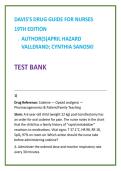
DAVIS'S DRUG GUIDE FOR NURSES
19TH EDITION
• AUTHOR(S)APRIL HAZARD
VALLERAND; CYNTHIA SANOSKI
TEST BANK
1
Drug Reference
Warfarin — Vitamin K Antagonist — Pharmacogenomics;
Special Dosing Considerations; Detecting and Managing
Adverse Drug Reactions
Clinical stem
A 68-year-old man is started on warfarin for new deep vein
thrombosis. He has chronic atrial fibrillation and takes
amiodarone. Baseline INR is 1.0. Genetic testing returned
showing a CYP2C9*3 variant and VKORC1 polymorphism
associated with warfarin sensitivity. Which nursing action is
most appropriate before administering the first dose?
,A. Give the standard initial dose per protocol and recheck INR in
72 hours.
B. Administer a lower initial dose and communicate genotype to
prescriber for dose adjustment.
C. Hold warfarin and request an immediate vitamin K order to
prevent bleeding.
D. Proceed with usual dose but advise the patient to avoid leafy
greens.
Correct answer: B
Rationale — Correct (B)
CYP2C93* and VKORC1 variants increase warfarin sensitivity
and bleeding risk; evidence-based practice is to start at a lower
initial dose and notify prescriber for genotype-guided dosing.
Nursing implication: document genotype, adjust dosing plan,
and plan closer INR monitoring. This reduces early over-
anticoagulation and adverse events.
Rationale — Incorrect
A. Standard dosing ignores genotype and amiodarone
interaction (inhibits warfarin metabolism), increasing bleeding
risk.
C. Holding warfarin and ordering vitamin K is inappropriate
prophylactically; vitamin K reverses anticoagulation and is
unnecessary without elevated INR/bleeding.
D. Dietary counseling is important but insufficient — genotype
and drug interactions require dose change and monitoring.
,Teaching point:
Genotype + interacting drugs → start lower warfarin dose and
increase INR monitoring.
Citation:
Vallerand, A. H., & Sanoski, C. (2025). Davis's Drug Guide for
Nurses (19th ed.). [Warfarin — Pharmacogenomics; Special
Dosing Considerations].
2
Drug Reference
Clopidogrel — P2Y₁₂ ADP Receptor Inhibitor (Antiplatelet) —
Pharmacogenomics; Drug Interactions; Medication Errors
Clinical stem
A 62-year-old woman had a drug-eluting stent placed yesterday
and is prescribed clopidogrel. Her chart notes she is a CYP2C19
poor metabolizer. Which action should the nurse take?
A. Give clopidogrel as ordered; genetic status doesn't affect
short-term antiplatelet effect.
B. Hold clopidogrel and notify the provider to consider an
alternative antiplatelet (e.g., ticagrelor).
C. Double the clopidogrel dose to overcome poor metabolism.
D. Administer clopidogrel and add aspirin to ensure platelet
inhibition.
Correct answer: B
, Rationale — Correct (B)
CYP2C19 poor metabolizers may not convert clopidogrel to its
active form, reducing efficacy and increasing stent thrombosis
risk. Best practice is to hold and notify provider to switch to a
non-CYP2C19-dependent agent (e.g., ticagrelor or prasugrel if
not contraindicated). This is an evidence-based, safety-oriented
action.
Rationale — Incorrect
A. Incorrect — genotype affects clopidogrel activation and
clinical effect, especially post-PCI.
C. Doubling dose is unsupported and increases bleeding risk
without reliably overcoming metabolism defect.
D. Adding aspirin unnecessarily increases bleeding risk; dual
therapy decisions are prescriber-level and must consider
genotype and bleeding risk.
Teaching point:
CYP2C19 poor metabolizers: consider non-clopidogrel
antiplatelet to prevent stent thrombosis.
Citation:
Vallerand, A. H., & Sanoski, C. (2025). Davis's Drug Guide for
Nurses (19th ed.). [Clopidogrel — Pharmacogenomics; Drug
Interactions].
3
19TH EDITION
• AUTHOR(S)APRIL HAZARD
VALLERAND; CYNTHIA SANOSKI
TEST BANK
1
Drug Reference
Warfarin — Vitamin K Antagonist — Pharmacogenomics;
Special Dosing Considerations; Detecting and Managing
Adverse Drug Reactions
Clinical stem
A 68-year-old man is started on warfarin for new deep vein
thrombosis. He has chronic atrial fibrillation and takes
amiodarone. Baseline INR is 1.0. Genetic testing returned
showing a CYP2C9*3 variant and VKORC1 polymorphism
associated with warfarin sensitivity. Which nursing action is
most appropriate before administering the first dose?
,A. Give the standard initial dose per protocol and recheck INR in
72 hours.
B. Administer a lower initial dose and communicate genotype to
prescriber for dose adjustment.
C. Hold warfarin and request an immediate vitamin K order to
prevent bleeding.
D. Proceed with usual dose but advise the patient to avoid leafy
greens.
Correct answer: B
Rationale — Correct (B)
CYP2C93* and VKORC1 variants increase warfarin sensitivity
and bleeding risk; evidence-based practice is to start at a lower
initial dose and notify prescriber for genotype-guided dosing.
Nursing implication: document genotype, adjust dosing plan,
and plan closer INR monitoring. This reduces early over-
anticoagulation and adverse events.
Rationale — Incorrect
A. Standard dosing ignores genotype and amiodarone
interaction (inhibits warfarin metabolism), increasing bleeding
risk.
C. Holding warfarin and ordering vitamin K is inappropriate
prophylactically; vitamin K reverses anticoagulation and is
unnecessary without elevated INR/bleeding.
D. Dietary counseling is important but insufficient — genotype
and drug interactions require dose change and monitoring.
,Teaching point:
Genotype + interacting drugs → start lower warfarin dose and
increase INR monitoring.
Citation:
Vallerand, A. H., & Sanoski, C. (2025). Davis's Drug Guide for
Nurses (19th ed.). [Warfarin — Pharmacogenomics; Special
Dosing Considerations].
2
Drug Reference
Clopidogrel — P2Y₁₂ ADP Receptor Inhibitor (Antiplatelet) —
Pharmacogenomics; Drug Interactions; Medication Errors
Clinical stem
A 62-year-old woman had a drug-eluting stent placed yesterday
and is prescribed clopidogrel. Her chart notes she is a CYP2C19
poor metabolizer. Which action should the nurse take?
A. Give clopidogrel as ordered; genetic status doesn't affect
short-term antiplatelet effect.
B. Hold clopidogrel and notify the provider to consider an
alternative antiplatelet (e.g., ticagrelor).
C. Double the clopidogrel dose to overcome poor metabolism.
D. Administer clopidogrel and add aspirin to ensure platelet
inhibition.
Correct answer: B
, Rationale — Correct (B)
CYP2C19 poor metabolizers may not convert clopidogrel to its
active form, reducing efficacy and increasing stent thrombosis
risk. Best practice is to hold and notify provider to switch to a
non-CYP2C19-dependent agent (e.g., ticagrelor or prasugrel if
not contraindicated). This is an evidence-based, safety-oriented
action.
Rationale — Incorrect
A. Incorrect — genotype affects clopidogrel activation and
clinical effect, especially post-PCI.
C. Doubling dose is unsupported and increases bleeding risk
without reliably overcoming metabolism defect.
D. Adding aspirin unnecessarily increases bleeding risk; dual
therapy decisions are prescriber-level and must consider
genotype and bleeding risk.
Teaching point:
CYP2C19 poor metabolizers: consider non-clopidogrel
antiplatelet to prevent stent thrombosis.
Citation:
Vallerand, A. H., & Sanoski, C. (2025). Davis's Drug Guide for
Nurses (19th ed.). [Clopidogrel — Pharmacogenomics; Drug
Interactions].
3