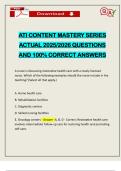
ATI Content Mastery Series
A nurse is discussing restorative health care with a newly licensed nurse. Which of the following
examples should the nurse include in the teaching? (Select all that apply.)
A. Home health care
B. Rehabilitation facilities
C. Diagnostic centers
D. Skilled nursing facilities
E. Oncology centers - Answer -A, B, D - Correct: Restorative health care involves intermediate follow-up
care for restoring health and promoting self-care.
C-Incorrect: Diagnostic centers are a type of secondary health care. Secondary health care includes the
diagnosis and treatment of acute injury or illness.
E- Incorrect: An oncology center is a type of tertiary health care. Tertiary health care is specialized and
highly technical care.
A nurse is explaining the various types of health care coverage clients might have to a group of nurses.
Which of the following health care financing mechanisms should the nurse include as federally funded?
(Select all that apply.)
A. Preferred provider organization (PPO)
B. Medicare
C. Long-term care insurance
D. Exclusive provider organization (EPO)
E. Medicaid - Answer -B, E- Correct: Medicare and Medicaid are federally funded.
,A, C, D - Incorrect: PPOs, Long-term care insurance, and EPOs are privately funded.
A nurse manager is developing strategies to care for the increasing number of clients who have obesity.
Which of the following actions should the nurse include as a primary health care strategy?
A. Collaborating with providers to perform obesity screenings during routine office visits.
B. Ensuring the availability of specialized beds in rehabilitation centers for clients who have obesity.
C. Providing specialized intraoperative training in surgical treatments for obesity.
D. Educating acute care nurses about postoperative complications related to obesity. - Answer -A-
Correct: Identify obesity screenings at office visits as an example of primary health care. Primary health
care emphasizes health promotion and disease control.
B- Incorrect: Rehabilitation care is an example of restorative health care.
C- Incorrect: Specialized and highly technical care is an example of tertiary health care.
D- Incorrect: Acute care is an example of secondary health care.
A nurse is discussing the purpose of regulatory agencies during a staff meeting. Which of the following
tasks should the nurse identify as the responsibility of state licensing boards?
A. Monitoring evidence-based practice for clients who have a specific diagnosis
B. Ensuring that health care providers comply with regulations
C. Setting quality standards for accreditation of health care facilities
D. Determining whether medications are safe for administration to clients - Answer -B- Correct: Identify
that state licensing boards are responsible for ensuring that health care providers and agencies comply
with state regulations
A.- Incorrect: Identify that utilization review committees have the responsibility of monitoring for
appropriate diagnosis and treatment according to evidence-based practice.
C- Incorrect: Identify that the Joint Commission has the responsibility of setting quality standards for
accreditation of health care facilities
,D-Incorrect: Identify that the U.S FDA has the responsibility of determining whether medications are safe
for administration to clients.
A nurse is explaining the various levels of health care services to a group of newly licensed nurses. Which
of the following examples of care or care settings should the nurse classify as tertiary care? (Select all
that apply.)
A. Intensive care unit
B. Oncology treatment center
C. Burn center
D. Cardiac rehabilitation
E. Home health care - Answer -A,B, and C- Correct: Tertiary health care involves the provision of
specialized and highly technical care.
D- Incorrect: Cardiac rehabilitation is an example of restorative care and also of tertiary prevention, but
not of tertiary care.
E-Incorrect: Home health care is an example of restorative care.
List the six (6) Quality and Safety Education for Nurses (QSEN) competencies, along with a brief
description of each. - Answer -1. Safety: Minimization of risk factors that could cause injury or harm
while promoting quality care and maintaining a secure environment for clients, self, and others
2. Patient-Centered Care: Provision of caring and compassionate, culturally sensitive care that addresses
clients' physiological, psychological, sociological, spiritual, and cultural needs, preferences, and values
3. Evidence-based Practice: Use of current knowledge from research and other credible sources on
which to base clinical judgement and client care.
4. Informatics: Use of information technology as a communication and information-gathering tool that
supports clinical decision-making and scientifically based nursing practice
, 5. Quality Improvement: Care-related and organizational processes that involve the development and
implementation of a plan to improve health care services and better meet clients' needs
6. teamwork and Collaboration: Delivery of client care in partnership with multidisciplinary members of
the health care team to achieve continuity of care and positive client outcomes
A nurse is caring for a group of clients on a medical-surgical unit. For which of the following client care
needs should the nurse initiate a referral for a social worker? (Select all that apply.)
A. A client who has terminal cancer requests hospice care in the home
B. A client asks about community resources available for older adults
C. A client states, "I would like to have my child baptized before surgery."
D. A client requests an electric wheelchair for use after discharge
E. A client states, "I do not understand how to use a nebulizer." - Answer -A, B, D: Correct: Initiate a
referral for a social worker to provide information and assistance in coordinating hospice care,
availability of community resources, and obtaining medical equipment after d/c.
C- Incorrect: Religious sacraments or prayers require a referral for spiritual support staff.
E- Incorrect: Provide client teaching for concerns regarding the use of a nebulizer. If additional
information is needed, initiate a referral for a respiratory therapist.
A goal for a client who has difficulty with self-feeding due to rheumatoid arthritis is to use adaptive
devices. The nurse caring for the client should initiate a referral to which of the following members of
the interprofessional care team?
A. Social worker
B. Certified nursing assistant
C. Registered dietitian
D. Occupational therapist - Answer -D - Correct: An occupational therapist can assist clients who have
physical challenges to use adaptive devices and strategies to help with self-care activities.
A nurse is discussing restorative health care with a newly licensed nurse. Which of the following
examples should the nurse include in the teaching? (Select all that apply.)
A. Home health care
B. Rehabilitation facilities
C. Diagnostic centers
D. Skilled nursing facilities
E. Oncology centers - Answer -A, B, D - Correct: Restorative health care involves intermediate follow-up
care for restoring health and promoting self-care.
C-Incorrect: Diagnostic centers are a type of secondary health care. Secondary health care includes the
diagnosis and treatment of acute injury or illness.
E- Incorrect: An oncology center is a type of tertiary health care. Tertiary health care is specialized and
highly technical care.
A nurse is explaining the various types of health care coverage clients might have to a group of nurses.
Which of the following health care financing mechanisms should the nurse include as federally funded?
(Select all that apply.)
A. Preferred provider organization (PPO)
B. Medicare
C. Long-term care insurance
D. Exclusive provider organization (EPO)
E. Medicaid - Answer -B, E- Correct: Medicare and Medicaid are federally funded.
,A, C, D - Incorrect: PPOs, Long-term care insurance, and EPOs are privately funded.
A nurse manager is developing strategies to care for the increasing number of clients who have obesity.
Which of the following actions should the nurse include as a primary health care strategy?
A. Collaborating with providers to perform obesity screenings during routine office visits.
B. Ensuring the availability of specialized beds in rehabilitation centers for clients who have obesity.
C. Providing specialized intraoperative training in surgical treatments for obesity.
D. Educating acute care nurses about postoperative complications related to obesity. - Answer -A-
Correct: Identify obesity screenings at office visits as an example of primary health care. Primary health
care emphasizes health promotion and disease control.
B- Incorrect: Rehabilitation care is an example of restorative health care.
C- Incorrect: Specialized and highly technical care is an example of tertiary health care.
D- Incorrect: Acute care is an example of secondary health care.
A nurse is discussing the purpose of regulatory agencies during a staff meeting. Which of the following
tasks should the nurse identify as the responsibility of state licensing boards?
A. Monitoring evidence-based practice for clients who have a specific diagnosis
B. Ensuring that health care providers comply with regulations
C. Setting quality standards for accreditation of health care facilities
D. Determining whether medications are safe for administration to clients - Answer -B- Correct: Identify
that state licensing boards are responsible for ensuring that health care providers and agencies comply
with state regulations
A.- Incorrect: Identify that utilization review committees have the responsibility of monitoring for
appropriate diagnosis and treatment according to evidence-based practice.
C- Incorrect: Identify that the Joint Commission has the responsibility of setting quality standards for
accreditation of health care facilities
,D-Incorrect: Identify that the U.S FDA has the responsibility of determining whether medications are safe
for administration to clients.
A nurse is explaining the various levels of health care services to a group of newly licensed nurses. Which
of the following examples of care or care settings should the nurse classify as tertiary care? (Select all
that apply.)
A. Intensive care unit
B. Oncology treatment center
C. Burn center
D. Cardiac rehabilitation
E. Home health care - Answer -A,B, and C- Correct: Tertiary health care involves the provision of
specialized and highly technical care.
D- Incorrect: Cardiac rehabilitation is an example of restorative care and also of tertiary prevention, but
not of tertiary care.
E-Incorrect: Home health care is an example of restorative care.
List the six (6) Quality and Safety Education for Nurses (QSEN) competencies, along with a brief
description of each. - Answer -1. Safety: Minimization of risk factors that could cause injury or harm
while promoting quality care and maintaining a secure environment for clients, self, and others
2. Patient-Centered Care: Provision of caring and compassionate, culturally sensitive care that addresses
clients' physiological, psychological, sociological, spiritual, and cultural needs, preferences, and values
3. Evidence-based Practice: Use of current knowledge from research and other credible sources on
which to base clinical judgement and client care.
4. Informatics: Use of information technology as a communication and information-gathering tool that
supports clinical decision-making and scientifically based nursing practice
, 5. Quality Improvement: Care-related and organizational processes that involve the development and
implementation of a plan to improve health care services and better meet clients' needs
6. teamwork and Collaboration: Delivery of client care in partnership with multidisciplinary members of
the health care team to achieve continuity of care and positive client outcomes
A nurse is caring for a group of clients on a medical-surgical unit. For which of the following client care
needs should the nurse initiate a referral for a social worker? (Select all that apply.)
A. A client who has terminal cancer requests hospice care in the home
B. A client asks about community resources available for older adults
C. A client states, "I would like to have my child baptized before surgery."
D. A client requests an electric wheelchair for use after discharge
E. A client states, "I do not understand how to use a nebulizer." - Answer -A, B, D: Correct: Initiate a
referral for a social worker to provide information and assistance in coordinating hospice care,
availability of community resources, and obtaining medical equipment after d/c.
C- Incorrect: Religious sacraments or prayers require a referral for spiritual support staff.
E- Incorrect: Provide client teaching for concerns regarding the use of a nebulizer. If additional
information is needed, initiate a referral for a respiratory therapist.
A goal for a client who has difficulty with self-feeding due to rheumatoid arthritis is to use adaptive
devices. The nurse caring for the client should initiate a referral to which of the following members of
the interprofessional care team?
A. Social worker
B. Certified nursing assistant
C. Registered dietitian
D. Occupational therapist - Answer -D - Correct: An occupational therapist can assist clients who have
physical challenges to use adaptive devices and strategies to help with self-care activities.