

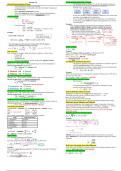
Chapter 10 Use the ideal gas equation in a reaction
Physical Characteristics of Gases - The ideal gas equation relates P, V, and T to the number of moles of
- Physical properties of gases are all similar. gas, n, which can be used in stoichiometric calculations.
- Composed mainly of nonmetallic elements with simple formulas and - Example: A(g) → B(s) + C(s)
low molar masses.
- Many molecular compounds are gases.
- Only a few elements are gases at normal pressure and temperature.
- Two or more gases always form a homogeneous mixture. - If only one variable in ideal gas equation is unknown, solve it first, then
Units of Pressure use moles of gas (mole A) in stoichiometry.
- Units - If two variables in ideal gas equation are unknown, use stoichiometry
o Psi = lb/in2 to find moles of gas (mole A) to plug into the equation to solve for the
o Pa = N/m2 (SI unit) second variable.
o 1 torr = 1 mm Hg Example:
- Unit Conversions
o 1 torr = 1 mmHg
o 1 atm = 760 torr = 760 mmHg = 1.01325 x 10⁵ Pa
o 1 atm = 101.3 kPa = 1.01325 bar
Example:
Density of Gases
𝑚 𝑃 ×𝑀𝑀
d= =
𝑉 𝑅𝑇
The Gas Laws Example:
Four variables are needed to define the physical condition, or state, of gas: What is the density of SF6 gas (in g/L) at 1.00 atm and 25C?
- Pressure (P) MM for SF6 = 32.07 + 6 x 19.00 = 146.07 g/mol
- Volume (V) 25C = 273.15 + 25 = 298.15 K
1.00 𝑎𝑡𝑚 𝑥 146.07 𝑔/𝑚𝑜𝑙
- Temperature (T) d= 𝐿•𝑎𝑡𝑚 = 𝟓. 𝟗𝟕 𝐠/𝐋
0.08206𝑚𝑜𝑙•𝐾 𝑥 298.15 𝐾
- Amount of gas particles, usually expressed as number of moles.
Gas Law 1: Pressure and Volume Gas Mixtures and Partial Pressures
Boyle’s Law – The volume of a fixed quantity of gas at constant temperature is - The pressure exerted by a particular component of a mixture of gases is
inversely proportional to the pressure. called the partial pressure of that component.
- PV = constant; V = constant x 1/P - The total pressure of a mixture of gases equals the sum of the pressures
- P1V1 = P2V2 that each would exert if it were present alone.
o Ptotal = P1 + P2 + P3…
Example:
What is the total pressure in a container that contains 0.450 atm of O 2, 0.780 atm of
Gas Law 2: Temperature and Volume He, and 1.675 atm of N2?
Charles’s Law – The volume of a fixed amount of gas at constant pressure is Ptotal = (0.450 + 0.780 + 1.675) atm = 2.905 atm
directly proportional to its absolute temperature (K). Partial Pressures and Mole Fraction
- V = constant x T; V/T = constant - Mole Fraction:
- V1/T1 = V2/T2 o X1 =
𝑀𝑜𝑙𝑒𝑠 𝑜𝑓 𝑐𝑜𝑚𝑝𝑜𝑢𝑛𝑑 1 𝑛
= 𝑛1
Temperature must be in Kelvin! 𝑇𝑜𝑡𝑎𝑙 𝑚𝑜𝑙𝑒𝑠 𝑡
- To find the partial pressure of a specific gas component in a gas
mixture, use the mole fraction:
𝑛
o P1 = (𝑛1 )Pt = X1Pt
Gas Law 3: Moles (Quantity) and Volume 𝑡
Avogadro’s Law – The volume of gas at constant temperature and pressure is Kinetic-Molecular Theory of Gases
directly proportional to the number of moles of the gas. Temperature is related to the average kinetic energy: KEave = 3/2 kT.
- V/n = constant; V = constant x n Individual molecules can have different speeds (v): KEave = ½ mv2.
- V1/n1 = V2/n2 OR V1/V2 = n1/n2 μmp is the most probable speed.
Additional Gas Law to help understand Avogadro’s Law μav is the average speed of the molecules.
Guy-Lussac’s Law – The pressure of a fixed quantity of gas at constant volume is μrms the root-mean-square speed, is the one associated with their kinetic energy.
directly proportional to its absolute temperature (in Kelvin). Molecular Speeds, Effusion, and Diffusion
- P1/T1 = P2/T2 Temperature must be in Kelvin! At any given temperature, the average kinetic energy of molecules is the same.
The Ideal-Gas Equation Same temperature means same average KEave. Therefore, 1/2m(μrms)2 = constant.
Combining PV = constant, V/T = constant, and V/n = constant, we get: Velocity is then inversely proportional to the mass of the gas molecule.
Lighter gas molecules will move faster than heavier gas molecules (average
molecular speed).
Molecular Speeds: Gas Particle Velocity
𝟑𝑹𝑻
The constant proportionality is known as R, the gas constant. Urms = √ R = 8.314 J/(mol•K)
𝑴
Units Numerical Value
Example:
L-atm/mol-K 0.08206
J/mol-K* 8.314
cal/mol-K 1.987
m3-Pa/mol-K* 8.314
L-torr/mol-K 62.36
*SI unit
PV = nRT (R = 0.08206 L•atm/mol•K)
Effusion is the escape of gas molecules through a tiny hole into an evacuated
Molar Volume
space. Diffusion (r) is the spread of one substance throughout a space or a second
STP: Standard Temperature and Pressure
substance.
- STP: T = 273.15 K and P = 1.00 atm
The molar volume (V/n) of any ideal gas at stp is 22.414 L/mol. 𝑟2 𝑀𝑀1
= √
𝑟1 𝑀𝑀2
Real Gases: Deviations from Ideal Behavior
Example: In the real world, the behavior of gases conforms to the ideal-gas equation only at
What is the volume (in L) occupied by 2.0 moles of neon gas under 1.00 atm of relatively high temperature and low pressure.
pressure at 0C? The Van Der Waals Equation
𝑛𝑅𝑇 𝑛2 ∗𝑎
PV = nRT, rearranged to find V: V = 𝑃 (P + )(𝑉 − 𝑛𝑏) = 𝑛𝑅𝑇
𝑉2
𝐿•𝑎𝑡𝑚
2.0 𝑚𝑜𝑙 𝑥 0.08206 𝑚𝑜𝑙•𝐾 𝑥 273.15 𝐾
V= = 45 𝐿
1.00 𝑎𝑡𝑚
Physical Characteristics of Gases - The ideal gas equation relates P, V, and T to the number of moles of
- Physical properties of gases are all similar. gas, n, which can be used in stoichiometric calculations.
- Composed mainly of nonmetallic elements with simple formulas and - Example: A(g) → B(s) + C(s)
low molar masses.
- Many molecular compounds are gases.
- Only a few elements are gases at normal pressure and temperature.
- Two or more gases always form a homogeneous mixture. - If only one variable in ideal gas equation is unknown, solve it first, then
Units of Pressure use moles of gas (mole A) in stoichiometry.
- Units - If two variables in ideal gas equation are unknown, use stoichiometry
o Psi = lb/in2 to find moles of gas (mole A) to plug into the equation to solve for the
o Pa = N/m2 (SI unit) second variable.
o 1 torr = 1 mm Hg Example:
- Unit Conversions
o 1 torr = 1 mmHg
o 1 atm = 760 torr = 760 mmHg = 1.01325 x 10⁵ Pa
o 1 atm = 101.3 kPa = 1.01325 bar
Example:
Density of Gases
𝑚 𝑃 ×𝑀𝑀
d= =
𝑉 𝑅𝑇
The Gas Laws Example:
Four variables are needed to define the physical condition, or state, of gas: What is the density of SF6 gas (in g/L) at 1.00 atm and 25C?
- Pressure (P) MM for SF6 = 32.07 + 6 x 19.00 = 146.07 g/mol
- Volume (V) 25C = 273.15 + 25 = 298.15 K
1.00 𝑎𝑡𝑚 𝑥 146.07 𝑔/𝑚𝑜𝑙
- Temperature (T) d= 𝐿•𝑎𝑡𝑚 = 𝟓. 𝟗𝟕 𝐠/𝐋
0.08206𝑚𝑜𝑙•𝐾 𝑥 298.15 𝐾
- Amount of gas particles, usually expressed as number of moles.
Gas Law 1: Pressure and Volume Gas Mixtures and Partial Pressures
Boyle’s Law – The volume of a fixed quantity of gas at constant temperature is - The pressure exerted by a particular component of a mixture of gases is
inversely proportional to the pressure. called the partial pressure of that component.
- PV = constant; V = constant x 1/P - The total pressure of a mixture of gases equals the sum of the pressures
- P1V1 = P2V2 that each would exert if it were present alone.
o Ptotal = P1 + P2 + P3…
Example:
What is the total pressure in a container that contains 0.450 atm of O 2, 0.780 atm of
Gas Law 2: Temperature and Volume He, and 1.675 atm of N2?
Charles’s Law – The volume of a fixed amount of gas at constant pressure is Ptotal = (0.450 + 0.780 + 1.675) atm = 2.905 atm
directly proportional to its absolute temperature (K). Partial Pressures and Mole Fraction
- V = constant x T; V/T = constant - Mole Fraction:
- V1/T1 = V2/T2 o X1 =
𝑀𝑜𝑙𝑒𝑠 𝑜𝑓 𝑐𝑜𝑚𝑝𝑜𝑢𝑛𝑑 1 𝑛
= 𝑛1
Temperature must be in Kelvin! 𝑇𝑜𝑡𝑎𝑙 𝑚𝑜𝑙𝑒𝑠 𝑡
- To find the partial pressure of a specific gas component in a gas
mixture, use the mole fraction:
𝑛
o P1 = (𝑛1 )Pt = X1Pt
Gas Law 3: Moles (Quantity) and Volume 𝑡
Avogadro’s Law – The volume of gas at constant temperature and pressure is Kinetic-Molecular Theory of Gases
directly proportional to the number of moles of the gas. Temperature is related to the average kinetic energy: KEave = 3/2 kT.
- V/n = constant; V = constant x n Individual molecules can have different speeds (v): KEave = ½ mv2.
- V1/n1 = V2/n2 OR V1/V2 = n1/n2 μmp is the most probable speed.
Additional Gas Law to help understand Avogadro’s Law μav is the average speed of the molecules.
Guy-Lussac’s Law – The pressure of a fixed quantity of gas at constant volume is μrms the root-mean-square speed, is the one associated with their kinetic energy.
directly proportional to its absolute temperature (in Kelvin). Molecular Speeds, Effusion, and Diffusion
- P1/T1 = P2/T2 Temperature must be in Kelvin! At any given temperature, the average kinetic energy of molecules is the same.
The Ideal-Gas Equation Same temperature means same average KEave. Therefore, 1/2m(μrms)2 = constant.
Combining PV = constant, V/T = constant, and V/n = constant, we get: Velocity is then inversely proportional to the mass of the gas molecule.
Lighter gas molecules will move faster than heavier gas molecules (average
molecular speed).
Molecular Speeds: Gas Particle Velocity
𝟑𝑹𝑻
The constant proportionality is known as R, the gas constant. Urms = √ R = 8.314 J/(mol•K)
𝑴
Units Numerical Value
Example:
L-atm/mol-K 0.08206
J/mol-K* 8.314
cal/mol-K 1.987
m3-Pa/mol-K* 8.314
L-torr/mol-K 62.36
*SI unit
PV = nRT (R = 0.08206 L•atm/mol•K)
Effusion is the escape of gas molecules through a tiny hole into an evacuated
Molar Volume
space. Diffusion (r) is the spread of one substance throughout a space or a second
STP: Standard Temperature and Pressure
substance.
- STP: T = 273.15 K and P = 1.00 atm
The molar volume (V/n) of any ideal gas at stp is 22.414 L/mol. 𝑟2 𝑀𝑀1
= √
𝑟1 𝑀𝑀2
Real Gases: Deviations from Ideal Behavior
Example: In the real world, the behavior of gases conforms to the ideal-gas equation only at
What is the volume (in L) occupied by 2.0 moles of neon gas under 1.00 atm of relatively high temperature and low pressure.
pressure at 0C? The Van Der Waals Equation
𝑛𝑅𝑇 𝑛2 ∗𝑎
PV = nRT, rearranged to find V: V = 𝑃 (P + )(𝑉 − 𝑛𝑏) = 𝑛𝑅𝑇
𝑉2
𝐿•𝑎𝑡𝑚
2.0 𝑚𝑜𝑙 𝑥 0.08206 𝑚𝑜𝑙•𝐾 𝑥 273.15 𝐾
V= = 45 𝐿
1.00 𝑎𝑡𝑚


