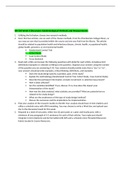
NR 503 Week 3 Discussion-Epidemiological Methods and Measurements; Cohort Study (Articles, Initial, Peer, Faculty Posts)
1. Utilizing the list below, choose two research methods. 2. Next, find two articles, one on each of the chosen methods, from the Chamberlain College library, or you may use one that is provided within the course and one you find from the library. The articles should be related to population health and infectious disease, chronic health, occupational health, global health, genomics, or environmental health: • Randomized Control Trial • Cohort Study • Case-Control Study • Cross-Sectional • The articles you choose should be completely in English (this includes the reference list). They should be related to population health and speak to one of the following elements from the course: Infectious disease, chronic health, occupational health, global health, genomics, or environmental health. 3. Read each article and answer the following questions with detail for each article, include succinct definitions/examples or rationale as fitting to the question. Organize your answers using the number of the question you are answering (1-8). Your answers should provide more than a "yes" or "no", your answers should provide examples, critical thinking, definitions, and examples. 1. Does the study design specify a question, goal, of the study? Why is this important? 2. Explain the methodology (Randomized Control Trial, Cohort Study, Case-Control Study). 3. Describe the participant information, include recruitment. Is selection bias present? 4. How is data collected? 5. Are the variables identified? If yes, discuss. If no, how does this impact your interpretation of the study? 6. How was the data analyzed, what statistics are provided? What are potential errors related to the study design? 7. What are the weaknesses of the type of study design/method? 8. Discuss the outcomes and the implications for implementation. 9. Post your analysis of the research studies to the DB. Your analysis should have in-text citations and utilize a scholarly voice with APA formatting. You may choose to write a Word doc and upload your doc to the discussion board for this week. 10. Respond to a total of two posts: either two (2) peer posts or a peer and faculty post, with a minimum of one paragraph of 4-5 sentences for each of their articles. Your reply post should integrate in-text citation(s) and be formatted with APA and a scholarly voice. Your reply post/s should integrate course content (such as data and correctly used course terminology) related to the study method as well as an integration of in-text citations along with a scholarly voice and APA formatting. Posting Directions 1. Posts should be made on a minimum of 3 separate days/dates. 2. All faculty replies to students must be responded to directly in the discussion board. 3. Minimum posting is: o Initial discussion board post to the weekly prompt, two peer posts (if there are no faculty postings), or one peer post and a faculty post. 1. Utilizing the list below, choose two research methods. 2. Next, find two articles, one on each of the chosen methods, from the Chamberlain College library, or you may use one that is provided within the course and one you find from the library. The articles should be related to population health and infectious disease, chronic health, occupational health, global health, genomics, or environmental health: • Randomized Control Trial • Cohort Study • Case-Control Study • Cross-Sectional • The articles you choose should be completely in English (this includes the reference list). They should be related to population health and speak to one of the following elements from the course: Infectious disease, chronic health, occupational health, global health, genomics, or environmental health. 3. Read each article and answer the following questions with detail for each article, include succinct definitions/examples or rationale as fitting to the question. Organize your answers using the number of the question you are answering (1-8). Your answers should provide more than a "yes" or "no", your answers should provide examples, critical thinking, definitions, and examples. 1. Does the study design specify a question, goal, of the study? Why is this important? 2. Explain the methodology (Randomized Control Trial, Cohort Study, Case-Control Study). 3. Describe the participant information, include recruitment. Is selection bias present? 4. How is data collected? 5. Are the variables identified? If yes, discuss. If no, how does this impact your interpretation of the study? 6. How was the data analyzed, what statistics are provided? What are potential errors related to the study design? 7. What are the weaknesses of the type of study design/method? 8. Discuss the outcomes and the implications for implementation. 9. Post your analysis of the research studies to the DB. Your analysis should have in-text citations and utilize a scholarly voice with APA formatting. You may choose to write a Word doc and upload your doc to the discussion board for this week. 10. Respond to a total of two posts: either two (2) peer posts or a peer and faculty post, with a minimum of one paragraph of 4-5 sentences for each of their articles. Your reply post should integrate in-text citation(s) and be formatted with APA and a scholarly voice. Your reply post/s should integrate course content (such as data and correctly used course terminology) related to the study method as well as an integration of in-text citations along with a scholarly voice and APA formatting. Posting Directions 1. Posts should be made on a minimum of 3 separate days/dates. 2. All faculty replies to students must be responded to directly in the discussion board. 3. Minimum posting is: o Initial discussion board post to the weekly prompt, two peer posts (if there are no faculty postings), or one peer post and a faculty post.
Geschreven voor
Documentinformatie
- Geüpload op
- 31 juli 2021
- Aantal pagina's
- 9
- Geschreven in
- 2020/2021
- Type
- OVERIG
- Persoon
- Onbekend

Ook beschikbaar in voordeelbundel