Manishshaw929
Sur cette page, vous trouverez tous les documents, offres groupées et cartes mémoire flash proposés par le vendeur manishshaw929.
- 234
- 0
- 5
Community
- Abonnés
- Abbonements
239 éléments
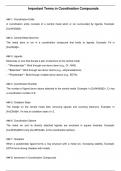
Chemistry class 12th Important_Terms_Coordination_Compounds
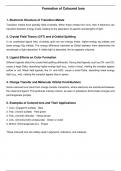
Coordination compounds consist of a central metal atom or ion surrounded by ligands. Key terms include ligand (molecules/ions donating electron pairs), coordination number (number of ligand attachments to the metal), and coordination sphere (metal-ligand complex). Ligands can be monodentate (one donor atom), bidentate (two donor atoms), or polydentate (multiple donor atoms). The chelate effect stabilizes complexes with polydentate ligands. Oxidation state refers to the metal’s charge. Geometri...
- Book
- Notes de cours
- • 2 pages •
Coordination compounds consist of a central metal atom or ion surrounded by ligands. Key terms include ligand (molecules/ions donating electron pairs), coordination number (number of ligand attachments to the metal), and coordination sphere (metal-ligand complex). Ligands can be monodentate (one donor atom), bidentate (two donor atoms), or polydentate (multiple donor atoms). The chelate effect stabilizes complexes with polydentate ligands. Oxidation state refers to the metal’s charge. Geometri...
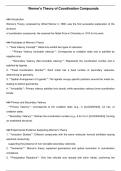
Chemistry class 12th Werner_Theory_Coordination_Compounds
Werner’s theory of coordination compounds, proposed by Alfred Werner in 1893, explains the bonding and structure of complex compounds. It states that metal atoms exhibit two types of valency: primary (oxidation state) and secondary (coordination number). The primary valency is ionizable, while the secondary valency determines the number of ligands attached to the metal. Ligands form coordinate bonds with the central metal ion, creating geometrically distinct structures like octahedral, tetrahe...
- Book
- Notes de cours
- • 2 pages •
Werner’s theory of coordination compounds, proposed by Alfred Werner in 1893, explains the bonding and structure of complex compounds. It states that metal atoms exhibit two types of valency: primary (oxidation state) and secondary (coordination number). The primary valency is ionizable, while the secondary valency determines the number of ligands attached to the metal. Ligands form coordinate bonds with the central metal ion, creating geometrically distinct structures like octahedral, tetrahe...
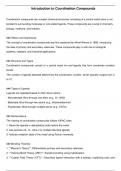
Chemistry class 12th Coordination_Compounds_Introduction
Coordination compounds consist of a central metal atom/ion bonded to surrounding ligands through coordinate covalent bonds. They follow Werner’s coordination theory, where the coordination number defines the number of ligand attachments. Ligands can be neutral molecules (H₂O, NH₃) or anions (Cl⁻, CN⁻), classified as monodentate, bidentate, or polydentate based on binding sites. These compounds exhibit unique colors, magnetism, and reactivity, widely used in medicine (cisplatin for canc...
- Book
- Notes de cours
- • 2 pages •
Coordination compounds consist of a central metal atom/ion bonded to surrounding ligands through coordinate covalent bonds. They follow Werner’s coordination theory, where the coordination number defines the number of ligand attachments. Ligands can be neutral molecules (H₂O, NH₃) or anions (Cl⁻, CN⁻), classified as monodentate, bidentate, or polydentate based on binding sites. These compounds exhibit unique colors, magnetism, and reactivity, widely used in medicine (cisplatin for canc...
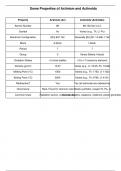
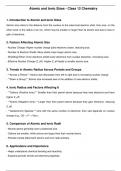
Chemistry class 12th Properties_of_Actinium_and_Actinoids
Actinium and actinoids (elements 89–103) belong to the f-block and exhibit unique properties. Actinium (Ac) is a silvery, radioactive metal with a +3 oxidation state, used in radiation therapy. Actinoids have variable oxidation states (commonly +3, but also +4 to +7), making them chemically versatile. They are highly electropositive, reactive with halogens and acids, and mostly radioactive. Elements like uranium and plutonium are crucial for nuclear energy and weaponry, while others like thori...
- Book
- Notes de cours
- • 1 pages •
Actinium and actinoids (elements 89–103) belong to the f-block and exhibit unique properties. Actinium (Ac) is a silvery, radioactive metal with a +3 oxidation state, used in radiation therapy. Actinoids have variable oxidation states (commonly +3, but also +4 to +7), making them chemically versatile. They are highly electropositive, reactive with halogens and acids, and mostly radioactive. Elements like uranium and plutonium are crucial for nuclear energy and weaponry, while others like thori...
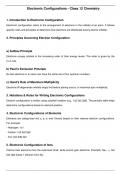
Chemistry class 12th Electronic_Configurations-1
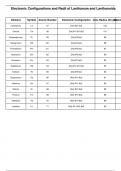
Electronic configuration describes the distribution of electrons in an atom's orbitals, following the Aufbau principle, Pauli exclusion principle, and Hund’s rule. Electrons fill orbitals in increasing energy order: 1s → 2s → 2p → 3s → 3p → 4s → 3d → 4p, and so on. s-, p-, d-, and f-block elements have unique configurations affecting their chemical properties. Transition metals show irregularities due to d-orbital stability, while lanthanoids and actinoids involve f-orbitals. Pr...
- Book
- Notes de cours
- • 2 pages •
Electronic configuration describes the distribution of electrons in an atom's orbitals, following the Aufbau principle, Pauli exclusion principle, and Hund’s rule. Electrons fill orbitals in increasing energy order: 1s → 2s → 2p → 3s → 3p → 4s → 3d → 4p, and so on. s-, p-, d-, and f-block elements have unique configurations affecting their chemical properties. Transition metals show irregularities due to d-orbital stability, while lanthanoids and actinoids involve f-orbitals. Pr...
Chemistry class 12th Oxidation_States_Explanation
Oxidation states represent the charge an atom would have if electrons were completely transferred in a bond. They help explain redox reactions, bonding, and element behavior. Elements can have multiple oxidation states due to electron configurations and bonding tendencies. Transition metals show variable oxidation states because of partially filled d-orbitals, allowing flexible electron loss. Main group elements follow a predictable pattern based on valence electrons (e.g., +1 for alkali metals,...
- Book
- Notes de cours
- • 1 pages •
Oxidation states represent the charge an atom would have if electrons were completely transferred in a bond. They help explain redox reactions, bonding, and element behavior. Elements can have multiple oxidation states due to electron configurations and bonding tendencies. Transition metals show variable oxidation states because of partially filled d-orbitals, allowing flexible electron loss. Main group elements follow a predictable pattern based on valence electrons (e.g., +1 for alkali metals,...
Chemistry class 12th Lanthanoids_vs_Actinoids
Lanthanoids and actinoids are two series of f-block elements with distinct properties. Lanthanoids (atomic numbers 57–71) exhibit a +3 oxidation state and are known for their magnetic, optical, and catalytic applications. They are used in strong magnets, phosphors, and electronics. Actinoids (atomic numbers 89–103) have variable oxidation states and include radioactive elements like uranium and plutonium, crucial for nuclear energy and weaponry. While lanthanoids are relatively stable and le...
- Book
- Notes de cours
- • 2 pages •
Lanthanoids and actinoids are two series of f-block elements with distinct properties. Lanthanoids (atomic numbers 57–71) exhibit a +3 oxidation state and are known for their magnetic, optical, and catalytic applications. They are used in strong magnets, phosphors, and electronics. Actinoids (atomic numbers 89–103) have variable oxidation states and include radioactive elements like uranium and plutonium, crucial for nuclear energy and weaponry. While lanthanoids are relatively stable and le...
Chemistry class 12th Applications_of_d_and_f_Block_Elements
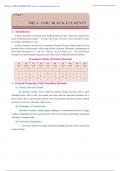
The d- and f-block elements, also known as transition and inner transition metals, have numerous applications due to their unique properties. Transition metals (d-block) like iron, copper, and titanium are used in construction, electronics, and catalysis. Platinum and palladium are essential in catalytic converters. f-block elements, primarily lanthanides, are used in strong magnets, lasers, and phosphors in LED screens. Actinides like uranium and plutonium play key roles in nuclear energy. Thei...
- Book
- Notes de cours
- • 1 pages •
The d- and f-block elements, also known as transition and inner transition metals, have numerous applications due to their unique properties. Transition metals (d-block) like iron, copper, and titanium are used in construction, electronics, and catalysis. Platinum and palladium are essential in catalytic converters. f-block elements, primarily lanthanides, are used in strong magnets, lasers, and phosphors in LED screens. Actinides like uranium and plutonium play key roles in nuclear energy. Thei...
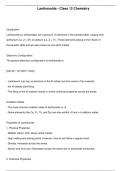
Chemistry class 12th Lanthanoids_Class12_Chemistry
Lanthanoids (lanthanides) are 14 elements from cerium (Ce) to lutetium (Lu) in the periodic table, following lanthanum (La). They belong to the f-block and have a general electronic configuration of [Xe] 4f¹⁻¹⁴ 5d⁰⁻¹ 6s². Due to the poor shielding of 4f electrons, they exhibit the lanthanoid contraction—a gradual decrease in atomic and ionic sizes across the series. They show variable oxidation states (mainly +3) and have high reactivity, especially with water and acids. Lanthanoid...
- Book
- Notes de cours
- • 3 pages •
Lanthanoids (lanthanides) are 14 elements from cerium (Ce) to lutetium (Lu) in the periodic table, following lanthanum (La). They belong to the f-block and have a general electronic configuration of [Xe] 4f¹⁻¹⁴ 5d⁰⁻¹ 6s². Due to the poor shielding of 4f electrons, they exhibit the lanthanoid contraction—a gradual decrease in atomic and ionic sizes across the series. They show variable oxidation states (mainly +3) and have high reactivity, especially with water and acids. Lanthanoid...
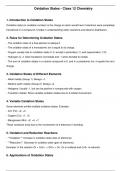
Chemistry class 12th Oxidation_States_Class12
Oxidation state (oxidation number) represents the apparent charge of an atom in a compound, indicating electron gain or loss. It follows specific rules: free elements have an oxidation state of zero, oxygen is usually -2 (except in peroxides: -1), and hydrogen is +1 (except in metal hydrides: -1). The sum of oxidation states in a neutral compound is zero, while in ions, it equals the ion’s charge. Transition elements show variable oxidation states due to partially filled d-orbitals. Oxidation ...
- Book
- Notes de cours
- • 2 pages •
Oxidation state (oxidation number) represents the apparent charge of an atom in a compound, indicating electron gain or loss. It follows specific rules: free elements have an oxidation state of zero, oxygen is usually -2 (except in peroxides: -1), and hydrogen is +1 (except in metal hydrides: -1). The sum of oxidation states in a neutral compound is zero, while in ions, it equals the ion’s charge. Transition elements show variable oxidation states due to partially filled d-orbitals. Oxidation ...