Chapter 5 – Proteins
Proteins can have multiple roles in food:
o Nutritional value: there are a source of amino acids.
o Structuring agent: gelling agent.
o Stabilizer: foams, emulsions.
The ones in red are functional ingredients.
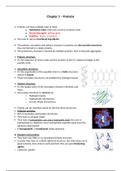
The primary, secondary and tertiary structure in proteins are intra protein structures;
they are formed in a single protein.
The quaternary structure is formed by multiple proteins; they’re basically aggregates.
1. Primary structure.
It’s the sequence of amino acids and the location of the S-S (sulphur) bridges in the
peptide chain.
2. Secondary structure.
It’s the organization of the peptide chain in α -helix structures
and/or β -sheets.
Those secondary structures are stabilized by hydrogen bonds.
3. Tertiary structure.
It’s the spatial order of the secondary structure elements and
loops.
The tertiary structure is stabilized by:
o Hydrogen bonds.
o Hydrophobic interactions.
o Van der Waals interactions.
Protein can be classified, based on the first three structures.
I.Globular proteins.
Rich in secondary and tertiary structures.
They have a compact shape.
They have a hydrophobic core and a hydrophilic shell; the core is
hydrophobic to shield the more hydrophobic peptides away from the
aqueous environment.
o β -lactoglobulin, α -lactalbumin (whey proteins).
II. Random coil proteins.
They have very little or no secondary/tertiary structure.
In water they take on a dilute spherical structure, but when they are in
good solvents, they tend to swell and then they are good thickening
agents.
o Caseinate, gelatin.
Proteins can have multiple roles in food:
o Nutritional value: there are a source of amino acids.
o Structuring agent: gelling agent.
o Stabilizer: foams, emulsions.
The ones in red are functional ingredients.
The primary, secondary and tertiary structure in proteins are intra protein structures;
they are formed in a single protein.
The quaternary structure is formed by multiple proteins; they’re basically aggregates.
1. Primary structure.
It’s the sequence of amino acids and the location of the S-S (sulphur) bridges in the
peptide chain.
2. Secondary structure.
It’s the organization of the peptide chain in α -helix structures
and/or β -sheets.
Those secondary structures are stabilized by hydrogen bonds.
3. Tertiary structure.
It’s the spatial order of the secondary structure elements and
loops.
The tertiary structure is stabilized by:
o Hydrogen bonds.
o Hydrophobic interactions.
o Van der Waals interactions.
Protein can be classified, based on the first three structures.
I.Globular proteins.
Rich in secondary and tertiary structures.
They have a compact shape.
They have a hydrophobic core and a hydrophilic shell; the core is
hydrophobic to shield the more hydrophobic peptides away from the
aqueous environment.
o β -lactoglobulin, α -lactalbumin (whey proteins).
II. Random coil proteins.
They have very little or no secondary/tertiary structure.
In water they take on a dilute spherical structure, but when they are in
good solvents, they tend to swell and then they are good thickening
agents.
o Caseinate, gelatin.