

EXPERIMENTAL RESEARCH
WEEK 1
LECTURE 1
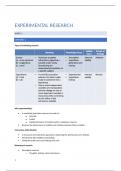
Types of marketing research
Why experimenting?
In marketing (and other sciences) we seek to:
o Describe
o Predict
o Explain behaviour of (market-parties, employees, buyers).
Break up the phenomena in variables and relations between those variables.
Conversion optimalisation
A structured and systematic approach to improving the performance of a website.
Informed by data insights & psychology.
Taking the traffic there and making most of it.
Behavioural research
Descriptive research
o Thoughts, feelings, ideas, behaviours.
1
, Correlational research: identifying relationships between different observed variables: measuring
thoughts, feelings, behaviour.
o “People save more during the economic crisis”.
o “Smoking mothers have more often problem children.”
o Measures the association between 2 variables.
Correlation of -1 (negative association) to 1 (positive association).
Problems with correlational research
Direction – correlations are bidirectional, you don’t know what is causing what.
Spurious correlations / confounds / omitted variable – there may be alternative explanations.
From description to prediction
Description: careful observation.
Correlation: relationship between observed variables.
Experimental: testing causality, A B?
Experimental research: settings
Field experimentation.
o Real life setting.
o Mundane reality: natural behaviour / setting / treatment.
o Less control.
Laboratory experimentation
o More control.
o Better able to manipulate variables.
o No natural setting.
Experimental research: Crux
Experimentation: only type of research that (potentially) can demonstrate that a change in one
variable causes a predictable change in another variable.
Most difficult: making sure that a change in Y was not caused by something else than X.
2
, Experimentation & Causation
Needs to be correlation between 2 variables.
Asymmetrical direction
A (cause) B (effect)
Change in A is accompanied by a change in B.
No alternative explanation for the change in B than the change in A (other possible causes are
controlled for).
Experimental research: essence
Test specific hypotheses about relationship between cause and effect via controlled (laboratory)
conditions.
o The effect of an IV on a DV.
o Manipulating the IV.
o Measure effects on dependent variable.
o Control other influences (high internal but low external validity).
Importance of randomization
Use all sorts of people with all sorts of characteristics.
Potential confounds are better under control.
So: change in Y can be attributed to X.
Problem identification
Sources of research ideas
o Real life experiences
o Previous research and theory
Conflicting findings.
Boundary conditions (moderator)
Find explanation for observed effects (mediator)
Applying a theory to a consumer setting.
Good research questions should both
Have real life relevance (implication for managers and consumers).
Contribute to current knowledge (theoretical contribution).
So, have a substantive and theoretical contribution.
LECTURE 2
Full empirical cycle
Identifying interesting and relevant research question.
Pinpoint conceptual variables
Identifying the proper relations between them that fit your theorizing (=hypotheses).
Develop a research design.
Develop manipulations and measures for the IV’s, DV’s, mediators and moderators.
3
, Collect data.
Analyse and interpret the results.
Write up study to submit to a journal.
Experimental research: main steps
Theoretical framework
o Problem identification.
o Hypothesis formulation.
Experimental design
o Manipulation of IVs.
o Measurement of DV.
o Control for confounds.
Data analyses
o Get familiar with your data.
o Checks
o Conduct main analyses.
o Conduct follow up analyses.
Conceptual models
All concepts measured in the experiment visualized, to show their expected relations.
What outcomes are you interested in? (DV)
Concepts you manipulated expecting systematic variance because of them. (IVs).
Thus: conceptual models show interrelations between IVs and DVs.
A moderating variable tells us when an effect will happen. A moderator becomes interesting when it
says something about the relationship between X and Y.
4
WEEK 1
LECTURE 1
Types of marketing research
Why experimenting?
In marketing (and other sciences) we seek to:
o Describe
o Predict
o Explain behaviour of (market-parties, employees, buyers).
Break up the phenomena in variables and relations between those variables.
Conversion optimalisation
A structured and systematic approach to improving the performance of a website.
Informed by data insights & psychology.
Taking the traffic there and making most of it.
Behavioural research
Descriptive research
o Thoughts, feelings, ideas, behaviours.
1
, Correlational research: identifying relationships between different observed variables: measuring
thoughts, feelings, behaviour.
o “People save more during the economic crisis”.
o “Smoking mothers have more often problem children.”
o Measures the association between 2 variables.
Correlation of -1 (negative association) to 1 (positive association).
Problems with correlational research
Direction – correlations are bidirectional, you don’t know what is causing what.
Spurious correlations / confounds / omitted variable – there may be alternative explanations.
From description to prediction
Description: careful observation.
Correlation: relationship between observed variables.
Experimental: testing causality, A B?
Experimental research: settings
Field experimentation.
o Real life setting.
o Mundane reality: natural behaviour / setting / treatment.
o Less control.
Laboratory experimentation
o More control.
o Better able to manipulate variables.
o No natural setting.
Experimental research: Crux
Experimentation: only type of research that (potentially) can demonstrate that a change in one
variable causes a predictable change in another variable.
Most difficult: making sure that a change in Y was not caused by something else than X.
2
, Experimentation & Causation
Needs to be correlation between 2 variables.
Asymmetrical direction
A (cause) B (effect)
Change in A is accompanied by a change in B.
No alternative explanation for the change in B than the change in A (other possible causes are
controlled for).
Experimental research: essence
Test specific hypotheses about relationship between cause and effect via controlled (laboratory)
conditions.
o The effect of an IV on a DV.
o Manipulating the IV.
o Measure effects on dependent variable.
o Control other influences (high internal but low external validity).
Importance of randomization
Use all sorts of people with all sorts of characteristics.
Potential confounds are better under control.
So: change in Y can be attributed to X.
Problem identification
Sources of research ideas
o Real life experiences
o Previous research and theory
Conflicting findings.
Boundary conditions (moderator)
Find explanation for observed effects (mediator)
Applying a theory to a consumer setting.
Good research questions should both
Have real life relevance (implication for managers and consumers).
Contribute to current knowledge (theoretical contribution).
So, have a substantive and theoretical contribution.
LECTURE 2
Full empirical cycle
Identifying interesting and relevant research question.
Pinpoint conceptual variables
Identifying the proper relations between them that fit your theorizing (=hypotheses).
Develop a research design.
Develop manipulations and measures for the IV’s, DV’s, mediators and moderators.
3
, Collect data.
Analyse and interpret the results.
Write up study to submit to a journal.
Experimental research: main steps
Theoretical framework
o Problem identification.
o Hypothesis formulation.
Experimental design
o Manipulation of IVs.
o Measurement of DV.
o Control for confounds.
Data analyses
o Get familiar with your data.
o Checks
o Conduct main analyses.
o Conduct follow up analyses.
Conceptual models
All concepts measured in the experiment visualized, to show their expected relations.
What outcomes are you interested in? (DV)
Concepts you manipulated expecting systematic variance because of them. (IVs).
Thus: conceptual models show interrelations between IVs and DVs.
A moderating variable tells us when an effect will happen. A moderator becomes interesting when it
says something about the relationship between X and Y.
4



