

Manishshaw929
On this page, you find all documents, package deals, and flashcards offered by seller manishshaw929.
- 234
- 0
- 5
Community
- Followers
- Following
239 items

Chemistry class 12th Ionic_Conductance
Ionic conductance refers to the ability of an ion to conduct electricity in a solution. It depends on factors like ion charge, size, mobility, and the viscosity of the solvent. Molar ionic conductance () is given by: lambda = frac{Lambda_m}{c} where is the molar conductivity and is the ion concentration. Kohlrausch’s Law states that at infinite dilution, ionic conductance is the sum of individual ion contributions: Lambda_m^circ = lambda_+^circ + lambda_-^circ I...
- Book
- Class notes
- • 2 pages •
Ionic conductance refers to the ability of an ion to conduct electricity in a solution. It depends on factors like ion charge, size, mobility, and the viscosity of the solvent. Molar ionic conductance () is given by: lambda = frac{Lambda_m}{c} where is the molar conductivity and is the ion concentration. Kohlrausch’s Law states that at infinite dilution, ionic conductance is the sum of individual ion contributions: Lambda_m^circ = lambda_+^circ + lambda_-^circ I...
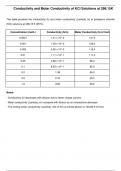
Chemistry class 12th KCl_Conductivity_Table
Potassium chloride (KCl) is commonly used as a standard in conductivity measurements due to its stable and well-known conductivity values. The KCl conductivity table provides the specific conductivity () of KCl solutions at different concentrations and temperatures. Conductivity increases with concentration but reaches a limit due to ion pairing. Temperature also affects conductivity, as higher temperatures enhance ion mobility. Standard KCl solutions (e.g., 0.01 M, 0.1 M) are used to calibrate ...
- Book
- Class notes
- • 1 pages •
Potassium chloride (KCl) is commonly used as a standard in conductivity measurements due to its stable and well-known conductivity values. The KCl conductivity table provides the specific conductivity () of KCl solutions at different concentrations and temperatures. Conductivity increases with concentration but reaches a limit due to ion pairing. Temperature also affects conductivity, as higher temperatures enhance ion mobility. Standard KCl solutions (e.g., 0.01 M, 0.1 M) are used to calibrate ...

Chemistry class 12th Wheatstone bridge
The Wheatstone bridge is an electrical circuit used to measure unknown resistance with high accuracy. It consists of four resistances arranged in a diamond shape, with a galvanometer and a voltage source. The bridge is balanced when the ratio of two known resistances equals the ratio of the unknown and adjustable resistance: frac{R_1}{R_2} = frac{R_3}{R_x} where is the unknown resistance. At balance, no current flows through the galvanometer. The Wheatstone bridge is widely used in se...
- Book
- Class notes
- • 1 pages •
The Wheatstone bridge is an electrical circuit used to measure unknown resistance with high accuracy. It consists of four resistances arranged in a diamond shape, with a galvanometer and a voltage source. The bridge is balanced when the ratio of two known resistances equals the ratio of the unknown and adjustable resistance: frac{R_1}{R_2} = frac{R_3}{R_x} where is the unknown resistance. At balance, no current flows through the galvanometer. The Wheatstone bridge is widely used in se...

Chemistry class 12th Molar_Conductivity
Molar conductivity () is the conductivity of an electrolyte solution per unit molar concentration. It is defined as: Lambda_m = frac{kappa}{C} where is the conductivity and is the concentration. It increases with dilution because ion interactions decrease, allowing better ion movement. Strong electrolytes follow Kohlrausch’s Law, which helps determine limiting molar conductivity (). Weak electrolytes exhibit a nonlinear increase in with dilution due to partial ionization. Molar ...
- Book
- Class notes
- • 1 pages •
Molar conductivity () is the conductivity of an electrolyte solution per unit molar concentration. It is defined as: Lambda_m = frac{kappa}{C} where is the conductivity and is the concentration. It increases with dilution because ion interactions decrease, allowing better ion movement. Strong electrolytes follow Kohlrausch’s Law, which helps determine limiting molar conductivity (). Weak electrolytes exhibit a nonlinear increase in with dilution due to partial ionization. Molar ...
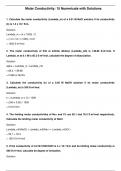
Chemistry class 12th Molar conductivity numericals
Molar conductivity () is the conductivity of an electrolyte solution per unit concentration and is given by: Lambda_m = frac{kappa}{C} where is the conductivity and is the molar concentration. It increases with dilution due to decreased ion interactions. The limiting molar conductivity () is determined using Kohlrausch’s Law: Lambda_m^circ = lambda_+^circ + lambda_-^circ Numerical problems involve calculating , , and ion conductivities using given and concentra...
- Book
- Class notes
- • 2 pages •
Molar conductivity () is the conductivity of an electrolyte solution per unit concentration and is given by: Lambda_m = frac{kappa}{C} where is the conductivity and is the molar concentration. It increases with dilution due to decreased ion interactions. The limiting molar conductivity () is determined using Kohlrausch’s Law: Lambda_m^circ = lambda_+^circ + lambda_-^circ Numerical problems involve calculating , , and ion conductivities using given and concentra...
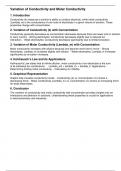
Chemistry class 12th Variation of conductivity
Conductivity varies based on factors like temperature, material composition, and impurities. In metals, conductivity typically decreases with increasing temperature due to increased electron scattering. In semiconductors, however, higher temperatures increase conductivity by exciting more charge carriers. In electrolytes, conductivity depends on ion concentration, mobility, and temperature. Higher ion concentration generally increases conductivity, but extreme concentrations can reduce it due to...
- Book
- Class notes
- • 1 pages •
Conductivity varies based on factors like temperature, material composition, and impurities. In metals, conductivity typically decreases with increasing temperature due to increased electron scattering. In semiconductors, however, higher temperatures increase conductivity by exciting more charge carriers. In electrolytes, conductivity depends on ion concentration, mobility, and temperature. Higher ion concentration generally increases conductivity, but extreme concentrations can reduce it due to...

Chemistry class 12th Limiting molar conductivity
Limiting molar conductivity (Λ°m) is the molar conductivity of an electrolyte at infinite dilution, where ion-ion interactions are negligible. It is determined by extrapolating conductivity measurements to zero concentration using Kohlrausch’s Law: Lambda_m = Lambda_m^circ - Kc^{1/2} where Λ°m is the limiting molar conductivity, K is a constant, and c is concentration. Strong electrolytes have high Λ°m due to complete ion dissociation, while weak electrolytes require dissocia...
- Book
- Class notes
- • 1 pages •
Limiting molar conductivity (Λ°m) is the molar conductivity of an electrolyte at infinite dilution, where ion-ion interactions are negligible. It is determined by extrapolating conductivity measurements to zero concentration using Kohlrausch’s Law: Lambda_m = Lambda_m^circ - Kc^{1/2} where Λ°m is the limiting molar conductivity, K is a constant, and c is concentration. Strong electrolytes have high Λ°m due to complete ion dissociation, while weak electrolytes require dissocia...

Chemistry class 12th Standard electrode potentials 298k
Standard electrode potentials (E°) at 298 K (25°C) represent the voltage of an electrode compared to the Standard Hydrogen Electrode (SHE) under standard conditions: 1 M ion concentration, 1 atm gas pressure, and 25°C temperature. The SHE is assigned a potential of 0.00 V, serving as a reference. Electrodes with positive E° values (e.g., Cu²⁺/Cu, +0.34 V) are better oxidizing agents, while those with negative E° values (e.g., Zn²⁺/Zn, -0.76 V) are better reducing agents. Standard elec...
- Book
- Class notes
- • 1 pages •
Standard electrode potentials (E°) at 298 K (25°C) represent the voltage of an electrode compared to the Standard Hydrogen Electrode (SHE) under standard conditions: 1 M ion concentration, 1 atm gas pressure, and 25°C temperature. The SHE is assigned a potential of 0.00 V, serving as a reference. Electrodes with positive E° values (e.g., Cu²⁺/Cu, +0.34 V) are better oxidizing agents, while those with negative E° values (e.g., Zn²⁺/Zn, -0.76 V) are better reducing agents. Standard elec...
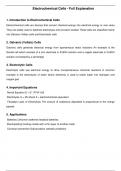
Chemistry class 12th Electrochemical cell explanation
An electrochemical cell is a device that converts chemical energy into electrical energy or vice versa through redox reactions. It consists of two electrodes (anode and cathode) immersed in an electrolyte, where oxidation occurs at the anode and reduction at the cathode. There are two main types: galvanic (voltaic) cells, which generate electricity from spontaneous reactions (e.g., batteries), and electrolytic cells, which use external voltage to drive non-spontaneous reactions (e.g., electropla...
- Book
- Class notes
- • 1 pages •
An electrochemical cell is a device that converts chemical energy into electrical energy or vice versa through redox reactions. It consists of two electrodes (anode and cathode) immersed in an electrolyte, where oxidation occurs at the anode and reduction at the cathode. There are two main types: galvanic (voltaic) cells, which generate electricity from spontaneous reactions (e.g., batteries), and electrolytic cells, which use external voltage to drive non-spontaneous reactions (e.g., electropla...

Chemistry class 12th Galvanic cells explanation
A galvanic cell is an electrochemical cell that converts chemical energy into electrical energy through spontaneous redox reactions. It consists of two half-cells, each containing an electrode immersed in an electrolyte. The anode undergoes oxidation, releasing electrons, while the cathode undergoes reduction, gaining electrons. A salt bridge maintains charge balance by allowing ion flow between half-cells. Electrons flow through an external circuit from the anode to the cathode, generating elec...
- Book
- Class notes
- • 2 pages •
A galvanic cell is an electrochemical cell that converts chemical energy into electrical energy through spontaneous redox reactions. It consists of two half-cells, each containing an electrode immersed in an electrolyte. The anode undergoes oxidation, releasing electrons, while the cathode undergoes reduction, gaining electrons. A salt bridge maintains charge balance by allowing ion flow between half-cells. Electrons flow through an external circuit from the anode to the cathode, generating elec...