

- Study guides, Class notes & Summaries
Looking for the best study guides, study notes and summaries about ? On this page you'll find 53 study documents about .
Exam (elaborations)
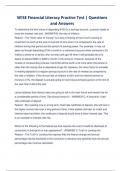
W!SE Financial Literacy Practice Test | Questions and Answers
To determine the time value of depositing $100 in a savings account, a person needs to know the interest rate and - ANSWER B: the rate of inflation. Reason : The ?time value of money? is a way of looking at how much a saving or investment is worth at the end of a period of time when it is compared to the rate of inflation during that period and the person?s earning power. For example, it may not seem as though depositing $100 a month in a retirement account when someone is 23 makes a whole...
 QUINTER
Exam (elaborations)
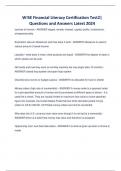
W!SE Financial Literacy Certification Test2| Questions and Answers Latest 2024
sources of income - ANSWER wages, rentals, interest, capital, profits, investments, entrepreneurship Exemption (aka an allowance) and how does it work - ANSWER allowance is used to reduce amount of taxed income Liquidity—what does it mean; what products are liquid - ANSWER the degree of ease in which assets can be sold
QUINTER
Exam (elaborations)
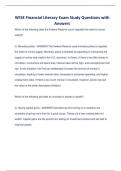
W!SE Financial Literacy Exam Study Questions with Answers
Which of the following does the Federal Reserve use to regulate the nation's money supply? C: Monetary policy - ANSWER The Federal Reserve uses monetary policy to regulate the nation's money supply. Monetary policy is directed at expanding or contracting the supply of money and credit in the U.S. economy. In theory, if there is too little money in circulation, consumers will spend less, interest rates will be high, and unemployment will rise. In this situation, the Fed can deliberately i...
QUINTER
Exam (elaborations)
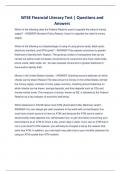
W!SE Financial Literacy Test | Questions and Answers
Which of the following does the Federal Reserve uses to regulate the nation's money supply? - ANSWER Monetary Policy Reason: Uses it to regulate the nation's money supply. Which of the following is a disadvantage of using of using phone cards, debit cards, electronic transfers, and ATM cards? - ANSWER They expose consumers to greater likelihood of identity theft. Reason: The growing number of transactions that can be carried out without cash increases convenience for consumers who have c...
QUINTER
Exam (elaborations)
W!SE Financial Literacy Certification Test Review| Questions and Answers
Liquidity - ANSWER The ability to convert an asset to cash quickly Products that are liquid - ANSWER Stocks and Money Market accounts Gift Cards - ANSWER a card that is given as a gift with a specified amount of money. There is a monthly inactivity fee that may begin after 12 months. Discretionary income - ANSWER The amount of an individuals income that is left for spending investing or saving after taxes and personal necessities
QUINTER
Exam (elaborations)
W!SE Financial Literacy Test-CREDIT | Questions and Answers
When a person declares bankruptcy that fact will appear on the person?s credit report - ANSWER for a 10 year period, Most of the adverse information on a credit report appears for 7 years. After a declared bankruptcy, the limit is 10 years.
QUINTER
Exam (elaborations)
W!SE Financial Literacy Certification Test| Questions and Answers Latest 2024
Earned Income - ANSWER Income derived from active participation in a trade or business, including wages, salary, tips, commissions and bonuses. Unearned Income - ANSWER Any income that comes from investments and other sources unrelated to employment services. Examples: interest from a savings account, bond interest, alimony, and dividends from stock
QUINTER
Exam (elaborations)
W!SE Financial Literacy A+ Graded Compiled Questions And Correct Answers
Demand Willingness and ability to buy products and services. Economy All aspects and activities relating to making and distributing goods and services within a certain area. Benefits forms of money or pay other than a salary or wage interest A sum paid or charged for the use of money or for borrowing money Net pay the money you actually make and bring home after deductions
 STANFORDGRADESS
Exam (elaborations)
W!SE Financial Literacy Certification Top Common Tested Questions And Correct Answers
Earned Income Income derived from active participation in a trade or business, including wages, salary, tips, commissions and bonuses. Unearned Income Any income that comes from investments and other sources unrelated to employment services. Examples: interest from a savings account, bond interest, alimony, and dividends from stock Exemptions (aka allowance) and how they work If you are not claimed as a dependent on another taxpayer's return, then you can claim one personal tax exem...
STANFORDGRADESS
Exam (elaborations)
W!SE Financial Literacy UPDATED Questions And Correct Answers 2024 Edition
Which of the following does the Federal Reserve uses to regulate the nation's money supply? Monetary Policy Reason: Uses it to regulate the nation's money supply. Which of the following is a disadvantage of using of using phone cards, debit cards, electronic transfers, and ATM cards? They expose consumers to greater likelihood of identity theft. Reason: The growing number of transactions that can be carried out without cash increases convenience for consumers who have credit cards, ph...
STANFORDGRADESS
Exam (elaborations)
W!SE Financial Literacy Key Predicted Questions And Correct Answers
To determine the time value of depositing $100 in a savings account, a person needs to know the interest rate andB: the rate of inflation. Reason : The ?time value of money? is a way of looking at how much a saving or investment is worth at the end of a period of time when it is compared to the rate of inflation during that period and the person?s earning power. For example, it may not seem as though depositing $100 a month in a retirement account when someone is 23 makes a whole lot of...
STANFORDGRADESS
Exam (elaborations)
W!SE Financial Literacy Top Forecasted Questions And Correct Answers
Bounced checka check written for an amount more than in your account Cashier's CheckA check issued by a bank and sold to you for personal payments to people who won't accept a personal check. It certifies that you have the money available. credit unionA nonprofit financial institution that is owned by its members and organized for their benefit. Commercial Banka for-profit institution that offers a full range of financial services Money OrderA form of check payment on which the financi...
STANFORDGRADESS
Exam (elaborations)
MONEY review for W!SE Financial Literacy Test Questions with Complete Solutions
Principal - The money originally invested or loaned, on which basis interest and returns are calculated Collateralized Loan - A loan that is secured by collateral, properties or assets that are subject to seizure on default. Barter - exchange goods without involving money Garnishment - a legal process that allows part of your paycheck to be withheld for payment of a debt gross pay - the total amount you earn before any deductions are subtracted net pay - the amou...
 TeeGrades
Exam (elaborations)
BANKING review for W!SE Financial Literacy Test Questions with Correct Solutions
Bounced check - a check written for an amount more than in your account Cashier's Check - A check issued by a bank and sold to you for personal payments to people who won't accept a personal check. It certifies that you have the money available. credit union - A nonprofit financial institution that is owned by its members and organized for their benefit. Commercial Bank - a for-profit institution that offers a full range of financial services Money Order - A form of ...
TeeGrades
Exam (elaborations)
CREDIT review for W!SE Financial Literacy Test Terms to know in preparation for the W!SE Financial Literacy Test
3 C's of Credit - Character(credit history), Capacity(ability to repay), Capital(assets) APR - Annual percentage rate; the annual rate of interest that is charged for using credit Chapter 7 - The chapter of the Bankruptcy Code providing for "liquidation" (i.e., the sale of a debtor's nonexempt property and the distribution of the proceeds to creditors). chapter 11 - Section of Bankruptcy law that allows businesses to reorganize, continue functioning and pay creditors equ...
TeeGrades
Exam (elaborations)
W!SE Financial Literacy Practice Test | with complete solution | 100% verified
W!SE Financial Literacy Practice Test | with complete solution | 100% verified
 STUVEX
Exam (elaborations)
W!SE FINANCIAL LITERACY CERTIFICATION TEST Topic Check List Questions with Correct Solutions A+
Sources of income - wages, rentals, interest, capital, profits, investments, entrepreneurship Exemption (aka an allowance)) and how does it work - allowance is used to reduce amount of taxed income Liquidity—what does it mean; what products are liquid - the degree of ease in which assets can be sold Gift cards and how they work (a monthly inactivity fee may begin after 12 months) - closed loop system and open loop system Discretionary income or budget surplus - not a...
TeeGrades
Exam (elaborations)
W!SE Financial Literacy Certification Test Topic Checklist Questions with Complete Solutions Rated A+
Earned Income - Income derived from active participation in a trade or business, including wages, salary, tips, commissions and bonuses. Unearned Income - Any income that comes from investments and other sources unrelated to employment services. Examples: interest from a savings account, bond interest, alimony, and dividends from stock Exemptions (aka allowance) and how they work - If you are not claimed as a dependent on another taxpayer's return, then you can claim one perso...
TeeGrades
Exam (elaborations)
W!SE Financial Literacy Certification Test Study Questions with Complete Answers Rated A+
sources of income - wages, rentals, interest, capital, profits, investments, entrepreneurship exemption (aka allowance) and how does it work - allowance is used to reduce amount of taxed income. personal exemptions are given for people with dependents or spouses. company exemptions are given for non-profits, religious organizations, and government corporations. liquidity—what does it mean? what products are liquid? - liquidity is the degree in which assets can be sold. cash on h...
TeeGrades
Exam (elaborations)
W!se Financial Literacy Practice Test Questions with Complete Solutions Graded to Pass
If you are denied credit based on your credit report, you are entitled to a: - Correct Answer : A: Free copy of the credit report if you request it within 60 days Reason : If requested within 60 days after the denial, you must be provided with a free copy of the credit report from the specific credit reporting agency whose report was the basis for credit, employment, insurance, or housing denial. At all other times, there is a small fee to get a credit report. Consumer Credit Counseling S...
TeeGrades