

- Study guides, Class notes & Summaries
Looking for the best study guides, study notes and summaries about ? On this page you'll find 17 study documents about .
Exam (elaborations)
PSY 366 FINAL EXAM QUESTIONS AND ANSWERS | PSY 366 FINAL EXAM STUDY GUIDE & PRACTICE TEST 2026/2027
PSY 366 FINAL EXAM QUESTIONS AND ANSWERS | PSY 366 FINAL EXAM STUDY GUIDE & PRACTICE TEST 2026/2027
 BravelRadon
Exam (elaborations)
PSY 366 Abnormal Psychology - Meier - ASU - Exam 2 Questions And Answers
PSY 366 Abnormal Psychology - Meier - ASU - Exam 2 Questions And Answers ...
 Zayla
Zayla
Exam (elaborations)
PSY 366 Final Exam Questions With 100% Correct Answers
PSY 366 Final Exam Questions With 100% Correct Answers What is Major Neurocognitive Disorder? Mild Neurocognitive Disorder? - answerA brain disorder characterized by a deteriorating course of deficits in neurocognitive functioning (i.e. memory, attention) that interferes significantly with independent living. What is aphasia? - answerlanguage disturbance Broca's aphasia (expressive aphasia): can't communicate ideas Wernicke's aphasia (receptive aphasia): can't understand words but can...
 sirjoel
Exam (elaborations)
PSY 366 Final Exam Questions With 100% Correct Answers
PSY 366 Final Exam Questions With 100% Correct Answers How do we decide what is considered a disorder? - answerThere is a category of presence of a disorder and a category of no presence of a disorder What is healthy functioning - answerA bell curve demonstrating where in the middle there is no evidence of a mental disorder and on the outsides of the bell there is a disorder What are the 4 D's defining disorder - answer-deviance -distress -dysfunction -danger What are qualitative obse...
sirjoel
Exam (elaborations)
PSY 366 Exam Questions And Answers (Verified And Updated)
PSY 366 Exam Questions And Answers (Verified And Updated) perceived relational value - answerwe want people to want us, to be around us, therefore the scale of how included or excluded we feel is how much value we place on ourselves. maximum inclusion - answerwhere others seek our company because they WANT to be with us ambivalence - answerwhen others don't care if they are or aren't around us maximum exclusion - answerwhen people send us away or banish us from their company Ostracism ...
sirjoel
Exam (elaborations)
PSY 366 Final Exam Questions With 100% Correct Answers
PSY 366 Final Exam Questions With 100% Correct Answers What is Major Neurocognitive Disorder? Mild Neurocognitive Disorder? - answerA brain disorder characterized by a deteriorating course of deficits in neurocognitive functioning (i.e. memory, attention) that interferes significantly with independent living. What is aphasia? - answerlanguage disturbance Broca's aphasia (expressive aphasia): can't communicate ideas Wernicke's aphasia (receptive aphasia): can't understand words but can...
 Fyndlay
Exam (elaborations)
PSY 366 Final Exam Questions With 100% Correct Answers
PSY 366 Final Exam Questions With 100% Correct Answers How do we decide what is considered a disorder? - answerThere is a category of presence of a disorder and a category of no presence of a disorder What is healthy functioning - answerA bell curve demonstrating where in the middle there is no evidence of a mental disorder and on the outsides of the bell there is a disorder What are the 4 D's defining disorder - answer-deviance -distress -dysfunction -danger What are qualitative obse...
Fyndlay
Exam (elaborations)
PSY 366 Exam Questions And Answers (Verified And Updated)
PSY 366 Exam Questions And Answers (Verified And Updated) perceived relational value - answerwe want people to want us, to be around us, therefore the scale of how included or excluded we feel is how much value we place on ourselves. maximum inclusion - answerwhere others seek our company because they WANT to be with us ambivalence - answerwhen others don't care if they are or aren't around us maximum exclusion - answerwhen people send us away or banish us from their company Ostracism ...
Fyndlay
Exam (elaborations)
PSY 366 TOP Exam Questions And CORRECT Answers
How do we decide what is considered a disorder? There is a category of presence of a disorder and a category of no presence of a disorder What is healthy functioning A bell curve demonstrating where in the middle there is no evidence of a mental disorder and on the outsides of the bell there is a disorder What are the 4 D's defining disorder -deviance -distress -dysfunction -danger What are qualitative observations? contain new and rare information, have a rich description, don't u...
 WIZGrades
Exam (elaborations)
PSY 366 UPDATED Exam Questions And CORRECT Answers
What is Major Neurocognitive Disorder? Mild Neurocognitive Disorder? A brain disorder characterized by a deteriorating course of deficits in neurocognitive functioning (i.e. memory, attention) that interferes significantly with independent living. What is aphasia? language disturbance Broca's aphasia (expressive aphasia): can't communicate ideas Wernicke's aphasia (receptive aphasia): can't understand words but can pay attention to intonation of voice What is echolalia Communicatio...
WIZGrades
Exam (elaborations)
PSY 366 Certification Exam Questions And CORRECT Answers
perceived relational vlaue we want people to want us, to be around us, therefore the scale of how included or excluded we feel is how much value we place on ourselves. maximum inclusion where others seek our company because they WANT to be with us ambivalence when others don't care if they are or aren't around us maximum exclusion when people send us away or banish us from their company Ostracism (The Silent Treatment) Very confusing, stress inducing, and very damaging to relationships...
WIZGrades
Exam (elaborations)
PSY 366 Final Exam Questions With 100% Correct Answers
PSY 366 Final Exam Questions With 100% Correct Answers What is Major Neurocognitive Disorder? Mild Neurocognitive Disorder? - answerA brain disorder characterized by a deteriorating course of deficits in neurocognitive functioning (i.e. memory, attention) that interferes significantly with independent living. What is aphasia? - answerlanguage disturbance Broca's aphasia (expressive aphasia): can't communicate ideas Wernicke's aphasia (receptive aphasia): can't understand words but can...
 TheStar
Exam (elaborations)
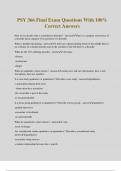
PSY 366 Final Exam Questions With 100% Correct Answers
PSY 366 Final Exam Questions With 100% Correct Answers How do we decide what is considered a disorder? - answerThere is a category of presence of a disorder and a category of no presence of a disorder What is healthy functioning - answerA bell curve demonstrating where in the middle there is no evidence of a mental disorder and on the outsides of the bell there is a disorder What are the 4 D's defining disorder - answer-deviance -distress -dysfunction -danger What are qualitative obse...
TheStar
Exam (elaborations)
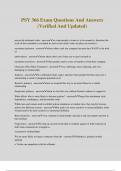
PSY 366 Exam Questions And Answers (Verified And Updated)
PSY 366 Exam Questions And Answers (Verified And Updated) perceived relational value - answerwe want people to want us, to be around us, therefore the scale of how included or excluded we feel is how much value we place on ourselves. maximum inclusion - answerwhere others seek our company because they WANT to be with us ambivalence - answerwhen others don't care if they are or aren't around us maximum exclusion - answerwhen people send us away or banish us from their company Ostracism ...
TheStar
Exam (elaborations)
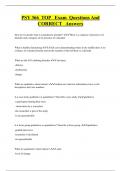
PSY 366 TOP Exam Questions And CORRECT Answers
How do we decide what is considered a disorder? There is a category of presence of a disorder and a category of no presence of a disorder What is healthy functioning A bell curve demonstrating where in the middle there is no evidence of a mental disorder and on the outsides of the bell there is a disorder What are the 4 D's defining disorder -deviance -distress -dysfunction -danger What are qualitative observations? contain new and rare information, have a rich description, don't u...
 MGRADES
Exam (elaborations)
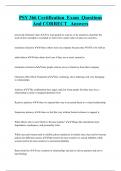
PSY 366 Certification Exam Questions And CORRECT Answers
perceived relational vlaue we want people to want us, to be around us, therefore the scale of how included or excluded we feel is how much value we place on ourselves. maximum inclusion where others seek our company because they WANT to be with us ambivalence when others don't care if they are or aren't around us maximum exclusion when people send us away or banish us from their company Ostracism (The Silent Treatment) Very confusing, stress inducing, and very damaging to relationships...
MGRADES
Exam (elaborations)
PSY 366 UPDATED Exam Questions And CORRECT Answers
What is Major Neurocognitive Disorder? Mild Neurocognitive Disorder? A brain disorder characterized by a deteriorating course of deficits in neurocognitive functioning (i.e. memory, attention) that interferes significantly with independent living. What is aphasia? language disturbance Broca's aphasia (expressive aphasia): can't communicate ideas Wernicke's aphasia (receptive aphasia): can't understand words but can pay attention to intonation of voice What is echolalia Communicatio...
MGRADES