

- Study guides, Class notes & Summaries
Looking for the best study guides, study notes and summaries about ? On this page you'll find 37 study documents about .

Other
Engineering Mechanics: Dynamics – Solutions Manual (Anthony Bedford & Wallace Fowler) | Complete Worked Solutions
This document is the complete Solutions Manual for Engineering Mechanics: Dynamics by Anthony Bedford and Wallace Fowler. It provides step-by-step worked solutions to problems from the textbook, covering kinematics of particles and rigid bodies, Newton’s laws, work-energy methods, impulse and momentum, and vibration analysis. Designed for engineering students, this manual reinforces theoretical concepts and supports exam preparation with detailed problem-solving strategies.
 ScholarNova

Other
Engineering Mechanics: Statics – Instructor’s Solutions Manual (14th Edition, Russell C. Hibbeler) | Complete Worked Solutions
This document is the full Instructor’s Solutions Manual (ISM) for Engineering Mechanics: Statics, 14th Edition by Russell C. Hibbeler. It provides detailed step-by-step solutions to problems from the textbook, covering forces, equilibrium, structures, trusses, frames, centroids, moments of inertia, and applications of statics principles. Designed to support instructors and engineering students, this manual reinforces key mechanics concepts and aids in both teaching and exam preparation.
ScholarNova
Other
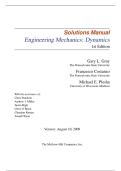
Engineering Mechanics: Dynamics – Solutions Manual (1st Edition, Gary Gray, Francesco Costanzo & Michael Plesha) | Complete Worked Solutions
This document is the complete Solutions Manual for Engineering Mechanics: Dynamics, 1st Edition by Gary Gray, Francesco Costanzo, and Michael Plesha. It provides detailed step-by-step solutions to problems from the main textbook, covering kinematics of particles and rigid bodies, kinetics, Newton’s laws, work-energy principles, impulse and momentum, and vibration analysis. Designed to assist engineering students, this manual helps reinforce concepts and supports exam preparation through clear,...
ScholarNova

Class notes
Basics of strain
In this document you will learn how to define strain in simple way and how to calculate the strain. These documents are very useful in your daily life.
 adilrazaq14
Class notes
Basics of stress
Stress and strain are very important in mechanics. By reading this notes you will be able to define stress,strain, calculation of stress and strain, In basic methods.
adilrazaq14

Other
Engineering mechanics statics JL Marium 9 th edition
In this book you will get information all about mechanics statics as you without studying statics you will not solve problems in civil, mechanical, electronics, robotics and many other fields that you are studying also include because in our daily life we use physics at the time of need so by learning this book you will have more information or knowledge in your mind to solve problems.
adilrazaq14
![[GEAS] ENGINEERING MECHANICS Study Guide Exam Questions With Accurate Guaranteed Answers.](/docpics/6958498/677edfa03c8d5_6958498_121_171.jpeg)
Exam (elaborations)
[GEAS] ENGINEERING MECHANICS Study Guide Exam Questions With Accurate Guaranteed Answers.
1.What is the magnitude of the resultant force of the two forces which are perpendicular to each other? The two forces are 20 units and 30 units respectively. A. 36 B. 42 C. 25 D. 40 - correct answer 2. A rope is stretched between two rigid walls 40 feet apart. At the midpoint, a load of 100 lbs was placed that caused it to sag 5 feet. Compute the approximate tension in the rope. A. 206 lbs B. 150 lbs C. 280 lbs D. 240 lbs - correct answer ...
RealGrades
Exam (elaborations)
Engineering Mechanics Prelim Exam Complete Questions And Answers Guaranteed Pass.
Isaac Newton - correct answer In the latter part of the seventeenth century, Sir _________ stated the fundamental principles of mechanics, which are the foundation of much of today's engineering. First Law of Motion - correct answer An object at rest remains at rest, except acted upon by an external force. Second Law of Motion - correct answer The rate of change of momentum o...
RealGrades
Exam (elaborations)
Engineering Mechanics Statics Certification Review Exam Questions With Multiple Choices And Verified Answers.
truss - correct answer structure composed of slender members joined together at their end points two-force member - correct answer the force acting at each end of the member will be directed along the axis of the member method of joints - correct answer if an entire truss is in equilibrium, then each of its joints are in equilibirum zero-force member - correct answer ...
RealGrades
Package deal
Engineering Mechanics Bundled Exam Questions with Verified Solutions (Graded A+)
Engineering Mechanics Bundled Exam Questions with Verified Solutions ( Graded A+) Already Passed
TutorJosh
Exam (elaborations)
Engineering Mechanics Test Questions with Complete Solutions Rated A+
Engineering Mechanics Test Questions with Complete Solutions Rated A+ engineering mechanics - Answers science that considers the effects of forces on rigid bodies statics and dynamics - Answers two parts of engineering mechanics statics - Answers forces on rigid bodies which are and remain at rest dynamics - Answers motion of rigid bodies caused by the forces acting upon them force systems and applications - Answers 2 subbranches of statics kinematics and kinetics - Answers 2 subbranches o...
TutorJosh
Exam (elaborations)
Health Education, Health Promotion, Health Education Specialists
Health Education, Health Promotion, Health Education Specialists, and Program Planning What are the major areas of responsibilities outlined in the Hierarchical Model of Responsibilities and Competencies for Health Education Specialist (areas I-VII) ? (pg 8) - ANSWERS-- Area of responsibility I: Assess Needs, Resources, and Capacity for Health Education/Promotion - Area of responsibility II: Plan Health Education/Promotion - Area of responsibility III: Implement Health Education/Prom...
 amon
amon

Exam (elaborations)
136 TOP Engineering Mechanics - Mechanical Engineering Multiple choice Questions and Answers
136 TOP Engineering Mechanics - Mechanical Engineering Multiple choice Questions and Answers Latest Engineering Mechanics Questions and Answers List 1. The unit of force in S.I. units is (a) kilogram (b) newton (c) watt (d) dyne (e) joule. Ans: b 2. The unit of work or energy in S.I. units is (a) newton (b) pascal (c) kilogram meter (d) watt (e) joule. Ans: e 3. The unit of power in S.I. units is (a) newton meter (b) watt (c) joule (d) kilogram meter/sec. ...
 GlobalExamArchive
Exam (elaborations)
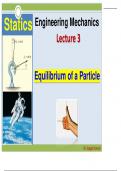
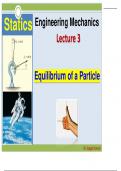
Exam (elaborations) Engineering Mechanics Equilibrium of a Particle
Exam (elaborations) Engineering Mechanics Equilibrium of a Particle 3.3 Coplanar Systems Copyright © 2010 Pearson Education South Asia Pte Ltd • Procedure for Analysis 1. Free-Body Diagram - Establish the x, y axes - Label all the unknown and known forces 2. Equations of Equilibrium - Apply F = ks to find spring force - When negative result force is the reserve - Apply the equations of equilibrium ∑Fx = 0 ∑Fy = 0
 BOSCOJONES
Exam (elaborations)
LATEST 2024 Engineering Mechanics Lecture 3
Chapter Outline Copyright © 2010 Pearson Education South Asia Pte Ltd 1. Condition for the Equilibrium of a Particle 2. The Free-Body Diagram 3. Coplanar Systems 4. Three-Dimensional Force Systems 3.1 Condition for the Equilibrium of a Particle Copyright © 2010 Pearson Education South Asia Pte Ltd • Particle at equilibrium if - At rest - Moving at constant a constant velocity • Newton’s first law of motion ∑F = 0 where ∑F is the vector sum of all the forces acting on t...
contenthive76
Exam (elaborations)
Engineering Mechanics: Statics with 100% verified answers.
Statics - a science which deals with the action of forces on bodies, the forces being so arranged that they are in equilibrium. Force - a pull or push, which acting on a body changes or tends to change, the state of rest or uniform motion of the body. Measured in Newton (N). Force System - a number of forces acting on a body
AmeliaLiam
Exam (elaborations)
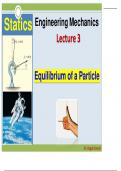
Engineering Mechanics equilibrium_of_a_particle
Engineering Mechanics equilibrium_of_a_particle 3.1 Condition for the Equilibrium of a Particle • Newton’s second law of motion ∑F = ma • When the force fulfill Newton's first law of motion, ma = 0 a = 0 therefore, the particle is moving in constant velocity or at rest 3.2 The Free-Body Diagram • Best representation of all the unknown forces (∑F) which acts on a body • A sketch showing the particle “free” from the surroundings with all the forces acting on ...
 wisdompoint