
- Study guides, Class notes & Summaries
Looking for the best study guides, study notes and summaries about ? On this page you'll find 157 study documents about .
Exam (elaborations)
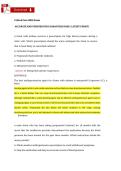
Critical Care HESI Exam Question Bank (PDF) – Complete High‑Acuity Nursing Prep with Answers & Detailed Rationales | Hemodynamics, Mechanical Ventilation, Shock, Cardiac, Neuro, Renal, Sepsis & Pharmacology
This Critical Care HESI Exam Question Bank provides a comprehensive collection of professionally written, exam‑style questions specifically designed for HESI Critical Care, advanced med‑surg, ICU rotations, and high‑acuity nursing exams. Every question includes a clear, evidence‑based rationale, making this resource ideal for students, new‑grad ICU nurses, CCRN candidates, NP students, and instructors who need reliable, high‑yield practice. Includes multiple‑choice, SATA, pri...
 ScholarNova
Exam (elaborations)
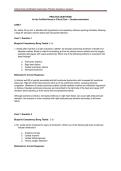
Critical Care Certification Exam Practice Questions & Answers – Comprehensive Review Resource
This Critical Care Certification Examination practice questions and answers resource is designed to support healthcare professionals preparing for critical care–related certification exams. It offers exam-style practice questions with clear answers that help reinforce essential concepts, improve clinical reasoning, and enhance exam readiness. The material covers key areas commonly tested in critical care certification exams, making it suitable for nurses, clinicians, and healthcare students...
 eNerd
eNerd
Exam (elaborations)
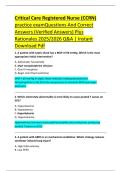
Critical Care Registered Nurse (CCRN) practice examQuestions And Correct Answers (Verified Answers) Plus Rationales 2025/2026 Q&A | Instant Download Pdf
1. A patient with septic shock has a MAP of 58 mmHg. Which is the most appropriate initial intervention? A. Administer furosemide B. Start norepinephrine infusion C. Give IV morphine D. Begin strict fluid restriction MAP < 65 mmHg in septic shock indicates inadequate perfusion. Norepinephrine is the first-line vasopressor to maintain MAP and organ perfusion. 2. Which electrolyte abnormality is most likely to cause peaked T waves on ECG? A. Hypocalcemia B. Hypokalemia ...
lewizranking
Exam (elaborations)
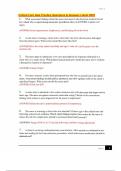
Critical Care Hesi Practice Questions & Answers Latest 2025
Critical Care Hesi Practice Questions & Answers Latest 2025Critical Care Hesi Practice Questions & Answers Latest 2025
 Lectjosh
Exam (elaborations)
Michener Critical Care Course Final Exam With All Correct &Amp; 100&Percnt; Verified Answers‖ Actual Complete Exam‖Already Graded A&Plus;
Michener Critical Care Course Final Exam With All Correct &Amp; 100&Percnt; Verified Answers‖ Actual Complete Exam‖Already Graded A&Plus;
 Stuvia2026
Exam (elaborations)
Critical Care Exam 1∷ Respiratory Practice Questions With All Correct &Amp; 100&Percnt; Verified Answers‖Already Graded A&Plus;
Critical Care Exam 1∷ Respiratory Practice Questions With All Correct &Amp; 100&Percnt; Verified Answers‖Already Graded A&Plus;
Stuvia2026
Exam (elaborations)
Critical Care-Exam 1 Questions With All Correct &Amp; 100&Percnt; Verified Answers‖Actual Complete Exam ‖Already Graded A&Plus;
Critical Care-Exam 1 Questions With All Correct &Amp; 100&Percnt; Verified Answers‖Actual Complete Exam ‖Already Graded A&Plus;
Stuvia2026
Exam (elaborations)
Critical Care HESI Exit Exam 2025/2026 – Complete 600 Questions & Verified Answers | A+ Graded
The Critical Care HESI Exit Exam 2025/2026 newest version is here! This complete prep resource includes 600 practice questions with 100% verified solutions to ensure you’re fully ready for the exit exam. All content is graded A+ and aligns with the latest HESI blueprint for practical nursing and RN students. It covers: Critical care nursing concepts (ventilation, shock, hemodynamics, cardiac emergencies) Delegation & leadership in high-acuity settings Legal and ethical scenarios (a...
TOPTIERTUTOR
Exam (elaborations)
Critical Care EXAM Questions and Answers Graded A+
Critical Care EXAM Questions and Answers Graded A+
lecturervince8
![NCLEX Critical-Care Nursing Certification Exam- Verified Question and Answers [100% Correct] 2025 Latest Update!!](/docpics/9123644/68c47a2a81874_9123644_121_171.jpeg)
Exam (elaborations)
NCLEX Critical-Care Nursing Certification Exam- Verified Question and Answers [100% Correct] 2025 Latest Update!!
NCLEX Critical-Care Nursing Certification Exam- Verified Question and Answers [100% Correct] 2025 Latest Update!! What is the most critical action when caring for a patient with an acute myocardial infarction in the emergency department? A. Administer a beta-blocker immediately B. Perform a 12-lead ECG and notify the cardiologist C. Provide oxygen therapy and administer nitroglycerin D. Assess the patient’s peripheral pulses A patient with septic shock is on a no...
 AcademicPlug
Exam (elaborations)
Introduction To Critical-Care- Exam Elaboration (100% Accurate) Question and Answers: Expert Solutions! 2025/2026 Version
Introduction To Critical-Care- Exam Elaboration (100% Accurate) Question and Answers: Expert Solutions! 2025/2026 Version 1) In this type of pattern, any physician with hospital admitting privileges can serve as the physician of record and oversee ICU care. Other physicians are now regarded as consultants. The **admitting and other attending doctors** manage treatment, change management, or perform procedures without the need to consult with a Critical Care Specialist. Critical...
AcademicPlug
![Guiding Principles of Critical Care Nursing- Mock Exam Question and Answers [100% Correct] 2025/2026 |EXPERT SOLUTION|](/docpics/9123629/68c479ed46303_9123629_121_171.jpeg)
Exam (elaborations)
Guiding Principles of Critical Care Nursing- Mock Exam Question and Answers [100% Correct] 2025/2026 |EXPERT SOLUTION|
Guiding Principles of Critical Care Nursing- Mock Exam Question and Answers [100% Correct] 2025/2026 |EXPERT SOLUTION| What are the critical nursing interventions for managing a patient with an open abdominal wound in the ICU? Critical interventions include ensuring sterile technique during dressing changes, monitoring for signs of infection, managing pain, and preventing abdominal compartment syndrome through careful monitoring of intra-abdominal pressure. Describe the role of...
AcademicPlug
Exam (elaborations)
Essentials of Critical Care Nursing (Chapter 1 & 2) *Q&A* (100% Correct) 2025/2026 |VERIFIED|
1 Essentials of Critical Care Nursing (Chapter 1 & 2) *Q&A* (100% Correct) 2025/2026 |VERIFIED| What are the primary physiological systems that are typically compromised in critically ill patients, and what are the implications for nursing care? The primary systems include the cardiovascular, respiratory, renal, and neurological systems, each presenting unique challenges in assessment, intervention, and monitoring. Nurses must recognize these vulnerabilities to i...
AcademicPlug
Exam (elaborations)
CRITICAL-CARE PRACTICE EXAM (100% CORRECT) GRADED A+ |VERIFIED| 2025
CRITICAL-CARE PRACTICE EXAM (100% CORRECT) GRADED A+ |VERIFIED| 2025 A chest X-ray has been ordered for a patient suspected of having adult respiratory distress syndrome (ARDS). What radiographic feature typically reflects the pathological changes of pulmonary edema and lung consolidation as ARDS advances? A) Complete white-out appearance. B) Infiltrates. C) Calcified cavities. D) Multiple nodules. A) Complete white-out appearance. A client recently placed und...
AcademicPlug
![Critical Care: Cardiac Sample Exam Question and Answers [100% Correct] 2025 Latest Release!!](/docpics/9123616/68c479738e636_9123616_121_171.jpeg)
Exam (elaborations)
Critical Care: Cardiac Sample Exam Question and Answers [100% Correct] 2025 Latest Release!!
Critical Care: Cardiac Sample Exam Question and Answers [100% Correct] 2025 Latest Release!! A patient is being discharged after hospitalization for left ventricular systolic dysfunction. As a nurse, which of the following statements about this condition is incorrect? A) "Signs and symptoms of this type of heart failure may include: difficulty breathing, a persistent cough, shortness of breath when lying down, and unexpected weight gain." B) "It is crucial to monitor dai...
AcademicPlug
Exam (elaborations)
Critical-Care Nursing *Q&A* (100% Correct) 2025/2026 |VERIFIED|
Critical-Care Nursing *Q&A* (100% Correct) 2025/2026 |VERIFIED| A 65-year-old female post-operative day 2 following a hip replacement presents with confusion, fever, and hypotension. Her white blood cell count is elevated. What is the most likely cause, and what is the initial intervention? Post-operative infection (e.g., urinary tract infection or surgical site infection); start broad spectrum antibiotics and initiate cultures from appropriate sites A 50-year-old male with a histor...
AcademicPlug
![Critical-Care Nursing Practice Exam- Question and Answers [100% Correct] 2025 Latest Version!!](/docpics/9123607/68c479360e201_9123607_121_171.jpeg)
Exam (elaborations)
Critical-Care Nursing Practice Exam- Question and Answers [100% Correct] 2025 Latest Version!!
Critical-Care Nursing Practice Exam- Question and Answers [100% Correct] 2025 Latest Version!! The primary goal of effective communication in healthcare is to: minimize patient errors. In the management of critically ill patients, certain practices are implemented to prevent ventilator associated pneumonia. These include elevating the head of the bed to 30 degrees, waking the patient from sedation daily to assess readiness for weaning off the ventilator, and following a regular or...
AcademicPlug
Exam (elaborations)
Critical-Care Nursing Final Certification Exam *Q&A* (100% Correct) 2025/2026 |VERIFIED|
Critical-Care Nursing Final Certification Exam *Q&A* (100% Correct) 2025/2026 |VERIFIED| A patient with chronic obstructive pulmonary disease (COPD) presents with increased sputum production, wheezing, and shortness of breath. What is the first-line treatment for this exacerbation? Administering nebulized bronchodilators and systemic corticosteroids What is the most important factor to monitor when managing a patient with aortic dissection? Blood pressure control to prevent further...
AcademicPlug
Exam (elaborations)
Comprehensive: Critical Care Mid-Term Exam (ch 1-12) *Q&A* (100% Correct) 2025/2026 |VERIFIED|
Comprehensive: Critical Care Mid-Term Exam (ch 1-12) *Q&A* (100% Correct) 2025/2026 |VERIFIED| 1. How does the body compensate for metabolic acidosis in critically ill patients? The body compensates for metabolic acidosis primarily through respiratory compensation, where increased ventilation helps to blow off carbon dioxide, thus reducing the concentration of hydrogen ions. 2. What is the main goal of mechanical ventilation in patients with ARDS (acute respiratory distress syndr...
AcademicPlug
Exam (elaborations)
Mastering Critical Care: Verified Respiratory Practice Questions and Answers (100% Accuracy) | 2025/2026 Edition
Mastering Critical Care: Verified Respiratory Practice Questions and Answers (100% Accuracy) | 2025/2026 Edition When suctioning a client with an endotracheal tube, the nurse observes a decrease in the client’s heart rate. What is the most appropriate intervention? - Continue the suctioning process - Immediately notify the healthcare provider - Stop the suctioning and provide reoxygenation to the client - Ensure suctioning is completed within 15 seconds A client...
AcademicPlug