
- Study guides, Class notes & Summaries
Looking for the best study guides, study notes and summaries about ? On this page you'll find 116 study documents about .
Exam (elaborations)
Aeromedical Factors exam Questions and answers
NewAeromedical Factors exam Questions and answers What is Hypoxia? - The result of reduced oxygen or inadequate oxygen transportation. Types of Hypoxia - Hypoxic Hypemic Histotoxic Stagnant
 NursingAcademy
Exam (elaborations)
Aeromedical Factors exam Questions and answers
NewAeromedical Factors exam Questions and answers Personal checklist - Aim Chapter 8 I - illness M - medication S- Stress A - Alcohol 8hr bottle throttle and BAC <.04 F - fatigue E - emotions/eating
NursingAcademy
Exam (elaborations)
Aeromedical Factors by wifiCFI Questions and answers
NewAeromedical Factors by wifiCFI Questions and answers What privileges can be exercised by pilots with a current First Class Medical Certificate? wifiCFI ATP Privileges What are the First Class Medical Certificate Privilege Durations for a pilot over the age of 40? wifiCFI 6 Calendar Months
NursingAcademy
Exam (elaborations)
Aeromedical exam Questions and answers
NewAeromedical exam Questions and answers What is Hypoxia? - The result of reduced oxygen or inadequate oxygen transportation. Types of Hypoxia - Hypoxic Hypemic Histotoxic Stagnant Hypoxic Hypoxia - Hypoxic Hypoxia is the result of an insufficient supply of oxygen to the body as a whole. For pilots, this is caused due to a low partial pressure at higher altitudes (normally higher that 12,000ft MSL) resulting in decreased molecules to pass through membranes in the respiratory system...
NursingAcademy
Exam (elaborations)
Aeromedical exam Questions and answers
NewAeromedical exam Questions and answers What are the four types of Hypoxia? (3-04.93) - Hypoxic, hypemic, histotoxic, and stagnant Describe hypoxic hypoxia - Occurs when there isn't enough oxygen in air or pressure prevents oxygen from lungs to bloodstream. Usually occurs at high altitudes due to reduction in pressure of oxygen in atmosphere.
NursingAcademy
Exam (elaborations)
Aeromedical exam Questions and answers
NewAeromedical exam Questions and answers What is the one common factor which affects most preventable accidents? - Human error. What often leads to spatial disorientation or collision with ground/obstacles when flying under Visual Flight Rules (VFR)? - Continual flight into instrument conditions.
NursingAcademy
Exam (elaborations)
Aeromedical exam Questions and answers
NewAeromedical exam Questions and answers Baroitis Media - Blocked ears Barosinusitis - More prevalent on descent, blocked sinus' trapped gas in frontal skull and jaw regions due to inflammation LEANS - Where the pilot will tilt wings to fly at which they percieve to be the vertical axis
NursingAcademy
Exam (elaborations)
Aeromedical exam Questions and answers
NewAeromedical exam Questions and answers How many types of Spatial Disorientation are there? - 3 What is the minimum amount of sleep for continous operations? - 5 A leak from a hydraulic hose or gauge, under pressures of up to 1,200 pounds per square inch, can produce - A finely divided aerosol fluid that diffuses quickly throughout the cockpit.
NursingAcademy
Exam (elaborations)
Aeromedical exam Questions and answers
NewAeromedical exam Questions and answers Large accumulations of carbon monoxide in the human body result in - Loss of muscular power Which statement best defines hypoxia - A state of oxygen deficiency in the body Rapid or extra deep breathing while using oxygen can cause a condition known as - Hyperventilatio
NursingAcademy
Exam (elaborations)
Aeromedical exam Questions and answers
NewAeromedical exam Questions and answers Hypoxia Definition - Hypoxia results when the body lacks oxygen. Types of Hypoxia - 1. Hypoxic 2. Hypemic 3. Histotoxic 4. Stagnant
NursingAcademy
Exam (elaborations)
Aeromedical exam Questions and answers
NewAeromedical exam Questions and answers Hypoxic Hypoxia / Altitude Hypoxia / Hypobaric Hypoxia - -going up into air with less pressure making it so that we can't get enough air molecules at once into our lungs. -Same amount of O2, there's just less pressure. Hypemic Hypoxia - -The bloods inability to bind to 02 from medical issues, cigarettes, or carbon monoxide poisoning. *Is Carbon Monoxide Poisoning detectable *what is it from - It has no smell and is from a leak in the exha...
NursingAcademy
Exam (elaborations)
Aeromedical exam Questions and answers
NewAeromedical exam Questions and answers Define Hypoxia (PHAK 17-3) - anytime tissues in the body are deprived of oxygen, particularly the brain What are the 4 types of Hypoxia? (PHAK 17-3) - Hypoxic Hypoxia Hypemic Hypoxia Stagnant Hypoxia Histotoxic Hypoxia
NursingAcademy
Exam (elaborations)
Aeromedical exam Questions and answers
NewAeromedical exam Questions and answers 1870 Siege of Paris: 160 soldiers were airlifted by hot air balloon. 1928 Nicaragua- Pilot used an aircraft with engine Helicopters: There are 2 types in EMS: - Single engine: Lighter, uses less fuel. - Twin engine: Quicker due to thrust power of the second engine. If 1 engine goes out the aircraft loses 80% power. Aircraft Components:
NursingAcademy
Exam (elaborations)
Aeromedical Evacuation exam Questions and answers
NewAeromedical Evacuation exam Questions and answers In the event a patient is injured while in the AE System, who can document the injury and the care rendered on the patient's medical record? A. CCAT B. AET C. FN D. ALL OF THE ABOVE - D. ALL OF THE ABOVE; CCAT, AET, FN, any qualified AECM. AFI 41-307 [1.6.5.3.1.]
NursingAcademy
Exam (elaborations)
Aeromedical Factors exam Questions and answers
NewAeromedical Factors exam Questions and answers Which statement defines hypoxia? - A state of oxygen deficiency in the body Which is not a type of hypoxia? - Hypertoxic Which of the following is a correct response to counteract the feelings of hypoxia in flight? - Promptly descend altitude
NursingAcademy
Exam (elaborations)
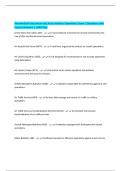
Aeromedical Exam | Questions with Correct Answers | 100% Pass
Aeromedical Exam | Questions with Correct Answers | 100% Pass
 ExamsCollection
Exam (elaborations)
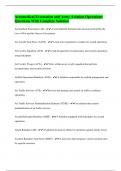
Aeromedical Evacuation and Army Aviation Operations Exam | Questions with Correct Answers | 100% Pass
Aeromedical Evacuation and Army Aviation Operations Exam | Questions with Correct Answers | 100% Pass
ExamsCollection
Exam (elaborations)
Aeromedical Evacuation and Army Aviation Operations Questions With Complete Solution
Aeromedical Evacuation (AE) - A noncombatant humanitarian mission protected by the Law of War and the Geneva Conventions. Air Assault Task Force (AATF) - A task force organized to conduct air assault operations. Air Cavalry Squadron (ACS) - A unit designed for reconnaissance and security operations using helicopters. Air Cavalry Troops (ACTs) - Units within an air cavalry squadron that perform reconnaissance and security missions. Airfield Operations Battalion (AOB) - A battalion responsi...
 DRJOY
DRJOY

Exam (elaborations)
Aeromedical Exam Questions With Complete Solution
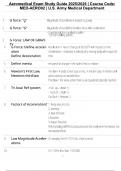
G force: "g" - Magnitude of accel force w respect to gravity G force: "G" - Magnitude of accel dimensionless force AND acceleration. - Gravitational force applied to pilots G Force: LAW OF GRAVITY - 120 mph (falling speed) G Force: Define acceleration Define deceleration - Acceleration = rate of change of VELOCITY with respect to time. Deceleration = reduction in velocity of a moving body with respect to time
DRJOY
Exam (elaborations)
NICET Level 1 Highway Construction Certification Exam Study Guide 2025/2026 | Course Code: NICET-HC01 | National Institute for Certification in Engineering Technologies (NICET), USA
This 2025/2026 study guide for the Aeromedical Exam provided by the U.S. Army Medical Department covers critical topics related to aeromedical evacuation, in-flight patient care, medical equipment management, emergency procedures, and the physiological impacts of flight on patients and crew. It includes detailed content reviews, procedural checklists, case scenarios, and practice questions designed to prepare military medical personnel for certification and operational readiness. This resource s...
 writingassistunlimited