
Digital Electronics
University of KwaZulu-Natal (UKZN)
Here are the best resources to pass Digital Electronics. Find Digital Electronics study guides, notes, assignments, and much more.
Class notes
Digital
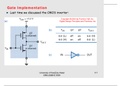
Gate Implementation Last time we discussed the CMOS inverter:
 mthimkhuluramasimong

Other
Digital Thermometer with Alarm and Logger
PopularSince the invention of microcontrollers, the production of “smart” electronic devices has since rose drastically. These microcontrollers are put inside a system and act as a brain to control a singular function in a device. This is accomplished by using its central processor to interpret data received from its I/O peripherals. The microcontroller's temporary data is saved in its data memory, where the processor accesses it and decodes and applies the incoming data using instructions st...
 percivalnyawose

Package deal
Digital Electronics
Full Course For Digital Electronics With Examples And Answers Learn At Home
mthimkhuluramasimong
Class notes
Electronic Measurement Systems
Understand basic measurement principles Look at a typical instrumentation system Usually some amplification of the sensor signal is needed
mthimkhuluramasimong
Class notes
References for Digital & Analog Conversion,Real World DACs,Matching Resolution & ExampleS
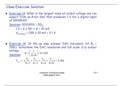
Wakerly doesn’t cover this section For the notes we used Rizzoni, (Principles and Applications of Electrical Engineering, Giorgio Rizzoni, 3rd, revised 4th or 5th edition) and Tocci/Widmer (Digital Systems – Principles & Applications, Ronald J Tocci & Neal S Widmer, 8th edition). Copies of Rizzoni are available in the library. The DAC circuit based on the inverting summer provided a useful hypothetical basis for discussion, but is not a practical circuit. Why? An 8-bit DAC has a...
mthimkhuluramasimong
Class notes
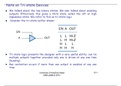
Note on Tri-state Devices & Digital to Analog Conversion
We talked about the two binary states. We also talked about enabling outputs. Effectively this gives a third state called the off or high impedance state. We refer to this as tri-state logic Digital to analog conversion is the process of taking a value in digital code format (straight binary, BCD, etc.) and converting it into a voltage or current that is proportional to the digital value
mthimkhuluramasimong
Class notes
Note on Tri-state Devices
We talked about the two binary states. We also talked about enabling outputs. Effectively this gives a third state called the off or high impedance state. We refer to this as tri-state logic Example: A 5-bit DAC has a current output such that a digital input of produces an output of 10 mA. What will Iout be for a digital input of 11101? Solution: Iout = 10 mA for an input of 2010 ⇒ K = 0.5 mA I’out = 0.5mA x 2910 = 14.5 mA
mthimkhuluramasimong
Class notes
Setup and Holds times
J-K Flip Flop
mthimkhuluramasimong

Class notes
Counters
Counters are circuits or networks which count pulses. It is important to define a few terms used in describing various circuits or networks. A sequential circuit is said to be a Moore machine or Moore network if its output is a direct function of its present state only and not of its input.
mthimkhuluramasimong
Class notes
Registers
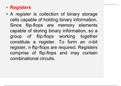
A register is collection of binary storage cells capable of holding binary information. Since flip-flops are memory elements capable of storing binary information, so a group of flip-flops working together constitute a register. To form an n-bit register, n flip-flops are required. Registers comprise of flip-flops and may contain combinational circuits.
mthimkhuluramasimong
Class notes
Real World Design
For more complex combinational problems with a larger number of inputs, one can resort to the use of a minimization algorithm, such as Quine-McCluskey. In practice however most designs are implemented using programmable Ics.
mthimkhuluramasimong
Class notes
Karnaugh Maps
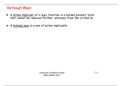
A prime implicant of a logic function is a normal product term that cannot be reduced further, obtained from the circled 1s. A minimal sum is a sum of prime implicants.
mthimkhuluramasimong
Class notes
real world design
Real World Design For more complex combinational problems with a larger number of inputs, one can resort to the use of aminimization algorithm, such as Quine-McCluskey.
mthimkhuluramasimong
Class notes
Simplifying Binary Representation
Simplifying Binary Representation Asthemagnitudeofnumbersincrease,binaryrepresentationbecomescumbersome.Base2isanaturalsystemforbinarymachineslikecomputersbutistediousforhumans. Inordertoreadbinarynumberseasilyweusebase8(octalnumbersystem)andbase16(hexadecimal). Sincebinary,octalandhexadecimalnumbershavemultiple-of-2bases,conversionfromonenumbersystemtotheotherissimple.Inconversiontooctal,justgroupbinarydigitsinto3sstartingfromthebinarypointtotheleftandtotheright.Thenconverteachgroupintotheco...
mthimkhuluramasimong
Class notes
Combinational Logic
Digital Circuits • Digitalcircuitscanbedescribedintermsofcombinationallogicorsequentiallogicorboth.Inacombinationallogic,theoutputofadigitalcircuitatanygiveninstantoftimeiscompletelydeterminedbytheinputspresentatthatparticulartime.Examplesofcombinationalcircuitsincludelogicgates,NANDgate,NOTgate,NORgateandsoforth. • Inthissection,wewillconsidercombinationalcircuitsonly
mthimkhuluramasimong
Class notes
Digital
Switching Device Characteristics
mthimkhuluramasimong
Class notes
Digital Electronics
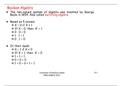
Boolean Algebra Thetwo-valuedsystemofalgebrawasinventedbyGeorgeBoolein1854.Alsocalledswitchingalgebra
mthimkhuluramasimong
Class notes
Digitital Electroci
YOU WANNA LEARN Introduction 1.2 TheBinaryNumberSystem 1.3 BaseConversions 1.4 BinaryAdditionandSubtraction 1.5 Sign-MagnitudeRepresentation 1.6 BinaryCodes 9 Section 2 − Combinational Logic 2.1 TruthTables 2.2 CombinationalGates 2.3 GateImplementation 2.4 PhysicalRepresentationofBinaryStates 2.5 LogicFamilies 2.6 BooleanAlgebra
mthimkhuluramasimong
Other
Binary to PACKED BCD conversion and vice versa
This Report consists of two projects, project 1 which deals with conversion from binary to BCD and vice versa using Shift add-3 algorithm. Project 2 deals with designing a counter that is a microcontroller based that will use two SSDs for display and implement switch debouncing. This counter will count up and down between 00 and 99. The program for both these projects was written an assembly language in MPLAB environment. The code was then inserted into a PIC16F690 microcontroller for imple...
percivalnyawose
Other
Binary to PACKED BCD conversion and vice versa
This Report consists of two projects, project 1 which deals with conversion from binary to BCD and vice versa using Shift add-3 algorithm. Project 2 deals with designing a counter that is a microcontroller based that will use two SSDs for display and implement switch debouncing. This counter will count up and down between 00 and 99. The program for both these projects was written an assembly language in MPLAB environment. The code was then inserted into a PIC16F690 microcontroller for imple...
percivalnyawose