CHEM 1252 (CHEM1252)

University Of North Carolina - Charlotte

Here are the best resources to pass CHEM 1252 (CHEM1252). Find CHEM 1252 (CHEM1252) study guides, notes, assignments, and much more.

All 13 results

Sort by:
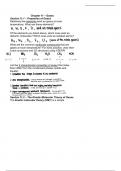
Molecular Geometry, Intermolecular Forces, and Bonding Theories Molecular Geometry, Intermolecular Forces, and Bonding Theories
  • Class notes

    Molecular Geometry, Intermolecular Forces, and Bonding Theories

  • This focused section covers intermolecular forces (IMFs)—the key attractive interactions that determine how molecules behave in the condensed phases. It starts by reviewing molecular polarity, helping students recognize when a molecule has a dipole moment based on structure and electronegativity. The notes then clearly explain the three main types of IMFs: dispersion forces (present in all substances), dipole-dipole interactions (in polar molecules), and hydrogen bonding (in molecules with H b...
  • danielleappel112
    $8.49 More Info
Gases Gases
  • Class notes

    Gases

  • Chapter 11 focuses on the fundamental behavior of gases, beginning with their unique physical properties—compressibility, low density, and the ability to form homogeneous mixtures. The notes explain the Kinetic Molecular Theory (KMT), which connects molecular motion to observable properties like pressure and temperature. You'll learn the assumptions of ideal gases, and how particle mass and velocity affect kinetic energy and root mean square speed (urms). The chapter then introduces gas press...
  • danielleappel112
    $8.49 More Info
Liquids and Solids Liquids and Solids
  • Class notes

    Liquids and Solids

  • Chapter 12 dives into the condensed phases of matter, explaining how intermolecular forces (IMFs) govern the structure and behavior of liquids and solids. The notes clearly distinguish between solids, liquids, and gases based on molecular interactions, and detail how properties like surface tension, viscosity, vapor pressure, melting point, and boiling point are directly related to the strength of IMFs. You'll learn how cohesion vs. adhesion, temperature, and molecular structure affect these pr...
  • danielleappel112
    $8.99 More Info
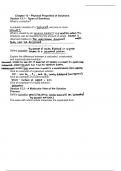
Physical Properties of Solutions Physical Properties of Solutions
  • Class notes

    Physical Properties of Solutions

  • This chapter explores the chemistry of solutions, beginning with the different types of solutions (solid, liquid, gaseous) and the role of the solute and solvent. It explains the concept of solubility, what makes a solution saturated, unsaturated, or supersaturated, and how “like dissolves like” helps predict solubility based on polarity. The notes guide you through the solution process at the molecular level, including the energetic steps of solute-solute, solvent-solvent, and solute-solven...
  • danielleappel112
    $8.99 More Info
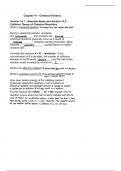
Chemical Kinetics Chemical Kinetics
  • Class notes

    Chemical Kinetics

  • This chapter breaks down the study of reaction rates and the factors that influence how quickly chemical reactions occur. It starts by defining reaction rate and explains how to measure it by tracking changes in reactant or product concentrations over time. The notes detail the collision theory—explaining how effective collisions and activation energy are necessary for reactions to proceed—and introduce the concept of the transition state. You'll learn how to determine rate laws from experi...
  • danielleappel112
    $8.99 More Info
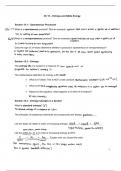
Entropy and Gibbs Energy Entropy and Gibbs Energy
  • Class notes

    Entropy and Gibbs Energy

  • Chapter 15 focuses on the thermodynamic principles that determine whether chemical and physical processes are spontaneous. The notes begin by distinguishing spontaneous vs. nonspontaneous processes and explain why enthalpy (ΔH) alone is not enough to predict spontaneity. You'll gain a solid understanding of entropy (S) as a measure of molecular disorder, including its mathematical definition
  • danielleappel112
    $8.49 More Info
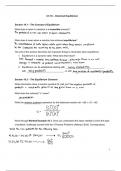
Chemical Equilibrium Chemical Equilibrium
  • Class notes

    Chemical Equilibrium

  • This chapter provides a deep dive into chemical equilibrium, beginning with the concept of reversible reactions and how equilibrium is achieved when the rates of the forward and reverse reactions become equal. The notes clearly define the reaction quotient (Qc) and equilibrium constant (Kc), teaching how to write expressions for both and interpret their values to determine whether a reaction mixture is at equilibrium or which direction it will shift to reach it. You'll also explore heterogeneou...
  • danielleappel112
    $8.09 More Info
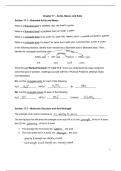
Acids, Bases, and Salts Acids, Bases, and Salts
  • Class notes

    Acids, Bases, and Salts

  • Chapter 17 builds a strong foundation in acid-base theory, beginning with Brønsted–Lowry acid-base definitions and identifying conjugate acid-base pairs in reactions. It then connects molecular structure to acid strength, explaining how bond strength and polarity affect acidity in hydrohalic acids and oxoacids, with trends based on electronegativity and oxidation number. You'll also learn the properties of amphoteric substances and the autoionization of water, leading into mastery of the pH ...
  • danielleappel112
    $8.49 More Info
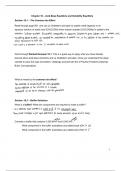
Acid-Base Equilibria and Solubility Equilibria Acid-Base Equilibria and Solubility Equilibria
  • Class notes

    Acid-Base Equilibria and Solubility Equilibria

  • This chapter explores the dynamic balance in acid-base and solubility systems, starting with the common ion effect and its impact on ionization and solubility through Le Châtelier’s Principle. The notes then dive into buffer solutions, explaining how they resist pH changes and are composed of a weak acid and its conjugate base (or vice versa). Both ICE table and Henderson-Hasselbalch equation methods are included for calculating pH of buffers. You’ll also find thorough coverage of acid-base...
  • danielleappel112
    $8.99 More Info
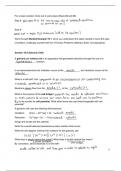
Electrochemistry Electrochemistry
  • Class notes

    Electrochemistry

  • This chapter offers a clear and thorough breakdown of electrochemical principles, focusing on the structure and function of galvanic (voltaic) cells. The notes explain how spontaneous redox reactions generate electricity and walk through the roles of the anode (site of oxidation) and cathode (site of reduction). You’ll learn how to construct cell diagrams using standard notation, understand electron flow direction, and identify the purpose of the salt bridge in maintaining charge balance. Deta...
  • danielleappel112
    $9.29 More Info
Get paid weekly? You can!
That summary you just bought made someone very happy. Also get paid weekly? Sell your study resources on Stuvia!