
P2CSTE307
University of Jammu
Here are the best resources to pass P2CSTE307. Find P2CSTE307 study guides, notes, assignments, and much more.

Summary
Genesis of IoT: Evolution, Digitization, Connected Transportation, and Industry 4.0
This presentation explores the origin and evolution of the Internet of Things (IoT), tracing its emergence as one of the most transformative technologies of the modern era. It explains the evolution of the Internet from basic connectivity to the IoT-driven digital world and distinguishes between IoT and digitization. The presentation examines real-world IoT applications in connected transportation systems, autonomous vehicles, smart roadways, connected factories (Industry 4.0), and intelligent b...
 bharti4

Summary
IPv6 for IoT – 6LoWPAN, 6TiSCH, RPL Routing and Security for Constrained Networks
PopularThis presentation explores advanced Internet Protocol technologies designed for constrained IoT environments. It introduces IPv6 optimization techniques such as 6LoWPAN, which enables efficient IPv6 communication over low-power wireless networks. The presentation also covers 6TiSCH for industrial wireless communication, RPL routing for low-power and lossy networks, and security frameworks including CoAP, DTLS, ACE, and DICE. Additionally, it discusses industry alliances and certification program...
bharti4
Package deal
Advanced IoT Networking & Communication Technologies: Sensors, Connectivity, IPv6 and IoT Protocols
This package covers advanced concepts in Internet of Things (IoT) communication and networking. It explores sensors and actuators, IoT connectivity requirements, wireless communication technologies, and modern networking protocols that enable large-scale IoT deployments. Topics include ZigBee, LoRaWAN, NB-IoT, LTE-M, Wi-Fi HaLow, IPv6, 6LoWPAN, RPL
bharti4
Package deal
Internet of Things (IoT) Foundations: Concepts, Evolution, Architectures, Security, and Smart Devices
This package provides a comprehensive introduction to the Internet of Things (IoT), covering its fundamental concepts, evolution, real-world applications, network architectures, security challenges, and smart device technologies. It explores how everyday objects become intelligent and connected through sensors, actuators, and network communication.
bharti4
Summary
IoT Protocols: CoAP (Constrained Application Protocol) & RESTful Architecture
This presentation offers an in-depth exploration of the Constrained Application Protocol (CoAP) and its vital role in the architecture of the Internet of Things (IoT), serving as an ideal resource for students referencing the file "T". The material begins by establishing how IPv6's vast address space enables a scalable Web of Things where billions of endpoints possess a unique identity to communicate autonomously and intelligently. It provides a critical analysis of why traditional prot...
bharti4
Summary
Application Protocols for IoT | TCP vs UDP, SCADA, HTTP, XMPP & CoAP Complete Study Notes
Comprehensive study notes covering IoT application protocols and transport layer communication. This resource explains TCP and UDP, protocol selection in IoT environments, Class 0 devices, SCADA integration, web-based protocols (HTTP/HTTPS and XMPP), and CoAP for constrained networks. Includes protocol comparisons, industrial automation concepts, transport methods, and key takeaways for IoT networking and communication systems.It is ideal for BCA, MCA, B.Tech, M.Tech, Computer Science, Data Scie...
bharti4
Summary
IP as the IoT Network Layer – IPv4, IPv6 and Internet Protocol for IoT Systems
This presentation explains the role of Internet Protocol (IP) as the foundation of modern Internet of Things (IoT) architectures. It discusses how IP enables seamless communication between IoT devices, gateways, edge platforms, and cloud data centers. The presentation highlights the business case for adopting IP in IoT environments, emphasizing interoperability, scalability, security, manageability, and long-term sustainability. It also examines the advantages of IPv4 and IPv6 deployment, IT-OT ...
bharti4
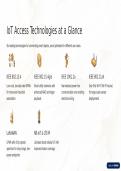
Summary
IoT Access Technologies – ZigBee, LoRaWAN, Wi-Fi HaLow, NB-IoT and LTE-M
This presentation provides a comprehensive study of the major access technologies used in Internet of Things deployments. It examines IEEE 802.15.4, IEEE 802.15.4g/e, IEEE 1901.2a, IEEE 802.11ah (Wi-Fi HaLow), LoRaWAN, NB-IoT, and LTE-M technologies. Key characteristics such as communication range, power consumption, network topology, security mechanisms, spectrum usage, and data rates are compared. The presentation also highlights real-world applications including smart grids, industrial automa...
bharti4
Summary
IoT Connectivity Fundamentals – Communication Criteria, Network Topologies and Wireless Technologies
This presentation introduces the key communication criteria used in selecting IoT connectivity technologies. It covers important factors such as communication range, frequency bands, power consumption, network topology, constrained devices, and constrained networks. The presentation explains short-, medium-, and long-range communication technologies and discusses network architectures including star, mesh, and peer-to-peer topologies. It also introduces constrained node classifications and batte...
bharti4

Summary
Sensors, Actuators and Smart Objects in IoT – Types, Applications and Real-World
This presentation provides a detailed introduction to sensors, actuators, and smart objects, which form the foundation of Internet of Things (IoT) systems. It explains how sensors collect physical-world data and convert it into digital information for intelligent decision-making. Various sensor categories, including motion, temperature, humidity, pressure, light, chemical, biosensors, and radiation sensors, are discussed with practical examples. The presentation also explores smartphone sensor e...
bharti4
Summary
IoT Network Architectures: oneM2M, Cisco Reference Model, Edge, Fog and Cloud Computing
This presentation provides a comprehensive overview of IoT network architectures and design principles. It discusses the importance of network architecture in large-scale IoT deployments and explores key drivers such as scalability, security, constrained devices, legacy system integration, and real-time analytics. The presentation compares leading IoT architectural frameworks, including the oneM2M architecture, Cisco IoT Reference Architecture, and simplified three-layer IoT models. It further e...
bharti4
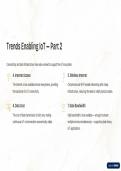
Class notes
Internet of Things (IoT): Benefits, Privacy, Security and Future Connectivity
This presentation explores advanced aspects of the Internet of Things ecosystem, including connectivity trends, cloud integration, wireless networking, and data infrastructure. It highlights the powerful and pervasive nature of IoT in homes, workplaces, healthcare, transportation, and daily life. The presentation further examines societal benefits such as automation, convenience, and global connectivity while addressing critical challenges related to privacy, cybersecurity, data protection, and ...
bharti4

Class notes
Fundamentals of Internet of Things
This presentation introduces the fundamental concepts of the Internet of Things (IoT), explaining how ordinary objects become smart connected devices through computational intelligence and network connectivity. It covers real-world IoT applications such as smart refrigerators, connected vehicles, RFID-enabled logistics systems, and compares IoT devices with traditional computers. The presentation also discusses the technological trends driving IoT adoption, including reduced hardware costs, mini...
bharti4