
Course Outlines
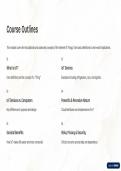
This module covers the foundational and advanced concepts of the Internet of Things, from basic definitions to real-world implications.
01 02
What is IoT? IoT Devices
Core definition and the concept of a "Thing" Examples including refrigerators, cars, and logistics
03 04
IoT Devices vs. Computers Powerful & Pervasive Nature
Key differences in purpose and design Cloud interfaces and omnipresence of IoT
05 06
Societal Benefits Risks, Privacy & Security
How IoT makes life easier and more connected Critical concerns around data and dependence
, What is IoT?
An IoT device is built by layering three elements onto any ordinary object:
A "Thing" Computational Intelligence Network Connectivity
Anything besides a traditional computer Add intelligence to improve the function Add internet access to greatly enhance
— a refrigerator, a car, a traffic light — of the device. A traditional refrigerator functionality. An IoT refrigerator orders
that has some features and uses. just keeps items cold; an intelligent one food when stock is low, searches for the
tells you when the door is open, when lowest prices, anticipates your meals,
the water filter needs replacement, and provides consumption data to
when you are low on butter, and what businesses for marketing. It does not
recipes match its contents — but it is look like a traditional computer and has
still not networked. no keyboard or mouse — internet is
required.
This module covers the foundational and advanced concepts of the Internet of Things, from basic definitions to real-world implications.
01 02
What is IoT? IoT Devices
Core definition and the concept of a "Thing" Examples including refrigerators, cars, and logistics
03 04
IoT Devices vs. Computers Powerful & Pervasive Nature
Key differences in purpose and design Cloud interfaces and omnipresence of IoT
05 06
Societal Benefits Risks, Privacy & Security
How IoT makes life easier and more connected Critical concerns around data and dependence
, What is IoT?
An IoT device is built by layering three elements onto any ordinary object:
A "Thing" Computational Intelligence Network Connectivity
Anything besides a traditional computer Add intelligence to improve the function Add internet access to greatly enhance
— a refrigerator, a car, a traffic light — of the device. A traditional refrigerator functionality. An IoT refrigerator orders
that has some features and uses. just keeps items cold; an intelligent one food when stock is low, searches for the
tells you when the door is open, when lowest prices, anticipates your meals,
the water filter needs replacement, and provides consumption data to
when you are low on butter, and what businesses for marketing. It does not
recipes match its contents — but it is look like a traditional computer and has
still not networked. no keyboard or mouse — internet is
required.


