

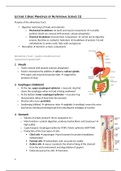
LECTURE 1 BASIC PRINCIPLES OF NUTRITIONAL SCIENCE (1)
Purpose of the alimentary tract:
Digestion (vertering) of foods and nutrients
o Mechanical breakdown via teeth and muscle movements in smaller
particles (teeth are covered with enamel; calcium phosphate)
o Chemical breakdown towards basic components carried out by digestive
enzyme (function as catalysts); hydrolysis breakdown of protein, fat and
carbohydrate to amino acids, fatty acids and glucose
Absorption of nutrients as basic components
Alimentary tract / gastro-intesti nal tract
(spijsverteringskanaal):
1. Mouth
o Teeth covered with enamel (calcium phosphate)
o Food is moisturized by addition of saliva by salivary glands;
99% water and enzymes/lysozyme/salts triggered by
presence of food
2. Esophagus (slokdarm)
o At the top: upper esophageal sphincter = muscular ring that
closes the esophagus when no food is being swallowed
o At the bottom: lower esophageal sphincter = muscular ring
that prevents reflux of food from the stomach
o Muscles who occur peristalsis
o Swallowing (slikken) sphincters relax epiglottis (=strotklep) covers the voice
box/larynx; hereby preventing food from entering the windpipe or trachea
3. Stomach
o Volume of empty stomach: 50 mL (expand to 1L)
o Main function = protein digestion, produces hydrochloric acid (zoutzuur)
high acidity
o 2 gate keepers: Esophageal sphincter (TOP), Pyloric sphincter (BOTTOM)
o Production of the four types of cells:
Chief cells pepsinogen (=(pro-)enzyme for protein breakdown,
selfactivated)
Parietal cells hydrochloric acid; accounts for acidity
Goblet cells mucus (=protects the interior lining of the stomach
from the acid environment and degradation of pepsin)
Endocrine-paracrine cells hormones
1
,4. Small intestine (dunne darm)
To increase the absorptive capacity of the intestine, the surface area of the interior lining of
the small intestine is amplified by 3 features:
1) Folds wrinkles of the entire intestinal wall
2) Villi network of blood vessels and a lymphatic vessel (called lacteal)
Absorbed fats go into small lacteals; collect into larger mesenteric lymph ducts and
finally into the large thoracic duct, which rungs parallel to the aorta. The content of
the thoraric duct drains into the circulation at the subclavian vein (holle ader)
3) Microvilli microscopically small
protrusions of the cell membrane of
enterocytes that face the lumen of the
small intestine
Types of cells below surface of the villi:
- Digestive enzymes
- Enterocytes
- Mucus producing Goblet cells
- Hormone producing entero-endocrine cells
- Paneth cells (secrete anti-bacterial lysozyme)
Crypts = the valley-like structures between the villi
Absorbed nutrients that are water soluble (e.g. amino acids, glucose,
electrolytes) enter into capillaries that combine to become veins
merge into the portal vein (poortader), which delivers the absorbed
nutrients to the liver next stop is heart
Duodenem (twaalfvingerige darm)
Connects stomach to the jejunem
Disgesive juices: bicarbonate neutralize the acid food from the stomach to allow
food disgestion to continue
Controls the rate of emptying of the stomach by producing secretin and
cholecystokinin
Jejunum
Generates the basic chemical components that the body can absorb
Ileum
Nutrient absorption
Food digestion is primarily performed by disgestive juices secreted by the pancreas,
small intestine & liver:
Pancreas Enzymes (lipases, amylase, protease) & biocarbonate
Small intestine Enzymes (disaccharidases, peptidases) & biacarbonate final
steps of nutrients digestion into basic chemical components (amino acids, glucose)
Liver Bile (gal) = emulsifier (phospholipids, cholesterol, bile acids)
2
, 5. Large intestine, colon (dikke darm)
o Absorbs water from the remaining indigestible food matter & serve as a vehicle for
the body to rid itself of waste material
o Large number of bacteria; carry out the fermentation of dietary fiber (anaerobe
gisting van voedingsvezels)
o Fecal matter (ontlasting) collects into descending colon and rectum accomplished
by peristalsis (=sequential contraction and relaxation of the circular muscles
surrounding the intestine, causes forward propulsion)
o Ascending colon – transverse colon – descending colon – rectum
6. Rectum & anus feces (ontlasting) collect here
o As the wall of rectum expands due to its filling, stretch receptors are activated
o Contraction of the anal sphincter muscle prevents feces from coming out of the
rectum
o Out? Relaxation of the anal sphincter & contraction of the abdominal muscle to
increase intra-abdominal pressure
Protein Carbohydrate Fat
Mouth X
Stomach X X
Small intestine X X X
Pancreas X X X
Lumenal border X X
Colon
Entero-endocrine cells specialized cells located throughout the alimentary tract; release
peptides reffered to as gut hormones
Gastrin = stimulates stomach to produce acid
Secretin = stimulates pancreas to stimulate bicarbonate
Incretins = stimulates insulin release
Cholecystokinin = causes satiety
Malfunction of the alimentary tract:
Abdominal pain caused by a multitude of underlying defects and may reflect a
minor transient disorder or serious disease
Diarrhea having watery stools that can lead to dehydration
Constipation infrequent bowel movements or bowel movements that are hard to
pass
Hermorrhoids swollen and inflamed veins around the anus or in the lower rectum
Colon cancer cancer that affects the colon or the rectum
3
Purpose of the alimentary tract:
Digestion (vertering) of foods and nutrients
o Mechanical breakdown via teeth and muscle movements in smaller
particles (teeth are covered with enamel; calcium phosphate)
o Chemical breakdown towards basic components carried out by digestive
enzyme (function as catalysts); hydrolysis breakdown of protein, fat and
carbohydrate to amino acids, fatty acids and glucose
Absorption of nutrients as basic components
Alimentary tract / gastro-intesti nal tract
(spijsverteringskanaal):
1. Mouth
o Teeth covered with enamel (calcium phosphate)
o Food is moisturized by addition of saliva by salivary glands;
99% water and enzymes/lysozyme/salts triggered by
presence of food
2. Esophagus (slokdarm)
o At the top: upper esophageal sphincter = muscular ring that
closes the esophagus when no food is being swallowed
o At the bottom: lower esophageal sphincter = muscular ring
that prevents reflux of food from the stomach
o Muscles who occur peristalsis
o Swallowing (slikken) sphincters relax epiglottis (=strotklep) covers the voice
box/larynx; hereby preventing food from entering the windpipe or trachea
3. Stomach
o Volume of empty stomach: 50 mL (expand to 1L)
o Main function = protein digestion, produces hydrochloric acid (zoutzuur)
high acidity
o 2 gate keepers: Esophageal sphincter (TOP), Pyloric sphincter (BOTTOM)
o Production of the four types of cells:
Chief cells pepsinogen (=(pro-)enzyme for protein breakdown,
selfactivated)
Parietal cells hydrochloric acid; accounts for acidity
Goblet cells mucus (=protects the interior lining of the stomach
from the acid environment and degradation of pepsin)
Endocrine-paracrine cells hormones
1
,4. Small intestine (dunne darm)
To increase the absorptive capacity of the intestine, the surface area of the interior lining of
the small intestine is amplified by 3 features:
1) Folds wrinkles of the entire intestinal wall
2) Villi network of blood vessels and a lymphatic vessel (called lacteal)
Absorbed fats go into small lacteals; collect into larger mesenteric lymph ducts and
finally into the large thoracic duct, which rungs parallel to the aorta. The content of
the thoraric duct drains into the circulation at the subclavian vein (holle ader)
3) Microvilli microscopically small
protrusions of the cell membrane of
enterocytes that face the lumen of the
small intestine
Types of cells below surface of the villi:
- Digestive enzymes
- Enterocytes
- Mucus producing Goblet cells
- Hormone producing entero-endocrine cells
- Paneth cells (secrete anti-bacterial lysozyme)
Crypts = the valley-like structures between the villi
Absorbed nutrients that are water soluble (e.g. amino acids, glucose,
electrolytes) enter into capillaries that combine to become veins
merge into the portal vein (poortader), which delivers the absorbed
nutrients to the liver next stop is heart
Duodenem (twaalfvingerige darm)
Connects stomach to the jejunem
Disgesive juices: bicarbonate neutralize the acid food from the stomach to allow
food disgestion to continue
Controls the rate of emptying of the stomach by producing secretin and
cholecystokinin
Jejunum
Generates the basic chemical components that the body can absorb
Ileum
Nutrient absorption
Food digestion is primarily performed by disgestive juices secreted by the pancreas,
small intestine & liver:
Pancreas Enzymes (lipases, amylase, protease) & biocarbonate
Small intestine Enzymes (disaccharidases, peptidases) & biacarbonate final
steps of nutrients digestion into basic chemical components (amino acids, glucose)
Liver Bile (gal) = emulsifier (phospholipids, cholesterol, bile acids)
2
, 5. Large intestine, colon (dikke darm)
o Absorbs water from the remaining indigestible food matter & serve as a vehicle for
the body to rid itself of waste material
o Large number of bacteria; carry out the fermentation of dietary fiber (anaerobe
gisting van voedingsvezels)
o Fecal matter (ontlasting) collects into descending colon and rectum accomplished
by peristalsis (=sequential contraction and relaxation of the circular muscles
surrounding the intestine, causes forward propulsion)
o Ascending colon – transverse colon – descending colon – rectum
6. Rectum & anus feces (ontlasting) collect here
o As the wall of rectum expands due to its filling, stretch receptors are activated
o Contraction of the anal sphincter muscle prevents feces from coming out of the
rectum
o Out? Relaxation of the anal sphincter & contraction of the abdominal muscle to
increase intra-abdominal pressure
Protein Carbohydrate Fat
Mouth X
Stomach X X
Small intestine X X X
Pancreas X X X
Lumenal border X X
Colon
Entero-endocrine cells specialized cells located throughout the alimentary tract; release
peptides reffered to as gut hormones
Gastrin = stimulates stomach to produce acid
Secretin = stimulates pancreas to stimulate bicarbonate
Incretins = stimulates insulin release
Cholecystokinin = causes satiety
Malfunction of the alimentary tract:
Abdominal pain caused by a multitude of underlying defects and may reflect a
minor transient disorder or serious disease
Diarrhea having watery stools that can lead to dehydration
Constipation infrequent bowel movements or bowel movements that are hard to
pass
Hermorrhoids swollen and inflamed veins around the anus or in the lower rectum
Colon cancer cancer that affects the colon or the rectum
3


