

Clinical Neuropsychology in Neurological
Rehabilitation
Introduction (Lafosse)
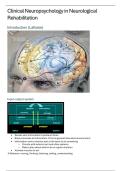
Input-output system
• Senses sent information to posterior brain
• Brain processes all information à forms general idea about environment
• Information sent to anterior part of the brain to do something
o Circuits with anterior part and other systems
o Make a plan about what to do in a given situation
• Activate muscles to act
à Behavior: moving, thinking, listening, talking, understanding
,Whole process
Process
• Senses send information to thalamus
• Thalamus sends information to posterior cortex
• Processing in primary, secondary and tertiary (association) regions
• Information sent to frontal lobes: tertiary, secondary and primary regions
• Subcortical circuits with limbic system, striatal system and cerebellum
• Output sent to muscles
Example limbic system
• French fries send sensory information to brain
• Limbic system to direct motivation and drive to eat
o Emotional valance: when disgusted feeling, you stop eating
o When no limbic system: apathic behavior
Example striatal system
• Striatal systems have memorized automatic behavior
• Energy can go to cognitive thinking process
• Eg: typing while listening to cognitive demanding words
• Eg: driving a car (except in sudden situation when all attention is needed)
Cerebellum
• Gives feedback in processing motor information so that motor performances are always
corrected
Brain stem
• Needed for general arousal of all these systems
Projection areas
• Modality specific
• Topotopical organization
• NO hemispherical lateralization
,Parallel pathways
Red arrows
• Send information directly to association cortex
Eye pathways
Older parallel pathway: from eyes to colliculus superior to parietal lobes (deciding where to look at)
New pathway: eyes send information to thalamus, ending in primary visual cortex and to parietal
lobes and temporal lobes
Association cortex
• Not modality specific
• Non-topotopical organization
• Hemispherical lateralization
Eg. cognition: what are you seeing and where
, Posterior part
Association cortex (grey stripes next to primary visual cortex)
• All information from senses are associated together
• Integration of function: supports neuroplasticity
Occipital is a primary projectory cortex, so no associative cortex
Blindsight
Bilateral visual cortex lesion
• No consciousness about what you see: acting like a blind person
• Eyes follow the object, so brain is processing through older pathways, so eyes know where the
information is
• But person is not aware of brain processing that information
• Spatially correct, but depth vision is gone, and person doesn’t see it
à Improvement only when primary visual cortex recovers
Rehabilitation
Introduction (Lafosse)
Input-output system
• Senses sent information to posterior brain
• Brain processes all information à forms general idea about environment
• Information sent to anterior part of the brain to do something
o Circuits with anterior part and other systems
o Make a plan about what to do in a given situation
• Activate muscles to act
à Behavior: moving, thinking, listening, talking, understanding
,Whole process
Process
• Senses send information to thalamus
• Thalamus sends information to posterior cortex
• Processing in primary, secondary and tertiary (association) regions
• Information sent to frontal lobes: tertiary, secondary and primary regions
• Subcortical circuits with limbic system, striatal system and cerebellum
• Output sent to muscles
Example limbic system
• French fries send sensory information to brain
• Limbic system to direct motivation and drive to eat
o Emotional valance: when disgusted feeling, you stop eating
o When no limbic system: apathic behavior
Example striatal system
• Striatal systems have memorized automatic behavior
• Energy can go to cognitive thinking process
• Eg: typing while listening to cognitive demanding words
• Eg: driving a car (except in sudden situation when all attention is needed)
Cerebellum
• Gives feedback in processing motor information so that motor performances are always
corrected
Brain stem
• Needed for general arousal of all these systems
Projection areas
• Modality specific
• Topotopical organization
• NO hemispherical lateralization
,Parallel pathways
Red arrows
• Send information directly to association cortex
Eye pathways
Older parallel pathway: from eyes to colliculus superior to parietal lobes (deciding where to look at)
New pathway: eyes send information to thalamus, ending in primary visual cortex and to parietal
lobes and temporal lobes
Association cortex
• Not modality specific
• Non-topotopical organization
• Hemispherical lateralization
Eg. cognition: what are you seeing and where
, Posterior part
Association cortex (grey stripes next to primary visual cortex)
• All information from senses are associated together
• Integration of function: supports neuroplasticity
Occipital is a primary projectory cortex, so no associative cortex
Blindsight
Bilateral visual cortex lesion
• No consciousness about what you see: acting like a blind person
• Eyes follow the object, so brain is processing through older pathways, so eyes know where the
information is
• But person is not aware of brain processing that information
• Spatially correct, but depth vision is gone, and person doesn’t see it
à Improvement only when primary visual cortex recovers


