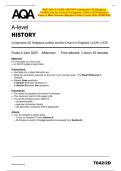
2025 AQA A-LEVEL HISTORY Component 2D Religious
Conflict and the Church in England, c1529–c1570 Question
Paper & Mark Scheme (Merged) Friday 6 June 2025 [VERIFIED]
A-level
HISTORY
Component 2D Religious conflict and the Church in England, c1529–c1570
Friday 6 June 2025 Afternoon Time allowed: 2 hours 30 minutes
Materials
For this paper you must have:
an AQA 16-page answer book.
Instructions
Use black ink or black ball-point pen.
Write the information required on the front of your answer book. The Paper Reference is
7042/2D.
Answer three questions.
In Section A answer Question 01.
In Section B answer two questions.
Information
The marks for questions are shown in brackets.
The maximum mark for this paper is 80.
You will be marked on your ability to:
– use good English
– organise information clearly
– use specialist vocabulary where appropriate.
Advice
You are advised to spend about:
– 1 hour on Question 01 from Section A
– 45 minutes on each of the two questions answered from Section B.
IB/M/Jun25/G4007/V5 7042/2D
, 2
Section A
Answer Question 01.
Source A
From a speech to an audience of nobility, councillors and judges by Henry VIII,
8 November 1528.
Our trusty and well-beloved subjects, both you of the nobility, and you of the lesser sort.
By God’s provision, and by true and lawful inheritance, we have reigned over this realm
of England for almost twenty years. Yet, when we remember our mortality, and that we
must die, then we think that all our doings in our lifetime are clearly worth nothing if we
leave you in trouble at the time of our death. For if our true heir be not known at the time 5
of our death, see what mischief and trouble shall be passed on to you and to your
children. And although it has pleased Almighty God to send us a fair daughter of a noble
woman, it hath been told us by several great Churchmen, that neither is she our lawful
daughter, nor her mother our lawful wife, but that we live together abominably and
detestably in open adultery. 10
Source B
From a letter to Cardinal Sanga, secretary to Pope Clement VII, from
Cardinal Campeggio, papal legate to the Court of Henry VIII, 25 October 1528.
In my most recent conversation with the Lord Cardinal, Wolsey said, and repeated many
times, “Most reverend lord, beware. In recent times, as a consequence of Luther, the
greatest part of Germany has become estranged from the Papacy and from the Faith; the
same may happen in England, and have the same result”. Wolsey has impressed upon
me that, if this divorce is not granted, the authority of the Pope in this kingdom will be 5
annihilated. Wolsey is desperate for preservation of the authority of the Pope, because
all his grandeur is connected with it. I find myself in a very difficult position, and I have a
heavy burden on my shoulders. I do not see how a judgement can be delayed, even for
a brief period. The King will endure no delaying tactics, alleging that the affairs of the
kingdom are at a standstill and are dependent on the outcome of this case. If it remains 10
unresolved, it will give rise to both immediate and to infinite dangers.
IB/M/Jun25/7042/2D
, 3
Source C
From the Act in Restraint of Appeals, 1533.
Whereby on the evidence of authentic histories and chronicles, it is declared that the
realm of England is an Empire governed by one Supreme Head and King. The King, and
his most noble forebears, have made laws for the protection of their authority to keep the
realm free from the interference of the See of Rome and from that of other foreign
powers. Notwithstanding this authority, dangers have arisen because of appeals relating 5
to causes of matrimony and divorce, made from within this realm to the See of Rome.
This has caused great distress, trouble, and cost to the King’s Highness and to many of
his subjects. It has led to the great delay in the true resolution of these problems. As a
result, the King’s Highness and his Parliament, enact that all such cases from henceforth
shall be definitively judged and determined within the King’s jurisdiction and authority and 10
not elsewhere.
0 1 With reference to these sources and your understanding of the historical context, assess
the value of these three sources to an historian studying the King’s ‘Great Matter’.
[30 marks]
Turn over for Section B
IB/M/Jun25/7042/2D Turn over ►
Conflict and the Church in England, c1529–c1570 Question
Paper & Mark Scheme (Merged) Friday 6 June 2025 [VERIFIED]
A-level
HISTORY
Component 2D Religious conflict and the Church in England, c1529–c1570
Friday 6 June 2025 Afternoon Time allowed: 2 hours 30 minutes
Materials
For this paper you must have:
an AQA 16-page answer book.
Instructions
Use black ink or black ball-point pen.
Write the information required on the front of your answer book. The Paper Reference is
7042/2D.
Answer three questions.
In Section A answer Question 01.
In Section B answer two questions.
Information
The marks for questions are shown in brackets.
The maximum mark for this paper is 80.
You will be marked on your ability to:
– use good English
– organise information clearly
– use specialist vocabulary where appropriate.
Advice
You are advised to spend about:
– 1 hour on Question 01 from Section A
– 45 minutes on each of the two questions answered from Section B.
IB/M/Jun25/G4007/V5 7042/2D
, 2
Section A
Answer Question 01.
Source A
From a speech to an audience of nobility, councillors and judges by Henry VIII,
8 November 1528.
Our trusty and well-beloved subjects, both you of the nobility, and you of the lesser sort.
By God’s provision, and by true and lawful inheritance, we have reigned over this realm
of England for almost twenty years. Yet, when we remember our mortality, and that we
must die, then we think that all our doings in our lifetime are clearly worth nothing if we
leave you in trouble at the time of our death. For if our true heir be not known at the time 5
of our death, see what mischief and trouble shall be passed on to you and to your
children. And although it has pleased Almighty God to send us a fair daughter of a noble
woman, it hath been told us by several great Churchmen, that neither is she our lawful
daughter, nor her mother our lawful wife, but that we live together abominably and
detestably in open adultery. 10
Source B
From a letter to Cardinal Sanga, secretary to Pope Clement VII, from
Cardinal Campeggio, papal legate to the Court of Henry VIII, 25 October 1528.
In my most recent conversation with the Lord Cardinal, Wolsey said, and repeated many
times, “Most reverend lord, beware. In recent times, as a consequence of Luther, the
greatest part of Germany has become estranged from the Papacy and from the Faith; the
same may happen in England, and have the same result”. Wolsey has impressed upon
me that, if this divorce is not granted, the authority of the Pope in this kingdom will be 5
annihilated. Wolsey is desperate for preservation of the authority of the Pope, because
all his grandeur is connected with it. I find myself in a very difficult position, and I have a
heavy burden on my shoulders. I do not see how a judgement can be delayed, even for
a brief period. The King will endure no delaying tactics, alleging that the affairs of the
kingdom are at a standstill and are dependent on the outcome of this case. If it remains 10
unresolved, it will give rise to both immediate and to infinite dangers.
IB/M/Jun25/7042/2D
, 3
Source C
From the Act in Restraint of Appeals, 1533.
Whereby on the evidence of authentic histories and chronicles, it is declared that the
realm of England is an Empire governed by one Supreme Head and King. The King, and
his most noble forebears, have made laws for the protection of their authority to keep the
realm free from the interference of the See of Rome and from that of other foreign
powers. Notwithstanding this authority, dangers have arisen because of appeals relating 5
to causes of matrimony and divorce, made from within this realm to the See of Rome.
This has caused great distress, trouble, and cost to the King’s Highness and to many of
his subjects. It has led to the great delay in the true resolution of these problems. As a
result, the King’s Highness and his Parliament, enact that all such cases from henceforth
shall be definitively judged and determined within the King’s jurisdiction and authority and 10
not elsewhere.
0 1 With reference to these sources and your understanding of the historical context, assess
the value of these three sources to an historian studying the King’s ‘Great Matter’.
[30 marks]
Turn over for Section B
IB/M/Jun25/7042/2D Turn over ►