Health – januari 2026 1
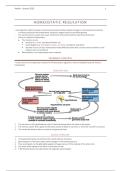
HOMEOSTATIC REGULATION
= the organism’s ability to keep its internal environment stable, despite changes in the external environment
- It involves processes like temperature, blood pH, oxygen pressure and blood glucose
- The central nervous system acts as an interface for interaction with the external environment
- Stress is a threat to homeostasis
• The stressor can be
▪ physical (e.g. cold), considered ‘bottom up’
▪ psychological (e.g. anticipation of pain, an exam), considered ‘top down’
▪ But both are or can be a homeostatic threat AND they both often use the same machinery in the
body to react to said threat
• What follows is a compensatory stress response
FEEDBACK CONTROL
= most common and important mechanism of homeostatic regulation, where a feedback loop will result in
homeostasis
TEMPERATURE
1. The set point in the hypothalamus notes if the body temperature increases or decreases
2. The nervous system then signals to the blood vessels to dilate or constrict or even the muscles to contract
3. This causes the body to lose or conserve and generate heat
BLOOD PRESSURE
1. Increased blood pressure stretches the carotid arteries and aorta
2. Baroreceptors in the heart detect these changes in the arterial pressure
3. They send signals via the glossopharyngeal and vagus nerves to the medulla of the brain stem
4. The brain sends signals to the heart to decrease its rate
If the blood pressure was decreased, the opposite would happen
,Health – januari 2026 2
BLOOD PH LEVELS
Also: arterial carbon dioxide pressure (PaCO2)
FEEDFORWARD CONTROL
= the body already initiates certain actions before a real physical change has started, because…
- Perturbations are being anticipated and corrected before they occur
- Classical conditioning as a viable mechanism, e.g. “Exercise Hyperpnea”: increases in ventilation and heart
rate occur at the onset of physical exercise, even before an increase in PaCO 2
HIERARCHY OF HOMEOSTATIC CONTROLS
There are different levels of our stress-response-machinery in
how it responds to changes or stressors:
,Health – januari 2026 3
INTRINSIC CONTROL MECHANISMS (AT THE ORGAN LEVEL)
= some organs adapt its functioning on its own in response to slow, local changes
- It does not happen with abrupt and/or large changes!
- One example is the Frank Starling mechanism:
1. If the returning (venous) blood volume increases, then the atrium chambers fill more before the next
beat
2. This more effective filling of the atria creates more wall stretch and more muscle fiber tension
3. This then causes a more vigorous contraction on the next beat
4. The left ventricle will also empty more completely
5. There will therefore be more effective blood flow to the aorta
• So the heart responds to flow demands caused by systemic circulation
• This is only possible when conditions are relatively stable
THE HYPOTHALAMUS
= the main hub in our brain controlling and organizing a lot of the behaviors that are necessary for survival
- It is a grouping of different nuclei: autonomic, endocrine, and skeletal-motor nuclei
• The autonomic nuclei send input to the brain stem affecting the autonomic regulation
• The endocrine nuclei control endocrine functions like the release of CRF (corticotropin releasing factor)
and AVP (arginine vasopressin or anti-diuretic hormone)
• The skeletal-motor nuclei can regulate our posture and locomotion
- The hypothalamus is connected to the brainstem and to higher brain centers like the limbic system (for
emotion) and the frontal cortex (for cognition)
AUTONOMIC CONTROL MECHANISMS
THE AUTONOMIC NERVOUS SYSTEM (ANS)
= controls the viscera (inner organs)
- We (usually) have limited awareness and voluntary control over these inner organs (i.e. can’t tell our hearts
how fast it should beat) → they are autonomic
- This works via negative feedback mechanisms
- The ANS does reciprocal regulation of organic function
- There are different pathways:
• Sensory pathways (afferent): from organs to brain
• Motor pathways (efferent): from brain to organs
- There are 2/3 divisions:
• Sympathetic nervous system (SNS): ‘fight or flight’, e.g. dilating pupils, decreasing salivation, increasing
breath rate, increasing heart rate
• Parasympathetic nervous system (PNS): ‘rest and digest’, e.g. constricting pupils, increasing salivation,
decreasing breath rate, decreasing heart rate
• (sometimes mentioned) enteric system: a semi-independent network in the gut
Each division has:
- Sensory pathways (afferent) from organs via the ganglia to the brainstem
- 4 response components (efferent):
1. Descending autonomic and pre-ganglionic fibers: nerve fibers that carry motor commands from the
brain (hypothalamus/brainstem) to the intermediolateral cell column of the spinal cord, before they
reach the autonomic ganglia
2. Ganglion: a relay station for as-/descending signals, also part of local regulation system/reflexes
3. Postganglionic fibers: messages get more elaborated than in the preganglionic fibers
4. Neuroeffector junctions: postganglionic fiber/receptor at target tissue, where nerve impulses are
translated into motor action
, Health – januari 2026 4
SYMPATHETIC DIVISION
- There is a certain ratio: there is 1 preganglionic nerve that is coupled to 10 postganglionic nerves
• This means there is a general, broad influence possible on the viscera
• There are extensive linkages across widely distributed ganglia
• There are closely integrated actions across different organs (‘in sympathy’)
- Neurotransmission between these nerve cells:
• Acetylcholine at the preganglionic level
HOMEOSTATIC REGULATION
= the organism’s ability to keep its internal environment stable, despite changes in the external environment
- It involves processes like temperature, blood pH, oxygen pressure and blood glucose
- The central nervous system acts as an interface for interaction with the external environment
- Stress is a threat to homeostasis
• The stressor can be
▪ physical (e.g. cold), considered ‘bottom up’
▪ psychological (e.g. anticipation of pain, an exam), considered ‘top down’
▪ But both are or can be a homeostatic threat AND they both often use the same machinery in the
body to react to said threat
• What follows is a compensatory stress response
FEEDBACK CONTROL
= most common and important mechanism of homeostatic regulation, where a feedback loop will result in
homeostasis
TEMPERATURE
1. The set point in the hypothalamus notes if the body temperature increases or decreases
2. The nervous system then signals to the blood vessels to dilate or constrict or even the muscles to contract
3. This causes the body to lose or conserve and generate heat
BLOOD PRESSURE
1. Increased blood pressure stretches the carotid arteries and aorta
2. Baroreceptors in the heart detect these changes in the arterial pressure
3. They send signals via the glossopharyngeal and vagus nerves to the medulla of the brain stem
4. The brain sends signals to the heart to decrease its rate
If the blood pressure was decreased, the opposite would happen
,Health – januari 2026 2
BLOOD PH LEVELS
Also: arterial carbon dioxide pressure (PaCO2)
FEEDFORWARD CONTROL
= the body already initiates certain actions before a real physical change has started, because…
- Perturbations are being anticipated and corrected before they occur
- Classical conditioning as a viable mechanism, e.g. “Exercise Hyperpnea”: increases in ventilation and heart
rate occur at the onset of physical exercise, even before an increase in PaCO 2
HIERARCHY OF HOMEOSTATIC CONTROLS
There are different levels of our stress-response-machinery in
how it responds to changes or stressors:
,Health – januari 2026 3
INTRINSIC CONTROL MECHANISMS (AT THE ORGAN LEVEL)
= some organs adapt its functioning on its own in response to slow, local changes
- It does not happen with abrupt and/or large changes!
- One example is the Frank Starling mechanism:
1. If the returning (venous) blood volume increases, then the atrium chambers fill more before the next
beat
2. This more effective filling of the atria creates more wall stretch and more muscle fiber tension
3. This then causes a more vigorous contraction on the next beat
4. The left ventricle will also empty more completely
5. There will therefore be more effective blood flow to the aorta
• So the heart responds to flow demands caused by systemic circulation
• This is only possible when conditions are relatively stable
THE HYPOTHALAMUS
= the main hub in our brain controlling and organizing a lot of the behaviors that are necessary for survival
- It is a grouping of different nuclei: autonomic, endocrine, and skeletal-motor nuclei
• The autonomic nuclei send input to the brain stem affecting the autonomic regulation
• The endocrine nuclei control endocrine functions like the release of CRF (corticotropin releasing factor)
and AVP (arginine vasopressin or anti-diuretic hormone)
• The skeletal-motor nuclei can regulate our posture and locomotion
- The hypothalamus is connected to the brainstem and to higher brain centers like the limbic system (for
emotion) and the frontal cortex (for cognition)
AUTONOMIC CONTROL MECHANISMS
THE AUTONOMIC NERVOUS SYSTEM (ANS)
= controls the viscera (inner organs)
- We (usually) have limited awareness and voluntary control over these inner organs (i.e. can’t tell our hearts
how fast it should beat) → they are autonomic
- This works via negative feedback mechanisms
- The ANS does reciprocal regulation of organic function
- There are different pathways:
• Sensory pathways (afferent): from organs to brain
• Motor pathways (efferent): from brain to organs
- There are 2/3 divisions:
• Sympathetic nervous system (SNS): ‘fight or flight’, e.g. dilating pupils, decreasing salivation, increasing
breath rate, increasing heart rate
• Parasympathetic nervous system (PNS): ‘rest and digest’, e.g. constricting pupils, increasing salivation,
decreasing breath rate, decreasing heart rate
• (sometimes mentioned) enteric system: a semi-independent network in the gut
Each division has:
- Sensory pathways (afferent) from organs via the ganglia to the brainstem
- 4 response components (efferent):
1. Descending autonomic and pre-ganglionic fibers: nerve fibers that carry motor commands from the
brain (hypothalamus/brainstem) to the intermediolateral cell column of the spinal cord, before they
reach the autonomic ganglia
2. Ganglion: a relay station for as-/descending signals, also part of local regulation system/reflexes
3. Postganglionic fibers: messages get more elaborated than in the preganglionic fibers
4. Neuroeffector junctions: postganglionic fiber/receptor at target tissue, where nerve impulses are
translated into motor action
, Health – januari 2026 4
SYMPATHETIC DIVISION
- There is a certain ratio: there is 1 preganglionic nerve that is coupled to 10 postganglionic nerves
• This means there is a general, broad influence possible on the viscera
• There are extensive linkages across widely distributed ganglia
• There are closely integrated actions across different organs (‘in sympathy’)
- Neurotransmission between these nerve cells:
• Acetylcholine at the preganglionic level