
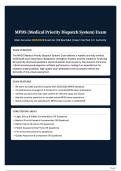
MPDS (Medical Priority Dispatch System) Exam
Most Accurate 2025/2026 Exam Set | 89 Real Q&A | Expert-Verified | A+ Authority
EXAM OVERVIEW
The MPDS (Medical Priority Dispatch System) Exam delivers a realistic and fully verified
2025/2026 exam experience designed to strengthen mastery and test readiness. Featuring
89 carefully structured questions and professional-level accuracy, this resource enhances
critical reasoning and supports confident performance, making it an essential tool for
students seeking reliable, high-quality exam preparation that accurately reflects the
demands of the actual assessment.
EXAM FEATURES
• 89 exam-accurate questions aligned with 2025/2026 MPDS standards
• Comprehensive coverage of 6 domains for complete MPDS exam preparation
• Verified accuracy and high-yield content for efficient study and review
• Realistic practice questions to simulate actual MPDS exam experience
• Builds confidence and expertise for MPDS exam success in 2025/2026
CORE TESTING AREAS
→ Legal, Ethical & Safety Considerations (14 Questions)
→ Medical Priority Dispatch Fundamentals (18 Questions)
→ Mpds Protocol Structure (14 Questions)
→ Patient Assessment By Phone (16 Questions)
→ Pre-arrival Instructions (12 Questions)
→ Quality Assurance & Compliance (15 Questions)
Page 1
,Medical Priority Dispatch Fundamentals (18 Questions)
Question 1
In MPDS, which axiom specifically dictates that a caller reporting agonal breathing must be
assigned a Priority 1 (Delta) response?
A. Axiom of Respiratory Distress
B. Axiom of Cardiac Arrest
C. Axiom of Unresponsiveness
D. Axiom of Life Threatening Bleeding
Correct Answer
Axiom of Cardiac Arrest
Rationale:
The Axiom of Cardiac Arrest states that any report of agonal (gasping) breathing indicates a possible cardiac arrest,
requiring the highest priority response.
Question 2
When providing Dispatch Life Support (DLS) instructions for a suspected opioid overdose,
which of the following actions should the EMD NOT include in the initial PDI?
A. Instruct the caller to administer naloxone if available
B. Advise the caller to perform rescue breathing at 10 breaths per minute
C. Tell the caller to place the patient in the recovery position after breathing resumes
D. Direct the caller to start chest compressions immediately
Correct Answer
Advise the caller to perform rescue breathing at 10 breaths per minute
Rationale:
Rescue breathing at 10 breaths per minute is not indicated for opioid overdose; the priority is naloxone
administration and chest compressions if the patient is unresponsive and not breathing.
Page 2
,Question 3
Which of the following best describes the "Priority Principle" that governs the transition from a
Priority 2 (Bravo) to a Priority 1 (Delta) dispatch during a live call?
A. Any change in the patient's skin color to pallor
B. Onset of a new symptom that indicates loss of airway protection
C. Patient's age exceeding 65 years
D. Presence of moderate pain rated 5/10 or higher
Correct Answer
Onset of a new symptom that indicates loss of airway protection
Rationale:
The priority principle requires escalation when a symptom emerges that threatens airway, breathing, or circulation,
such as loss of airway protection.
Question 4
During a medical dispatch, the EMD must evaluate the caller's description of "chest pain
radiating to the left arm". Which MPDS protocol element is primarily used to determine the
appropriate priority level?
A. Chief Complaint Algorithm
B. Secondary Assessment Checklist
C. Medical Priority Dispatch Determinant Matrix
D. Patient Age Modifier
Correct Answer
Medical Priority Dispatch Determinant Matrix
Rationale:
The Determinant Matrix cross-references chief complaint, symptom descriptors, and modifiers to assign the correct
priority.
Page 3
, Question 5
In the context of MPDS, what is the most accurate definition of "Implementation" as it pertains
to the EMD's role?
A. Recording call details for later review
B. Providing the caller with post‑dispatch instructions after the unit arrives
C. Activating the appropriate response tier and delivering real‑time medical guidance
D. Conducting a debriefing session with field personnel after the call
Correct Answer
Activating the appropriate response tier and delivering real‑time medical guidance
Rationale:
Implementation involves the EMD's immediate actions to dispatch resources and give medical direction during the
call.
Question 6
Which of the following scenarios would require the EMD to assume the "Logistics Coordinator"
role rather than the "Life Support Instruction Provider" role?
A. Providing CPR instructions to a bystander
B. Arranging for a specialized cardiac monitor unit to be staged en route
C. Guiding the caller to perform the Heimlich maneuver
D. Instructing the caller to apply a tourniquet for severe limb hemorrhage
Correct Answer
Arranging for a specialized cardiac monitor unit to be staged en route
Rationale:
The Logistics Coordinator role focuses on resource positioning and staging, not direct medical instruction.
Page 4
Most Accurate 2025/2026 Exam Set | 89 Real Q&A | Expert-Verified | A+ Authority
EXAM OVERVIEW
The MPDS (Medical Priority Dispatch System) Exam delivers a realistic and fully verified
2025/2026 exam experience designed to strengthen mastery and test readiness. Featuring
89 carefully structured questions and professional-level accuracy, this resource enhances
critical reasoning and supports confident performance, making it an essential tool for
students seeking reliable, high-quality exam preparation that accurately reflects the
demands of the actual assessment.
EXAM FEATURES
• 89 exam-accurate questions aligned with 2025/2026 MPDS standards
• Comprehensive coverage of 6 domains for complete MPDS exam preparation
• Verified accuracy and high-yield content for efficient study and review
• Realistic practice questions to simulate actual MPDS exam experience
• Builds confidence and expertise for MPDS exam success in 2025/2026
CORE TESTING AREAS
→ Legal, Ethical & Safety Considerations (14 Questions)
→ Medical Priority Dispatch Fundamentals (18 Questions)
→ Mpds Protocol Structure (14 Questions)
→ Patient Assessment By Phone (16 Questions)
→ Pre-arrival Instructions (12 Questions)
→ Quality Assurance & Compliance (15 Questions)
Page 1
,Medical Priority Dispatch Fundamentals (18 Questions)
Question 1
In MPDS, which axiom specifically dictates that a caller reporting agonal breathing must be
assigned a Priority 1 (Delta) response?
A. Axiom of Respiratory Distress
B. Axiom of Cardiac Arrest
C. Axiom of Unresponsiveness
D. Axiom of Life Threatening Bleeding
Correct Answer
Axiom of Cardiac Arrest
Rationale:
The Axiom of Cardiac Arrest states that any report of agonal (gasping) breathing indicates a possible cardiac arrest,
requiring the highest priority response.
Question 2
When providing Dispatch Life Support (DLS) instructions for a suspected opioid overdose,
which of the following actions should the EMD NOT include in the initial PDI?
A. Instruct the caller to administer naloxone if available
B. Advise the caller to perform rescue breathing at 10 breaths per minute
C. Tell the caller to place the patient in the recovery position after breathing resumes
D. Direct the caller to start chest compressions immediately
Correct Answer
Advise the caller to perform rescue breathing at 10 breaths per minute
Rationale:
Rescue breathing at 10 breaths per minute is not indicated for opioid overdose; the priority is naloxone
administration and chest compressions if the patient is unresponsive and not breathing.
Page 2
,Question 3
Which of the following best describes the "Priority Principle" that governs the transition from a
Priority 2 (Bravo) to a Priority 1 (Delta) dispatch during a live call?
A. Any change in the patient's skin color to pallor
B. Onset of a new symptom that indicates loss of airway protection
C. Patient's age exceeding 65 years
D. Presence of moderate pain rated 5/10 or higher
Correct Answer
Onset of a new symptom that indicates loss of airway protection
Rationale:
The priority principle requires escalation when a symptom emerges that threatens airway, breathing, or circulation,
such as loss of airway protection.
Question 4
During a medical dispatch, the EMD must evaluate the caller's description of "chest pain
radiating to the left arm". Which MPDS protocol element is primarily used to determine the
appropriate priority level?
A. Chief Complaint Algorithm
B. Secondary Assessment Checklist
C. Medical Priority Dispatch Determinant Matrix
D. Patient Age Modifier
Correct Answer
Medical Priority Dispatch Determinant Matrix
Rationale:
The Determinant Matrix cross-references chief complaint, symptom descriptors, and modifiers to assign the correct
priority.
Page 3
, Question 5
In the context of MPDS, what is the most accurate definition of "Implementation" as it pertains
to the EMD's role?
A. Recording call details for later review
B. Providing the caller with post‑dispatch instructions after the unit arrives
C. Activating the appropriate response tier and delivering real‑time medical guidance
D. Conducting a debriefing session with field personnel after the call
Correct Answer
Activating the appropriate response tier and delivering real‑time medical guidance
Rationale:
Implementation involves the EMD's immediate actions to dispatch resources and give medical direction during the
call.
Question 6
Which of the following scenarios would require the EMD to assume the "Logistics Coordinator"
role rather than the "Life Support Instruction Provider" role?
A. Providing CPR instructions to a bystander
B. Arranging for a specialized cardiac monitor unit to be staged en route
C. Guiding the caller to perform the Heimlich maneuver
D. Instructing the caller to apply a tourniquet for severe limb hemorrhage
Correct Answer
Arranging for a specialized cardiac monitor unit to be staged en route
Rationale:
The Logistics Coordinator role focuses on resource positioning and staging, not direct medical instruction.
Page 4


