
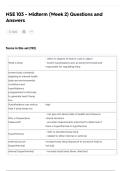
NSE 103 - Midterm (Week 2) Questions and
Answers
Save
Terms in this set (192)
- refers to degree of heat or cold in object
What is temp - brain's hypothalamus acts as body thermostat and
responsible for regulating temp
human body constantly
adapting to internal health
state and environmental
conditions and
hypothalamus
programmed to tell body
to generate heat if temp
low
Hypothalamus can reduce high
heat if body temp too
- can give info about state of health and influence
Why is Temperature clinical decisions
Measured? - accurate measurements important to determine if
there is hyperthermia or hypothermia
- refer to elevated body temp
Hyperthermia
- related to either internal or external
external source increase body temp (exposure to excessive heat ex.
(hyperthermia) hot tub)
internal (hyperthermia) - increase body temp (fever, infection)
, hyperthermia is associated infectious agent such as bacteria or virus --> also
with known as febrile
what happens if lead to cell damage
unresolved hyperthermic
- lowered body temp
external; being exposed to cold for long
hypothermia
internal; surgery, medical condition
- reduce O2
what happens if slow cellular processes --> lead to loss of
unresolved hypothermic consciousness
influencing factor that - age, stress, diurnal cycle, menstruation, preg,
affect temp (6) exercise
- depends on age, cognitive functioning, level of
Methods of Measurement
consciousness, state of health, safety and agency
depends on 5 things
policy
health care providers
choose best method after
considering client safety,
accuracy and least
invasiveness
what is the most accurate invasive method through pulmonary artery catheter --
way to measure core body > only performed in critical care area when constant
temp? measurements required (life saving interventions)
methods of measurement oral, axillary, tympanic, rectal and dermal routes
include (5)
tympanic common in adults both primary and acute setting
can be taken with client that can follow instructions
- over age of 4
oral temp
- determine if client had hot or cold fluid --> take
tympanic or axillary if that is the case
Answers
Save
Terms in this set (192)
- refers to degree of heat or cold in object
What is temp - brain's hypothalamus acts as body thermostat and
responsible for regulating temp
human body constantly
adapting to internal health
state and environmental
conditions and
hypothalamus
programmed to tell body
to generate heat if temp
low
Hypothalamus can reduce high
heat if body temp too
- can give info about state of health and influence
Why is Temperature clinical decisions
Measured? - accurate measurements important to determine if
there is hyperthermia or hypothermia
- refer to elevated body temp
Hyperthermia
- related to either internal or external
external source increase body temp (exposure to excessive heat ex.
(hyperthermia) hot tub)
internal (hyperthermia) - increase body temp (fever, infection)
, hyperthermia is associated infectious agent such as bacteria or virus --> also
with known as febrile
what happens if lead to cell damage
unresolved hyperthermic
- lowered body temp
external; being exposed to cold for long
hypothermia
internal; surgery, medical condition
- reduce O2
what happens if slow cellular processes --> lead to loss of
unresolved hypothermic consciousness
influencing factor that - age, stress, diurnal cycle, menstruation, preg,
affect temp (6) exercise
- depends on age, cognitive functioning, level of
Methods of Measurement
consciousness, state of health, safety and agency
depends on 5 things
policy
health care providers
choose best method after
considering client safety,
accuracy and least
invasiveness
what is the most accurate invasive method through pulmonary artery catheter --
way to measure core body > only performed in critical care area when constant
temp? measurements required (life saving interventions)
methods of measurement oral, axillary, tympanic, rectal and dermal routes
include (5)
tympanic common in adults both primary and acute setting
can be taken with client that can follow instructions
- over age of 4
oral temp
- determine if client had hot or cold fluid --> take
tympanic or axillary if that is the case


