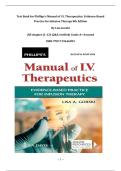
Test Bank for Phillips’s Manual of I.V. Therapeutics: Evidence-Based
Practice for Infusion Therapy 8th Edition
By Lisa Gorski
|All chapter (1-12) |Q&A verified| Grade A+ Assured
ISBN 9781719646093
~1~
, TABLE OF CONTENTS
Chapter 1: Professional Practice Concepts for Infusion Therapy ......................... 3
Chapter 2: Infection Prevention and Occupational Risks ................................... 24
Chapter 3: Fundamentals of Fluid and Electrolyte Balance ................................ 32
Chapter 4: Parenteral Solutions........................................................................... 48
Chapter 5: Infusion Equipment............................................................................ 50
Chapter 6: Peripheral I.V. Catheters: Initiation and Maintenance of Peripheral
Infusion Therapy.................................................................................................. 55
Chapter 7: Phlebotomy Techniques ..................................................................... 70
Chapter 8: Complications of Infusion Therapy: Peripheral and Central Vascular
Access Devices ...................................................................................................... 76
Chapter 9: Complications of Infusion Therapy: Peripheral and Central Vascular
Access Devices ...................................................................................................... 85
Chapter 10: Infusion Medication Safety, Methods, and Routes ........................... 94
Chapter 11: TransfusionTherapy ........................................................................ 100
Chapter 12: Parenteral Nutrition........................................................................ 111
~2~
,Chapter 1: Professional Practice Concepts for Infusion Therapy
Multiple Choice
Identify the choice that best completes the statement or Answerthe question.
1. A nurse is attempting to initiate I.V. therapy for a client diagnosed with
gastroenteritis. The client is combative and resists the nurse’s efforts to start the I.V.
Which action by the nurse would result in an intentional tort?
A. Failing to document the client’s combativeness
B. Refusing to wear gloves while starting the I.V.
C. Failing to report the client’s combativeness to a physician
D. Starting an I.V. on a coherent client against the client’s wishes
2. A nurse who is caring for clients understands that he or she should provide care
that meets at least the minimum standards of practice for nursing. Which phrase
regarding standards of practice is most accurate?
A. Standards of practice focus on the care provider and define needed activities and
behaviors.
B. Standards of practice focus on the recipient of care and describe the outcomes of
care.
C. Standards of practice are written laws enacted by the legislature.
D. Standards of practice are the result of the performance of a function or process.
3. Which incident would cause a nurse to be named as a defendant in a malpractice
suit?
A. The nurse notes blood return noted in a peripheral IV catheter line.
B. The nurse reports early signs of infection from a peripheral line inserted by a
nurse on another unit
C. The nurse places two peripheral IV catheters in a patient requiring emergency IV
fluids, but only uses one
D. The nurse records nerve damage caused by a peripheral IV catheter inserted the
previous shift nurse
~3~
, 4.The intravenous route is the most commonly used infusion route. The nurse notes that
a client diagnosed with metastatic cancer is receiving an intraosseous infusion. Should
the nurse question the healthcare pro- vider’s order?
A. Yes; the healthcare provider is not following INS recommendations.
B. No; the nurse should never question the healthcare provider’s order when it
comes to chemother- apy.
C. Yes; this route of infusion is dangerous and not accepted by the INS.
D. No; other routes might be appropriate for administration in certain situations
and with selected fluids and medications.
5. Which competency assessment method is acceptable for nursing competencies
which will occur once per year in the skilled nursing facility?
A. Client Evaluation
B. Clinical Data
C. Sentinel Event Report
D. Skills Checklist
6. One of the primary values of the INS designation of CRNI (certified registered
nurse, infusion) is to: A. Protect the public
B. Attain competence
C. Reflect a measurable goal
D. Hold nurses accountable
7. Which problem-solving approach to clinical practice is the nurse manager
applying when determining patient preference and values for successful clinical
outcomes?
A. Effective health-care practice
B. Evidence-based practice (EBP)
C. Answeringa burning clinical question
D. One’s own clinical expertise
~4~
Practice for Infusion Therapy 8th Edition
By Lisa Gorski
|All chapter (1-12) |Q&A verified| Grade A+ Assured
ISBN 9781719646093
~1~
, TABLE OF CONTENTS
Chapter 1: Professional Practice Concepts for Infusion Therapy ......................... 3
Chapter 2: Infection Prevention and Occupational Risks ................................... 24
Chapter 3: Fundamentals of Fluid and Electrolyte Balance ................................ 32
Chapter 4: Parenteral Solutions........................................................................... 48
Chapter 5: Infusion Equipment............................................................................ 50
Chapter 6: Peripheral I.V. Catheters: Initiation and Maintenance of Peripheral
Infusion Therapy.................................................................................................. 55
Chapter 7: Phlebotomy Techniques ..................................................................... 70
Chapter 8: Complications of Infusion Therapy: Peripheral and Central Vascular
Access Devices ...................................................................................................... 76
Chapter 9: Complications of Infusion Therapy: Peripheral and Central Vascular
Access Devices ...................................................................................................... 85
Chapter 10: Infusion Medication Safety, Methods, and Routes ........................... 94
Chapter 11: TransfusionTherapy ........................................................................ 100
Chapter 12: Parenteral Nutrition........................................................................ 111
~2~
,Chapter 1: Professional Practice Concepts for Infusion Therapy
Multiple Choice
Identify the choice that best completes the statement or Answerthe question.
1. A nurse is attempting to initiate I.V. therapy for a client diagnosed with
gastroenteritis. The client is combative and resists the nurse’s efforts to start the I.V.
Which action by the nurse would result in an intentional tort?
A. Failing to document the client’s combativeness
B. Refusing to wear gloves while starting the I.V.
C. Failing to report the client’s combativeness to a physician
D. Starting an I.V. on a coherent client against the client’s wishes
2. A nurse who is caring for clients understands that he or she should provide care
that meets at least the minimum standards of practice for nursing. Which phrase
regarding standards of practice is most accurate?
A. Standards of practice focus on the care provider and define needed activities and
behaviors.
B. Standards of practice focus on the recipient of care and describe the outcomes of
care.
C. Standards of practice are written laws enacted by the legislature.
D. Standards of practice are the result of the performance of a function or process.
3. Which incident would cause a nurse to be named as a defendant in a malpractice
suit?
A. The nurse notes blood return noted in a peripheral IV catheter line.
B. The nurse reports early signs of infection from a peripheral line inserted by a
nurse on another unit
C. The nurse places two peripheral IV catheters in a patient requiring emergency IV
fluids, but only uses one
D. The nurse records nerve damage caused by a peripheral IV catheter inserted the
previous shift nurse
~3~
, 4.The intravenous route is the most commonly used infusion route. The nurse notes that
a client diagnosed with metastatic cancer is receiving an intraosseous infusion. Should
the nurse question the healthcare pro- vider’s order?
A. Yes; the healthcare provider is not following INS recommendations.
B. No; the nurse should never question the healthcare provider’s order when it
comes to chemother- apy.
C. Yes; this route of infusion is dangerous and not accepted by the INS.
D. No; other routes might be appropriate for administration in certain situations
and with selected fluids and medications.
5. Which competency assessment method is acceptable for nursing competencies
which will occur once per year in the skilled nursing facility?
A. Client Evaluation
B. Clinical Data
C. Sentinel Event Report
D. Skills Checklist
6. One of the primary values of the INS designation of CRNI (certified registered
nurse, infusion) is to: A. Protect the public
B. Attain competence
C. Reflect a measurable goal
D. Hold nurses accountable
7. Which problem-solving approach to clinical practice is the nurse manager
applying when determining patient preference and values for successful clinical
outcomes?
A. Effective health-care practice
B. Evidence-based practice (EBP)
C. Answeringa burning clinical question
D. One’s own clinical expertise
~4~