

Written by students who passed Immediately available after payment Read online or as PDF Wrong document? Swap it for free 4.6 TrustPilot
logo-home
Document preview thumbnail
Preview 2 out of 5 pages
Exam (elaborations)

OCS9 – Cardiovascular, Lymphatic, and Thoracic Inlet Exam | 60+ Verified Q&A | CT & CXR Reading, Valve Landmarks, HVLA & TART | 2025/2026

Document preview thumbnail
Preview 2 out of 5 pages

This document provides 60+ expert-verified, clinically integrated questions and answers from the OCS9 (Objective Clinical Skills – Week 19 PQ/OCS/OMM) module at Medical University, for the 2025/2026 academic year. It integrates radiological interpretation, cardiovascular history-taking, lymphatic histology, and osteopathic physical exam techniques for the thoracic inlet and ribs, equipping students for OSCEs, practical exams, and board-style clinical reasoning. Covered content includes: Radiology Skills: Interpretation of axial CT images of the chest and systematic reading of PA/AP chest X-rays, emphasizing stepwise analysis of lung fields, mediastinum, cardiac silhouette, and diaphragm position. Lymphatic System Microanatomy: Structure and function of lymph vessels, diffuse vs nodular lymphatic tissue, and microscopic anatomy of tonsils, lymph nodes, thymus, and spleen. Lymphedema vs Cardiac Edema: Pathophysiology of primary vs secondary lymphedema, how it differs from cardiac-origin edema, and how to assess underlying systemic vs localized dysfunction. Cardiac Illness Scripts: Clinical presentation, pathophysiology, and differential diagnosis of: Atrial fibrillation due to mitral stenosis Supraventricular tachycardia (SVT) Hyperthyroidism Ventricular septal defects (VSD) Cardiac History & Physical Exam: Focused interviewing for chest pain and cardiac complaints using HPI, PMH, Meds, ROS, Allergies, SocHx, and corresponding auscultation landmarks for all valves: aortic, pulmonic, tricuspid, mitral. Osteopathic Exam & Treatment: Perform and document TART findings for the thoracic inlet Diagnose and treat somatic dysfunction of the thoracic inlet and ribs Implement techniques such as rib raising, thoracic soft tissue, HVLA for ribs, and thoracic hyperextension Classify HVLA and articulatory techniques by activity and direction (active/passive, direct/indirect) Discuss indications, contraindications, and safety considerations for OMM in the thoracic region Ideal for: MD/DO students preparing for OSCEs, COMLEX/USMLE exams, and physical exam assessments PA and Nursing students reviewing CV and lymphatic systems and learning auscultation and imaging interpretation Learners in OMM-intensive programs focused on rib mechanics and thoracic inlet assessments Keywords: chest CT interpretation, chest X-ray analysis, lymph node histology, lymphedema vs edema, cardiac auscultation, thoracic inlet exam, rib HVLA, TART findings, atrial fibrillation, supraventricular tachycardia, VSD, hyperthyroidism, lymphatic vessels, thymus, spleen histology, osteopathic rib treatment, OMM thoracic inlet

Content preview

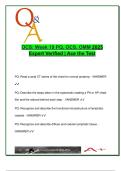
OCS: Week 19 PQ, OCS, OMM 2025
Expert Verified | Ace the Test


PQ: Read a axial CT series of the chest for normal anatomy - 🧠ANSWER

✔✔


PQ: Describe the steps taken in the systematic reading a PA or AP chest

film and the rational behind each step. - 🧠ANSWER ✔✔


PQ: Recognize and describe the functional microstructure of lymphatic

vessels - 🧠ANSWER ✔✔


PQ: Recognize and describe diffuse and nodular lymphatic tissue -

🧠ANSWER ✔✔

, PQ: Recognize and describe the functional microstructure of tonsils, lymph

nodes, thymus and spleen - 🧠ANSWER ✔✔


PQ: Describe the pathophysiology of primary and secondary lymphedema

and differentiate it from edema of cardiac origin. - 🧠ANSWER ✔✔


PQ: Describe the natural history, clinical presentation and differential

diagnosis of:


1.) Atrial fibrillation secondary to mitral valve stenosis

2.) Supraventricular tachycardia

3.) Hyperthyroidism


4.) Ventricular septal defects opens in new window - 🧠ANSWER ✔✔


CS: Obtain an appropriate patient history (HPI, PMSFSocHX, Meds, Alg,

ROS) for a patient with a cardiac complaint - 🧠ANSWER ✔✔


CS: Identify and give a rationale for the relevant systems to include in ROS

for a given complaint based on anatomical, biochemical and physiological

principles and differential diagnosis. - 🧠ANSWER ✔✔

Document information

Uploaded on
December 15, 2025
Number of pages
5
Written in
2025/2026
Type
Exam (elaborations)
Contains
Questions & answers
$15.99

Wrong document? Swap it for free Within 14 days of purchase and before downloading, you can choose a different document. You can simply spend the amount again.
Written by students who passed
Immediately available after payment
Read online or as PDF

Seller avatar
Reputation scores are based on the amount of documents a seller has sold for a fee and the reviews they have received for those documents. There are three levels: Bronze, Silver and Gold. The better the reputation, the more your can rely on the quality of the sellers work.
JOSHCLAY
3.6
(87)
Sold
401
Followers
15
Items
20795
Last sold
2 days ago


Why students choose Stuvia

Created by fellow students, verified by reviews

Quality you can trust: written by students who passed their tests and reviewed by others who've used these notes.

Didn't get what you expected? Choose another document

No worries! You can instantly pick a different document that better fits what you're looking for.

Pay as you like, start learning right away

No subscription, no commitments. Pay the way you're used to via credit card and download your PDF document instantly.

Student with book image

“Bought, downloaded, and aced it. It really can be that simple.”

Alisha Student

Working on your references?

Create accurate citations in APA, MLA and Harvard with our free citation generator.

Working on your references?

Frequently asked questions

