
FTCE ESE EXAM QUESTIONS AND ANSWERS
Save
Terms in this set (53)
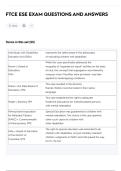
Individuals with Disabilities represents the latest phase in the philosophy
Education Act (IDEA) of educating children with disabilities
While this case specifically addressed the
Brown v. Board of inequality of "separate but equal" facilities on the basis
Education, of race, the concept that segregation was inherently
1954 unequal—even if facilities were provided—was later
applied to handicapping conditions.
This case resulted in the decision
Diana v. the State Board of
that all children must be tested in their native
Education, 1970
language
This case established the right to adequate
Wyatt v. Stickney, 1971 treatment (education) for institutionalized persons
with mental retardation
Pennsylvania Association Special Education was guaranteed to children with
for Retarded Citizens mental retardation. The victory in this case sparked
(PARC) v. Commonwealth other court cases for children with
of Pennsylvania, 1972 other disabilities
The right to special education was extended to all
Mills v. Board of Education
children with disabilities, not just mentally retarded
of the District of
children. Judgments in PARC and Mills paved the way
Columbia, 1972
for P.L. 94-142
, The first comprehensive federal statute to address
Public Law 93-112 specifically the rights of disabled youth. It prohibited
(Rehabilitation illegal discrimination in education, employment, or
Amendments of 1973) housing on the
basis of a disability
Section 504 expands an older law by extending its
protection to other areas that receive federal
assistance, such as education. Protected individuals
must (a) have a physical or mental impairment that
substantially limits one or more major life activities,
such as self-care,
Section 504, Rehabilitation
walking, seeing, breathing, working, or learning
Act of 1973
; (b) have a record of such an impairment
; or (c) be regarded as having such an impairment. A
disability in itself is not sufficient grounds for a
complaint of discrimination. The person must be
otherwise qualified, or able to meet, the requirements
of the program in question
Public Law 94-142 is the funding portion of this act. It
required states to provide full educational
Public Law 93-380
opportunities for children with disabilities. It
(Education Amendments
addressed identification, fair
of 1974):
evaluation, alternative placements, due process
procedures, and free, appropriate public education.
This law provided for a free, appropriate public
education for all children with disabilities, defined
special education and related services, and imposed
Public Law 94-142 rigid guidelines on the provisions of those services.
(Education for all (Refer to Objectives 2 and 3 in this section). It
Handicapped Children paralleled the provision for a free and appropriate
Act), 1975 public education in Section in 504 of Public Law 94-
142 and extended these services to preschool
children with disabilities (ages 3-5) through provisions
to preschool incentive grants.


