Calculus II Chapter 5
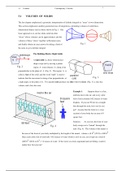
The last chapter emphasized a geometric interpretation of definite integrals as "areas" in two dimensions. This section emphasizes another geometrical use of integration, calculating volumes of solid three– dimensional objects such as those shown in Fig. 1. Our basic approach is to cut the whole solid into thin "slices" whose volumes can be approximated, add the volumes of these "slices" together (a Riemann sum), and finally obtain an exact answer by taking a limit of the sums to get a definite integral. The Building Blocks: Right Solids A right solid is a three–dimensional shape swept out by moving a planar region A some distance h along a line perpendicular to the plane of A (Fig. 2). The region A is called a face of the solid, and the word "right" is used to indicate that the movement is along a line perpendicular, at a right angle, to the plane of A. Two parallel cuts produce one slice with two faces (Fig. 3): a slice has volume, and a face has area. Example 1: Suppose there is a fine, uniform mist in the air, and every cubic foot of mist contains 0.02 ounces of water droplets. If you run 50 feet in a straight line through this mist, how wet do you get? Assume that the front (or a cross section) of your body has an area of 8 square feet. Solution: As you run, the front of your body sweeps out a "tunnel" through the mist (Fig. 4). The volume of the tunnel is the area of the front of your body multiplied by the length of the tunnel: volume = (8 ft2 )(50 ft) = 400 ft3 . Since each cubic foot of mist held 0.02 ounces of water which is now on you, you swept out a total of (400 ft3 ). (0.02 oz/ft3 ) = 8 ounces of water. If the water was truly suspended and not falling, would it matter how fast you ran? 5.1 Volumes Contemporary Calculus 2 If A is a rectangle (Fig. 5), then the "right solid" formed by moving A along the line is a 3–dimensional solid box B. The volume of B is (area of A). (distance along the line) = (base). (height). (width). If A is a circle with radius r meters (Fig. 6), then the "right solid" formed by moving A along the line h meters is a right circular cylinder with volume equal to {area of A}. {distance along the line} = { π (r ft)2 }. {h ft} = { π. r 2 ft2 }. { h ft } = π r 2h ft3 .
Document information
- Uploaded on
- February 18, 2021
- Number of pages
- 89
- Written in
- 2020/2021
- Type
- Exam (elaborations)
- Contains
- Questions & answers