
D459 TASK 1 2 AND 3 WGU 2026 EXAM
SCRIPT COMPLETE QUESTIONS AND
SOLUTIONS GRADED A+
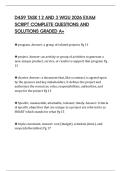
◉ program. Answer: a group of related projects Pg 13
◉ project. Answer: an activity or group of activities to generate a
new, unique product, service, or results to support that program Pg
13
◉ charter. Answer: a document that, like a contract, is agreed upon
by the sponsor and key stakeholders. It defines the project and
authorizes the resources, roles, responsibilities, authorities, and
scope for the project Pg 13
◉ Specific, measurable, attainable, relevant, timely. Answer: Criteria
of specific objectives that are unique to a project are referred to as
SMART which stands for what Pg 15
◉ triple constraint. Answer: cost (budget), schedule (time), and
scope (deliverables) Pg 17
,◉ stakeholder analysis. Answer: analysis to define the relevant
stakeholders, their interests, and their communication needs Pg 19
◉ Change Control Board (CCB). Answer: a group of people who track
changes in a project and can be used as a governance tool Pg 19
◉ Work Breakdown Structures (WBS). Answer: a key tool so that
people understand what is expected of them and how they will be
held accountable Pg 21
◉ Project Management Institute (PMI). Answer: Founded in 1969,
it's headquartered in Newton, PA, and has member chapters on
every continent (except Antarctica). Publishes foundational and
practice standards and is the largest in the world. Pg 22
◉ Association for Project Management (APM). Answer: A UK-based
charter organization that is the largest professional body of its kind
in Europe. Formed in 1972, it's membership is primarily limited to
the United Kingdom. Pg 22
◉ International Project Management Association (IPMA). Answer:
the world's first project management association, founded in 1965.
The leading authority on competent project, programme, and
portfolio management (PPPM) Pg 22
, ◉ AXELOS, Ltd. Answer: a joint venture between the government of
the United Kingdom and Captia PLC. It was formed to manage and
grow a number of standards and associated certifications developed
by the Cabinet office, including ITIL (Information Technology
Infrastructure Library), PRINCE2, and Managing Successful
Programs (MSP). Pg 22
◉ Functional (Departmentalized) Organization pros/cons. Answer:
Pros: Lines of authority are clear; work is easily prioritized by
identified departmental authority
Cons: Utilizing resources across functions can be difficult; project is
not managed holistically
◉ Projectized Organization pros and cons. Answer: Pros: Clear lines
of authority; project is managed holistically; gain historical data
from prior projects.
Cons: Approach is expensive because of the duplication of
personnel; SME assigned may not have the most appropriate
knowledge or expertise for the project
◉ Matrix Organization pros and cons. Answer: Pros: Central focus is
the project; issues are responded to quickly.
SCRIPT COMPLETE QUESTIONS AND
SOLUTIONS GRADED A+
◉ program. Answer: a group of related projects Pg 13
◉ project. Answer: an activity or group of activities to generate a
new, unique product, service, or results to support that program Pg
13
◉ charter. Answer: a document that, like a contract, is agreed upon
by the sponsor and key stakeholders. It defines the project and
authorizes the resources, roles, responsibilities, authorities, and
scope for the project Pg 13
◉ Specific, measurable, attainable, relevant, timely. Answer: Criteria
of specific objectives that are unique to a project are referred to as
SMART which stands for what Pg 15
◉ triple constraint. Answer: cost (budget), schedule (time), and
scope (deliverables) Pg 17
,◉ stakeholder analysis. Answer: analysis to define the relevant
stakeholders, their interests, and their communication needs Pg 19
◉ Change Control Board (CCB). Answer: a group of people who track
changes in a project and can be used as a governance tool Pg 19
◉ Work Breakdown Structures (WBS). Answer: a key tool so that
people understand what is expected of them and how they will be
held accountable Pg 21
◉ Project Management Institute (PMI). Answer: Founded in 1969,
it's headquartered in Newton, PA, and has member chapters on
every continent (except Antarctica). Publishes foundational and
practice standards and is the largest in the world. Pg 22
◉ Association for Project Management (APM). Answer: A UK-based
charter organization that is the largest professional body of its kind
in Europe. Formed in 1972, it's membership is primarily limited to
the United Kingdom. Pg 22
◉ International Project Management Association (IPMA). Answer:
the world's first project management association, founded in 1965.
The leading authority on competent project, programme, and
portfolio management (PPPM) Pg 22
, ◉ AXELOS, Ltd. Answer: a joint venture between the government of
the United Kingdom and Captia PLC. It was formed to manage and
grow a number of standards and associated certifications developed
by the Cabinet office, including ITIL (Information Technology
Infrastructure Library), PRINCE2, and Managing Successful
Programs (MSP). Pg 22
◉ Functional (Departmentalized) Organization pros/cons. Answer:
Pros: Lines of authority are clear; work is easily prioritized by
identified departmental authority
Cons: Utilizing resources across functions can be difficult; project is
not managed holistically
◉ Projectized Organization pros and cons. Answer: Pros: Clear lines
of authority; project is managed holistically; gain historical data
from prior projects.
Cons: Approach is expensive because of the duplication of
personnel; SME assigned may not have the most appropriate
knowledge or expertise for the project
◉ Matrix Organization pros and cons. Answer: Pros: Central focus is
the project; issues are responded to quickly.


