

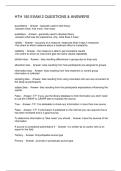
HTH 150 EXAM 2 QUESTIONS & ANSWERS
quantitative - Answer --basically used to test theory
-answers what, how much, how many
qualitative - Answer --generally used to develop theory
-answers what was the experience, why, what does it mean
validity - Answer --accuracy of a measure, measures what it says it measures
-the extent to which evidence about a treatment effect is trustworthy
reliability - Answer --the measure is able to get consistent results
-the extent to which an instrument gets the same results repeatedly
attrition bias - Answer --bias resulting differences in groups due to drop outs
allocation bias - Answer -bias resulting from how participants are assigned to groups
information bias - Answer -bias resulting from how treatment or control group
information is collected
sampling bias - Answer -bias resulting from using volunteers who are are convenient to
the study as participants
subject bias - Answer -bias resulting from the participants expectations influencing the
results
False - Answer -T/F: If you use the library database to find information you don't need
to use the CRAAP or CAARP test to evaluate the source.
True - Answer -T/F: It is advisable to check any information in more than one source.
False - Answer -T/F: If information if published on the internet you can assume that is
has been reviewed and is a good source.
To determine information is "fake news" you should - Answer -trace the sources of the
information
A source is considered authoritative if - Answer -it is written by an author who is an
expert in the field
Tertiary - Answer -Encyclopedia source type
Primary - Answer -Journals or periodicals source type
quantitative - Answer --basically used to test theory
-answers what, how much, how many
qualitative - Answer --generally used to develop theory
-answers what was the experience, why, what does it mean
validity - Answer --accuracy of a measure, measures what it says it measures
-the extent to which evidence about a treatment effect is trustworthy
reliability - Answer --the measure is able to get consistent results
-the extent to which an instrument gets the same results repeatedly
attrition bias - Answer --bias resulting differences in groups due to drop outs
allocation bias - Answer -bias resulting from how participants are assigned to groups
information bias - Answer -bias resulting from how treatment or control group
information is collected
sampling bias - Answer -bias resulting from using volunteers who are are convenient to
the study as participants
subject bias - Answer -bias resulting from the participants expectations influencing the
results
False - Answer -T/F: If you use the library database to find information you don't need
to use the CRAAP or CAARP test to evaluate the source.
True - Answer -T/F: It is advisable to check any information in more than one source.
False - Answer -T/F: If information if published on the internet you can assume that is
has been reviewed and is a good source.
To determine information is "fake news" you should - Answer -trace the sources of the
information
A source is considered authoritative if - Answer -it is written by an author who is an
expert in the field
Tertiary - Answer -Encyclopedia source type
Primary - Answer -Journals or periodicals source type


