
LCSW Exam Prep (2025) UPDATE Verified Questions And Answers | With
100% Correct Answers graded A+ Guaranteed Success!!
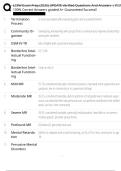
1. Termination Is most associated with evaluating goals and accomplishments
Process
2. Community Or- Developing and working with groups from a community to improve relationships
ganizer among the residents
3. DSM-IV-TR Most helpful with assessment interpretation
4. Borderline Intel- IQ 71-84
lectual Function-
ing
5. Borderline Intel- Code on Axis II
lectual Function-
ing
6. Mild MR 55-70, considered educable, minimal assistance, may need some supervision and
guidance, live in community or in supervised settings
7. Moderate MR 35-55, considered trainable, able to preform at 2nd grade level, moderate super-
vision, can attend to their own personal care, can perform unskilled or semi-skilled
work, can live in the community
8. Severe MR 20-35, considered trainable, generally institutionalize, have little or no commu-
nicative speech, possible group home.
9. Profound MR IQ below 20, generally total care
10. Mental Retarda- Deficits in adaptive and social functioning, an IQ of 70 or less, onset prior to age
tion 18.
11. Pervasive Mental
Disorders
, LCSW Exam Prep (2025) UPDATE Verified Questions And Answers | With
100% Correct Answers graded A+ Guaranteed Success!!
Involves multiple functions and behaviors are not considered normal at any age.
Impairment in reciprocal interaction, verbal and nonverbal skills, imaginative
activity, and intellectual skills
12. Autistic Disorder Age of onset requirement is age 3, self-stimulating, self injuring behaviors often
present, such as, rocking, spinning, head banging.
13. Rett's Disorder Only in females, deceleration of head growth, start out normal and 5 to 24 months
problems develop, loss of previously acquired hand skills, loss of social engage-
ment, appearance of stereotyped movements, impaired language functioning
generally associated with severe or profound mental retardation
14. Childhood Disin- Normal development for two years then a drastic decline followed by a loss of
tegrative Disor- previously acquired skills, and development of autistic like symptoms
der
15. Asperger's Disor- Autistic like symptoms without language impairment, severely impaired social
der interaction, these children often have normal to above normal intelligence
16. ADHD symptoms must persist for atleast 6 months, predominately inattentive, hyperac-
tivity-impulsivity, combined. Generally before age 7.
17. Conduct Disor- Pattern of behavior that violates rights of others, aggression to people and
der animale, deceitfulness or theft, destruction of property, serious violations of rules
18. Tourette's Disor- vocal and motor tics, onset before age 18, symptoms must last for a at least a year.
der
19. Enuresis Elimination or urine during day or night, must be age 5 before it can be diagnosed
20. Encopresis Elimination of feces or soiling in inappropriate places; occurs one time a month
for 3 months, must be at least 4 years of age to diagnose
, LCSW Exam Prep (2025) UPDATE Verified Questions And Answers | With
100% Correct Answers graded A+ Guaranteed Success!!
21. Seperation Anxi- Excessive anxiety over separation from home or whom attached, must last 4 weeks
ety Disorder and begin before age 18.
22. Stranger Anxiety A normal reaction experienced by an infant when startled or feeling threatened.
23. Separation Anxi- Feelings of anxiety and fear that result after being separated from a significant
ety other, such as, parent or partner.
24. Selective Mutism At least 1 month in duration, an inability to speak or understand spoken language
25. Delirium Clouded sensorium, brief duration, can happen in young and old
26. Dementia No clouded sensorium, long duration, must have disturbance in occupational and
social functioning, characterized by multiple cognitive deficits.
27. Substance Abuse Continue use knowing it is causing harm
28. Substance De- Needs to take larger amounts with unsuccessful attempts to quit
pendence
29. Substance Intoxi- Recent ingestion of psychoactive substance
cation
30. Substance With- Maladaptive cognitive and behavioral declines due to reduction of a substance
drawal
31. Substance abuse 12 months
is considered to
be in remission
32. Schizophrenic, Marked incoherence, lack of systematized delusions, silly affect
Disorganized
Type
100% Correct Answers graded A+ Guaranteed Success!!
1. Termination Is most associated with evaluating goals and accomplishments
Process
2. Community Or- Developing and working with groups from a community to improve relationships
ganizer among the residents
3. DSM-IV-TR Most helpful with assessment interpretation
4. Borderline Intel- IQ 71-84
lectual Function-
ing
5. Borderline Intel- Code on Axis II
lectual Function-
ing
6. Mild MR 55-70, considered educable, minimal assistance, may need some supervision and
guidance, live in community or in supervised settings
7. Moderate MR 35-55, considered trainable, able to preform at 2nd grade level, moderate super-
vision, can attend to their own personal care, can perform unskilled or semi-skilled
work, can live in the community
8. Severe MR 20-35, considered trainable, generally institutionalize, have little or no commu-
nicative speech, possible group home.
9. Profound MR IQ below 20, generally total care
10. Mental Retarda- Deficits in adaptive and social functioning, an IQ of 70 or less, onset prior to age
tion 18.
11. Pervasive Mental
Disorders
, LCSW Exam Prep (2025) UPDATE Verified Questions And Answers | With
100% Correct Answers graded A+ Guaranteed Success!!
Involves multiple functions and behaviors are not considered normal at any age.
Impairment in reciprocal interaction, verbal and nonverbal skills, imaginative
activity, and intellectual skills
12. Autistic Disorder Age of onset requirement is age 3, self-stimulating, self injuring behaviors often
present, such as, rocking, spinning, head banging.
13. Rett's Disorder Only in females, deceleration of head growth, start out normal and 5 to 24 months
problems develop, loss of previously acquired hand skills, loss of social engage-
ment, appearance of stereotyped movements, impaired language functioning
generally associated with severe or profound mental retardation
14. Childhood Disin- Normal development for two years then a drastic decline followed by a loss of
tegrative Disor- previously acquired skills, and development of autistic like symptoms
der
15. Asperger's Disor- Autistic like symptoms without language impairment, severely impaired social
der interaction, these children often have normal to above normal intelligence
16. ADHD symptoms must persist for atleast 6 months, predominately inattentive, hyperac-
tivity-impulsivity, combined. Generally before age 7.
17. Conduct Disor- Pattern of behavior that violates rights of others, aggression to people and
der animale, deceitfulness or theft, destruction of property, serious violations of rules
18. Tourette's Disor- vocal and motor tics, onset before age 18, symptoms must last for a at least a year.
der
19. Enuresis Elimination or urine during day or night, must be age 5 before it can be diagnosed
20. Encopresis Elimination of feces or soiling in inappropriate places; occurs one time a month
for 3 months, must be at least 4 years of age to diagnose
, LCSW Exam Prep (2025) UPDATE Verified Questions And Answers | With
100% Correct Answers graded A+ Guaranteed Success!!
21. Seperation Anxi- Excessive anxiety over separation from home or whom attached, must last 4 weeks
ety Disorder and begin before age 18.
22. Stranger Anxiety A normal reaction experienced by an infant when startled or feeling threatened.
23. Separation Anxi- Feelings of anxiety and fear that result after being separated from a significant
ety other, such as, parent or partner.
24. Selective Mutism At least 1 month in duration, an inability to speak or understand spoken language
25. Delirium Clouded sensorium, brief duration, can happen in young and old
26. Dementia No clouded sensorium, long duration, must have disturbance in occupational and
social functioning, characterized by multiple cognitive deficits.
27. Substance Abuse Continue use knowing it is causing harm
28. Substance De- Needs to take larger amounts with unsuccessful attempts to quit
pendence
29. Substance Intoxi- Recent ingestion of psychoactive substance
cation
30. Substance With- Maladaptive cognitive and behavioral declines due to reduction of a substance
drawal
31. Substance abuse 12 months
is considered to
be in remission
32. Schizophrenic, Marked incoherence, lack of systematized delusions, silly affect
Disorganized
Type


