
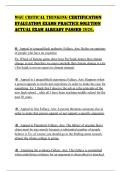
WGU CRITICAL THINKING CERTIFICATION
EVALUATION EXAMS PRACTICE SOLUTION
ACTUAL EXAM ALREADY PASSED 2026.
◍ Appeal to (unqualified) authority Fallacy. Ans: Relies on opinions
of people who have no expertise
Ex: Wheel of fortune game show host Pat Sajak denies that climate
change is real, therefore we must conclude that climate change is a lie
( Pat Sajak is not an expert in climate change)
◍ Appeal to ( unqualified) experience Fallacy. Ans: Happens when
a person appeals to irrelevant experience in order to make the case for
something. Ex: I think that I deserve the job as a the principle of the
new high school... after all I have been teaching middle school for the
past 30 years.
◍ Appeal to fear Fallacy. Ans: A person threatens someone else in
order to make that person support or not support a specific argument.
◍ Appeal to Popularity Fallacy. Ans: The fallacy of arguing that a
claim must be true merely because a substantial number of people
believe it. Ex: of course you should go to the Rolling stone concert,
almost the whole college is going.
◍ Attacking the evidence Fallacy. Ans: This fallacy is committed
when underlying evidence for an argument is discredited or attacked.
, Ex: The dinosaur fossil record does not show that the earth is really
old. It is possible, after all the dinosaurs existed alongside humans
◍ Begging the question Fallacy. Ans: A fallacy in which a claim is
based on evidence or support that is in doubt. Ex: The new ax law is
morally wrong because it is not ethically justified that some people
should have to pay more taxes than others. **When they re-word that
they gave for that conclusion.
◍ Denying inconsistencies Fallacy. Ans: Refusing to admit
contradictions or inconsistencies when making an argument of
defending a position. Ex: I did not really mean to imply that I was
sick and also not sick yesterday. Sometimes the wrong words come
out of my mouth.
◍ Either or Fallacy. Ans: Offering only two alternatives when more
do exist. Ex: Either we start manufacturing a completely new product
or we will lose all of our customers.
◍ Evading Questions. Ans: Avoiding direct and truthful answers to
difficult questions through diversionary tactics, vagueness, or
deliberately confusing or complex responses. Not answering in a
precise manner the issue being asked.
◍ Faulty Analogy. Ans: Occurs when an analogy compares two
things that are not comparable. Assumption that because two things
are alike in one way that they must also be alike in another way. Ex:
Toms motorcycle is red and very fast. Since Johns moped is also red,
it must be the case that it is also very fast.
EVALUATION EXAMS PRACTICE SOLUTION
ACTUAL EXAM ALREADY PASSED 2026.
◍ Appeal to (unqualified) authority Fallacy. Ans: Relies on opinions
of people who have no expertise
Ex: Wheel of fortune game show host Pat Sajak denies that climate
change is real, therefore we must conclude that climate change is a lie
( Pat Sajak is not an expert in climate change)
◍ Appeal to ( unqualified) experience Fallacy. Ans: Happens when
a person appeals to irrelevant experience in order to make the case for
something. Ex: I think that I deserve the job as a the principle of the
new high school... after all I have been teaching middle school for the
past 30 years.
◍ Appeal to fear Fallacy. Ans: A person threatens someone else in
order to make that person support or not support a specific argument.
◍ Appeal to Popularity Fallacy. Ans: The fallacy of arguing that a
claim must be true merely because a substantial number of people
believe it. Ex: of course you should go to the Rolling stone concert,
almost the whole college is going.
◍ Attacking the evidence Fallacy. Ans: This fallacy is committed
when underlying evidence for an argument is discredited or attacked.
, Ex: The dinosaur fossil record does not show that the earth is really
old. It is possible, after all the dinosaurs existed alongside humans
◍ Begging the question Fallacy. Ans: A fallacy in which a claim is
based on evidence or support that is in doubt. Ex: The new ax law is
morally wrong because it is not ethically justified that some people
should have to pay more taxes than others. **When they re-word that
they gave for that conclusion.
◍ Denying inconsistencies Fallacy. Ans: Refusing to admit
contradictions or inconsistencies when making an argument of
defending a position. Ex: I did not really mean to imply that I was
sick and also not sick yesterday. Sometimes the wrong words come
out of my mouth.
◍ Either or Fallacy. Ans: Offering only two alternatives when more
do exist. Ex: Either we start manufacturing a completely new product
or we will lose all of our customers.
◍ Evading Questions. Ans: Avoiding direct and truthful answers to
difficult questions through diversionary tactics, vagueness, or
deliberately confusing or complex responses. Not answering in a
precise manner the issue being asked.
◍ Faulty Analogy. Ans: Occurs when an analogy compares two
things that are not comparable. Assumption that because two things
are alike in one way that they must also be alike in another way. Ex:
Toms motorcycle is red and very fast. Since Johns moped is also red,
it must be the case that it is also very fast.


