
Lecture final study guide
Unit one:
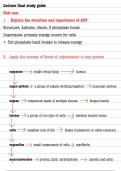
1. Explain the structure and importance of ATP
Structure: Adenine, ribose, 3 phosphate bonds
Importance: primary energy source for cells
• 3rd phosphate band breaks to release energy
2. Apply the concept of levels of organization to any system
organism single living thing human
organ system a group of organs working together muscular system
organs component made of multiple tissues biceps brachii
tissues a group of one type of cells skeletal muscle tissue
cells smallest unit of life blasts (immature) or cytes (mature)
organelles small components of cells myofibrils
macromolecules protein, lipid, carbohydrate myosin and actin
, atoms what molecules are made of calcium
3. Explain the importance of standard anatomical position
It provides a standard reference for directional terms to reduce
confusion when talking about location of structures
4. Apply anatomical terms to describe points on the body
Directional terms:
Superior: above
Inferior: below
Anterior: to the front
Posterior: to the back
Medial: closer to midline
Lateral: further from midline
Proximal: closer to point of attachment
Distal: further from point of attachment
Body planes:
Transverse frontal sagittal
Unit one:
1. Explain the structure and importance of ATP
Structure: Adenine, ribose, 3 phosphate bonds
Importance: primary energy source for cells
• 3rd phosphate band breaks to release energy
2. Apply the concept of levels of organization to any system
organism single living thing human
organ system a group of organs working together muscular system
organs component made of multiple tissues biceps brachii
tissues a group of one type of cells skeletal muscle tissue
cells smallest unit of life blasts (immature) or cytes (mature)
organelles small components of cells myofibrils
macromolecules protein, lipid, carbohydrate myosin and actin
, atoms what molecules are made of calcium
3. Explain the importance of standard anatomical position
It provides a standard reference for directional terms to reduce
confusion when talking about location of structures
4. Apply anatomical terms to describe points on the body
Directional terms:
Superior: above
Inferior: below
Anterior: to the front
Posterior: to the back
Medial: closer to midline
Lateral: further from midline
Proximal: closer to point of attachment
Distal: further from point of attachment
Body planes:
Transverse frontal sagittal


