
I. PSYCHOPHARMACOLOGY
1. NEUROSIGNALING AND NEUROMODULATION
See also: Primer to the nervous system
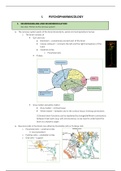
➢ The nervous system exists of the brain (brainstem), spinal cord and peripheral nerves
o The brain consists of
▪ Gyri and sulci
• Brainstem – evolutionary ancient part of the brain
• Corpus collosum – connects the left and the right hemisphere of the
brain
• Cerebral cortex
o Pyramidal cells
▪ 4 lobes
▪ Gray matter and white matter
• Gray matter – cortical tissue
• White matter – between and in the cortical tissue, forming connections
[!] Several brain functions can be explained by changed/different connections
between brain parts (e.g. self-conciousness), so we need to understand the
brain as a dynamic organ
➢ Neurons (cells in the brain) can either be Pyramidal cells or Purkinje cells
o Pyramidal cells – cerebral cortex
=> most prevalent
o Purkinje cells – cerebellar cortex
o Glial cells – support
, 1. Action potentials and synaptic transmission
See also: Primer to the nervous system
➢ An action potential is the functional element of nerve communication. A brain cell receives all
kinds of input: EPSP’s and IPSP’s. These ESPS’s and IPSP’s on the dendritic tree and cell body will
be summed and do or do not depolarize the membrane at initial segment to threshold level,
generating an action potential.
➢ The propagation of action potentials happens due to depolarization (Na + ions are coming free).
The depolarization travels along each single segment of the axon terminal. Each single segment
triggers another segment, resulting in the action potential traveling along the axon.
o Myelinated axons => speed traveling (100 m/s) [!] Higher threshold
o Non myelinated axons => slow traveling (2 m/s)
➢ While the action potential travels along the axon terminal, calcium triggers a process of
release/exocytosis of the synaptic vesicles. The neurotransmitters are then actually released in
the synaptic cleft and diffusion of the neurotransmitter takes place.
➢ Thereafter, the neurotransmitters needs to be removed, to limit the function in time (which is
important for responding to new/other information). So there’s a certain episode of activation vs.
relatively silence.
, 2. The four main types of receptor-effector linkage
➢ When a neurotransmitter is released and reaches the post- synapctic receptor, different ways of
reacting can occur, based on the type of receptor
Ionotropic Metabotropic Kinase-linked Nuclear
receptor receptor receptor receptor
Location Membrane membrane membrane intracellular
Effector ion channel channel or enzyme protein gene
kinases transcription
Coupling Direct G protein or direct via DNA
arrestin
Examples nicotinic muscarinic insulin, steroid
acetylcholine acetylcholine growth receptors
receptor, receptor, factors,
GABAA receptor adrenoreceptors cytokine
receptors
➢ Metabotropic receptors-linkages happens due to first messengers, receptors and second
messengers
o Example: receptor → G-protein → adenylyl cyclase (target enzyme) → cyclic-AMP
(second messenger) → phosphorylation of ion channel (effector) → channel closes
o Bidirectional control of a target enzyme, such as adenylyl cyclase by Gi and Gs: the
heterogeneity of G proteins allow different (inhibitory vs. stimulatory) receptors to exert
opposite effects on a target enzyme
▪ Example: bidirectional control of the production of dopamine
• Inhibitory receptor connects to Gi-protein (-> inhibition) and stimulatory
receptor connects to Gs-protein (-> stimulation)
o Example: receptor → G-protein → phospholipase C (target enzyme) → DAG (second
messenger) → hydrolysis of phospholipids from the membrane and affects the cell
(effector)


