

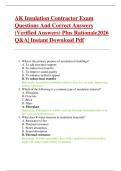
AK Insulation Contractor Exam
Questions And Correct Answers
(Verified Answers) Plus Rationale2026
Q&A| Instant Download Pdf
1. What is the primary purpose of insulation in buildings?
A. To add structural support
B. To reduce heat transfer
C. To improve sound quality
D. To enhance aesthetic appeal
B. To reduce heat transfer
Rationale: Insulation primarily reduces heat loss or gain, improving
energy efficiency.
2. Which of the following is a common type of insulation material?
A. Fiberglass
B. Concrete
C. Brick
D. Glass
A. Fiberglass
Rationale: Fiberglass is widely used for thermal insulation due to its
low cost and effectiveness.
3. What does R-value measure in insulation materials?
A. Resistance to fire
B. Thermal resistance
C. Water absorption
D. Sound absorption
B. Thermal resistance
Rationale: R-value quantifies how well a material resists heat flow;
higher R-value means better insulation.
,4. Which insulation type is typically sprayed into walls or ceilings?
A. Batt insulation
B. Loose-fill insulation
C. Rigid foam board
D. Reflective foil
B. Loose-fill insulation
Rationale: Loose-fill insulation is blown or sprayed to fill cavities and
conform to irregular spaces.
5. Why is vapor barrier important in insulation installation?
A. To prevent insects
B. To reduce moisture migration
C. To increase R-value
D. To support the structure
B. To reduce moisture migration
Rationale: Vapor barriers prevent condensation within walls, which
can cause mold and damage.
6. Which of the following insulation materials is considered
environmentally friendly?
A. Spray foam
B. Cellulose
C. Fiberglass
D. Polystyrene
B. Cellulose
Rationale: Cellulose insulation is made from recycled paper and has
low environmental impact.
7. What is the recommended insulation thickness for attics in cold
climates?
A. 3–6 inches
B. 6–12 inches
C. 12–20 inches
D. 1–2 inches
C. 12–20 inches
Rationale: Greater attic insulation thickness reduces heat loss in cold
climates.
8. Which insulation material is most resistant to fire?
A. Fiberglass
B. Mineral wool
, C. Polystyrene
D. Cellulose
B. Mineral wool
Rationale: Mineral wool is non-combustible and has high fire
resistance.
9. When installing batt insulation, how should it fit between studs?
A. Compressed tightly
B. Slightly loose
C. Cut smaller than cavity
D. Overlap edges
B. Slightly loose
Rationale: Insulation should fill the cavity without compression to
maintain R-value.
10. Which of the following is a key safety concern when handling
fiberglass insulation?
A. Hearing protection
B. Skin irritation
C. Eye strain
D. Weight lifting
B. Skin irritation
Rationale: Fiberglass fibers can irritate skin, eyes, and lungs;
protective gear is recommended.
11. What is the main advantage of spray foam insulation over batt
insulation?
A. Lower cost
B. Higher R-value per inch
C. Easier to install by hand
D. Reusable
B. Higher R-value per inch
Rationale: Spray foam provides superior insulation and air sealing in
tight spaces.
12. In which area is reflective insulation most effective?
A. Exterior walls
B. Roof/attic
C. Basement floors
D. Crawlspaces
B. Roof/attic
Questions And Correct Answers
(Verified Answers) Plus Rationale2026
Q&A| Instant Download Pdf
1. What is the primary purpose of insulation in buildings?
A. To add structural support
B. To reduce heat transfer
C. To improve sound quality
D. To enhance aesthetic appeal
B. To reduce heat transfer
Rationale: Insulation primarily reduces heat loss or gain, improving
energy efficiency.
2. Which of the following is a common type of insulation material?
A. Fiberglass
B. Concrete
C. Brick
D. Glass
A. Fiberglass
Rationale: Fiberglass is widely used for thermal insulation due to its
low cost and effectiveness.
3. What does R-value measure in insulation materials?
A. Resistance to fire
B. Thermal resistance
C. Water absorption
D. Sound absorption
B. Thermal resistance
Rationale: R-value quantifies how well a material resists heat flow;
higher R-value means better insulation.
,4. Which insulation type is typically sprayed into walls or ceilings?
A. Batt insulation
B. Loose-fill insulation
C. Rigid foam board
D. Reflective foil
B. Loose-fill insulation
Rationale: Loose-fill insulation is blown or sprayed to fill cavities and
conform to irregular spaces.
5. Why is vapor barrier important in insulation installation?
A. To prevent insects
B. To reduce moisture migration
C. To increase R-value
D. To support the structure
B. To reduce moisture migration
Rationale: Vapor barriers prevent condensation within walls, which
can cause mold and damage.
6. Which of the following insulation materials is considered
environmentally friendly?
A. Spray foam
B. Cellulose
C. Fiberglass
D. Polystyrene
B. Cellulose
Rationale: Cellulose insulation is made from recycled paper and has
low environmental impact.
7. What is the recommended insulation thickness for attics in cold
climates?
A. 3–6 inches
B. 6–12 inches
C. 12–20 inches
D. 1–2 inches
C. 12–20 inches
Rationale: Greater attic insulation thickness reduces heat loss in cold
climates.
8. Which insulation material is most resistant to fire?
A. Fiberglass
B. Mineral wool
, C. Polystyrene
D. Cellulose
B. Mineral wool
Rationale: Mineral wool is non-combustible and has high fire
resistance.
9. When installing batt insulation, how should it fit between studs?
A. Compressed tightly
B. Slightly loose
C. Cut smaller than cavity
D. Overlap edges
B. Slightly loose
Rationale: Insulation should fill the cavity without compression to
maintain R-value.
10. Which of the following is a key safety concern when handling
fiberglass insulation?
A. Hearing protection
B. Skin irritation
C. Eye strain
D. Weight lifting
B. Skin irritation
Rationale: Fiberglass fibers can irritate skin, eyes, and lungs;
protective gear is recommended.
11. What is the main advantage of spray foam insulation over batt
insulation?
A. Lower cost
B. Higher R-value per inch
C. Easier to install by hand
D. Reusable
B. Higher R-value per inch
Rationale: Spray foam provides superior insulation and air sealing in
tight spaces.
12. In which area is reflective insulation most effective?
A. Exterior walls
B. Roof/attic
C. Basement floors
D. Crawlspaces
B. Roof/attic


