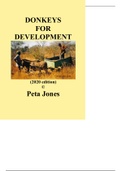
DONKEYS
FOR
DEVELOPMENT
(2020 edition)
©
Peta Jones
,ABOUT USING THE PDF VERSION OF THIS BOOK
Advantages of electronic version
No index has been provided, but of course search/find is easy
enough with electronic versions. Hopefully the headings are
clear enough, and the document short enough, that this will not
arise as problem. In any case, the system of side headings has
been provided specifically to make searching easy for a reader.
The greatest advantage is the capacity for view enlargement, so
that the various labels can be easily read on those figures that
had to be squeezed in order to format a page properly. Of
course, a magnifying glass can be used on a print copy, but the
result would not be as good.
Printing
Each page has been formatted so as be printed at A5 size,
portrait orientation, 14.8 cm wide by 21 cm long. Each chapter
begins with an uneven page number so as to be on top if pages
are printed on both sides of a sheet. Except for a reverse side to
the Table of Contents, there are no blank pages.
, TABLE OF CONTENTS
Diagrams and photographs on nearly
every page
Pages
Introduction i-vi
Ch 1 What it means to have donkeys
The special nature of donkeys and how they can help humans not
1
just through work.
Ch 2 Choosing a good donkey
Considering breeds and behaviour, and ways of judging physical
25
and mental suitability.
Ch 3 The life cycle of donkeys
What may be expected at different stages in a donkey’s long life. 43
Ch 4 Keeping donkeys
What care is needed in different circumtances. Best
61
environments, and also relocating to new ones.
Ch 5 Veterinary considerations
Common health problems and simple remedies What to look for
and what may be serious, including notifiable diseases. How to 77
inject, dose and generally approach treatment.
Ch 6 Equipment suitable for donkeys
Nothing that cannot easily be made or found at home, for a
variety of circumstances. Includes harnessing and hitching.for 101
carts.
Ch 7 Training donkeys
Using the donkey’s intelligence to help it learn, which it often 147
does from other donkeys rather than humans.
Appx A Economic calculations
Some useful formula to heop calculate the costs, savings and profits 163
to be made drom a donkey
Appx B Some medicines
Some repetition, but includes list of poisonous plants and how to deal 169
with snake attack.
Appx C Patterns for equipment
177
Diagrams and suggestions.
Appx D Hitching to carts
191
In more detail.
Glossary
197
Definitions of terms that appear in this and other manuals.
Further sources of information about donkeys 203
, INTRODUCTION
It seems to have taken unreasonably long for development workers to realize what a
vital role donkeys can play in an economy. In many cases, farmers realized it earlier,
if they ever forgot. The donkey, after all, seems to have been in use very soon after
humans first engaged in farming, and if in the last 70 years or so its usefulness seemed
to have ended, that was only an illusion, or perhaps delusion, indulged in by wealthy
countries in which (at the expense of others) machinery and fuel had become cheap.
Inevitably, the view of the wealthy prevails, so that in Africa, for instance, an animal
that could have been useful in the last half century was considered (and is often still
considered) beneath notice. But wealthy countries, it seems, are giving up agriculture
just at a time when international agencies are reporting that the world is no longer
producing enough food to feed its people. The logical corollary of this is that the
poorer countries must now produce more food, for in the ways of the wealthy there is
no reasonable future for humankind. The race to increase agricultural production is
now under way again, but this time it is obvious that machines and fossil fuels, even
chemicals, will not be available to give it speed. There are other kinds of advanced
technology, perhaps, such as genetic engineering, which may increase yields, but it is
becoming accepted that intensification must dispense with plowing and artificial
fertilizers. Animals will play an important role, but there will also be some machinery,
such as the ripper-planter – for which donkeys are well suited.
Transport has perhaps become the bigger problem. With the industrialized countries
opting out of agriculture, an even greater proportion of the world's farmers live in
remote places and on small plots, ill served by roads and transport systems. Transport
is often therefore.over rocky, sandy and muddy terrain, for which humankind is
turning to back to one of its oldest friends: the one with the strong back and four
nimble feet. This friend is also quite good at pulling carts as well as plows, but the
donkey's biggest role, I predict, will be what it always was: as a pack animal.
For much of humankind, throughout history, women have also filled this role, but now
at last it is beginning to be realized that women have more important work to do, since
they possess human brains - which donkeys do not, bright though they often are. So
the spotlight has turned back to the donkey, still ready, after half a dozen millennia, to
do heavy work for humans. But are humans ready for the donkey ?
In the areas of its original adoption – the Middle and Near East and the Mediterranean
– the donkey never really went out of use, or so briefly that the traditions governing it
may easily be revived. In the Americas, too, colonized from the Mediterranean, the
donkey's place is still recognizable even if value and therefore treatment has
deteriorated. But there is much more developing world than that. In the distant past,
i
FOR
DEVELOPMENT
(2020 edition)
©
Peta Jones
,ABOUT USING THE PDF VERSION OF THIS BOOK
Advantages of electronic version
No index has been provided, but of course search/find is easy
enough with electronic versions. Hopefully the headings are
clear enough, and the document short enough, that this will not
arise as problem. In any case, the system of side headings has
been provided specifically to make searching easy for a reader.
The greatest advantage is the capacity for view enlargement, so
that the various labels can be easily read on those figures that
had to be squeezed in order to format a page properly. Of
course, a magnifying glass can be used on a print copy, but the
result would not be as good.
Printing
Each page has been formatted so as be printed at A5 size,
portrait orientation, 14.8 cm wide by 21 cm long. Each chapter
begins with an uneven page number so as to be on top if pages
are printed on both sides of a sheet. Except for a reverse side to
the Table of Contents, there are no blank pages.
, TABLE OF CONTENTS
Diagrams and photographs on nearly
every page
Pages
Introduction i-vi
Ch 1 What it means to have donkeys
The special nature of donkeys and how they can help humans not
1
just through work.
Ch 2 Choosing a good donkey
Considering breeds and behaviour, and ways of judging physical
25
and mental suitability.
Ch 3 The life cycle of donkeys
What may be expected at different stages in a donkey’s long life. 43
Ch 4 Keeping donkeys
What care is needed in different circumtances. Best
61
environments, and also relocating to new ones.
Ch 5 Veterinary considerations
Common health problems and simple remedies What to look for
and what may be serious, including notifiable diseases. How to 77
inject, dose and generally approach treatment.
Ch 6 Equipment suitable for donkeys
Nothing that cannot easily be made or found at home, for a
variety of circumstances. Includes harnessing and hitching.for 101
carts.
Ch 7 Training donkeys
Using the donkey’s intelligence to help it learn, which it often 147
does from other donkeys rather than humans.
Appx A Economic calculations
Some useful formula to heop calculate the costs, savings and profits 163
to be made drom a donkey
Appx B Some medicines
Some repetition, but includes list of poisonous plants and how to deal 169
with snake attack.
Appx C Patterns for equipment
177
Diagrams and suggestions.
Appx D Hitching to carts
191
In more detail.
Glossary
197
Definitions of terms that appear in this and other manuals.
Further sources of information about donkeys 203
, INTRODUCTION
It seems to have taken unreasonably long for development workers to realize what a
vital role donkeys can play in an economy. In many cases, farmers realized it earlier,
if they ever forgot. The donkey, after all, seems to have been in use very soon after
humans first engaged in farming, and if in the last 70 years or so its usefulness seemed
to have ended, that was only an illusion, or perhaps delusion, indulged in by wealthy
countries in which (at the expense of others) machinery and fuel had become cheap.
Inevitably, the view of the wealthy prevails, so that in Africa, for instance, an animal
that could have been useful in the last half century was considered (and is often still
considered) beneath notice. But wealthy countries, it seems, are giving up agriculture
just at a time when international agencies are reporting that the world is no longer
producing enough food to feed its people. The logical corollary of this is that the
poorer countries must now produce more food, for in the ways of the wealthy there is
no reasonable future for humankind. The race to increase agricultural production is
now under way again, but this time it is obvious that machines and fossil fuels, even
chemicals, will not be available to give it speed. There are other kinds of advanced
technology, perhaps, such as genetic engineering, which may increase yields, but it is
becoming accepted that intensification must dispense with plowing and artificial
fertilizers. Animals will play an important role, but there will also be some machinery,
such as the ripper-planter – for which donkeys are well suited.
Transport has perhaps become the bigger problem. With the industrialized countries
opting out of agriculture, an even greater proportion of the world's farmers live in
remote places and on small plots, ill served by roads and transport systems. Transport
is often therefore.over rocky, sandy and muddy terrain, for which humankind is
turning to back to one of its oldest friends: the one with the strong back and four
nimble feet. This friend is also quite good at pulling carts as well as plows, but the
donkey's biggest role, I predict, will be what it always was: as a pack animal.
For much of humankind, throughout history, women have also filled this role, but now
at last it is beginning to be realized that women have more important work to do, since
they possess human brains - which donkeys do not, bright though they often are. So
the spotlight has turned back to the donkey, still ready, after half a dozen millennia, to
do heavy work for humans. But are humans ready for the donkey ?
In the areas of its original adoption – the Middle and Near East and the Mediterranean
– the donkey never really went out of use, or so briefly that the traditions governing it
may easily be revived. In the Americas, too, colonized from the Mediterranean, the
donkey's place is still recognizable even if value and therefore treatment has
deteriorated. But there is much more developing world than that. In the distant past,
i