

Written by students who passed Immediately available after payment Read online or as PDF Wrong document? Swap it for free 4.6 TrustPilot
logo-home
Document preview thumbnail
Preview 1 out of 4 pages
Exam (elaborations)

stylistics test theory 1 advanced test questions and correct detailed answers.

Document preview thumbnail
Preview 1 out of 4 pages

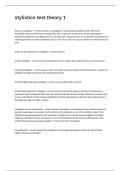
What is a metaphor? - correct answers A metaphor is a purely lexical stylistic device (the most frequently used and well-known among other SD's). It denotes transference of meaning based on resemblance between two objects (for ex. pancake, ball, volcano for the sun) It denotes transference of meaning based on a covert comparison (for ex. he is not a man, he is just a machine or what an ass you are!) what can de compared in a metaphor - correct answers simple metaphor - correct answers Metaphors may be simple, when expressed by a word or phrase complex metaphor - correct answers when a broader context is required to understand it, or when the metaphor includes more than one element of the text. A fresh/original/ genuine metaphor - correct answers first used in speech. A trite/hackneyed/stale metaphor - correct answers overused in speech, it has lost it freshness of expression. Such metaphors often turn into idiomatic phrases that are fixed in dictionary (seeds of evil, to burn with desire) or they having completely lost their expressiveness become just another entry in the dictionary (leg of a table, sunrise) metaphors can be expressed by - correct answers Metaphor can be expressed by all notional parts of speech (смысловые части речи), and functions in the sentence as any of its members. Apart from attributive(определительные) and nominative words(слова в именительном падеже) metaphor might be embodied in verbs and adverb. (1. In the slanting beams that streamed through the open window the dust danced and was golden. 2. The leaves fell sorrowfully.) Personification - correct answersif a metaphor involves likeness between inanimate and animate objects. (the face of London) What is a metonymy? - correct answers Metonymy - lexical stylistic device, which denotes a transference of meaning which is based on contiguity (nearness) of notions (перенос, основанный на смежности), not on resemblance. a detailed description of the metonymy - correct answersIn cases of metonymy, the name of one object is used instead of another, closely connected with it. What is the difference in the grounds of transference in metonymy and metaphor? - correct answersMetonymy denotes a transference of meaning based on nearness of notions. Metaphor denotes a transference of meaning based on associated likeness between two objects.(на сходстве) The scope of transference in metonymy is much more limited than that of metaphor - this is why metonymy, on the whole, is a less frequently observed SD, than metaphor. Enumerate the basic shifts of transference in metonymy. Give examples - correct answersThe name of a part instead of the name of a whole (synecdoche) - the word colors in the phrase to defend the colors of a school denotes the organization itself; The name of a container instead of the contents - Will you have another cup? (= the conversational cliché) The name of a characteristic feature of an object instead of the object - My brass will call your brass (meaning that my boss will call your boss- the transference of names is caused by both bosses being officers, wearing uniform caps with brass cockades) The name of an instrument instead of an action or the doer of an action - All they that take the sword shall perish with the sword (= war, fighting) Все кто берут меч, погибнут от меча. Between the material and object (What a graceful lady in silk) Between person and his/her age (She fresh pale eighteen) Between the place/location and its people (the senate has voted) Between the process and its result (he has taken with him some good examples of pen and inks) Between specific feature and the man possessing it (he made his way through perfume and conversation) What semantic types of epithets do you know? Give examples. - correct answersAffective (emotive proper) epithets convey the emotional evaluation of the object by the speaker. Qualifying words found in the dictionary can be and are used as affective epithets ("gorgeous", "nasty", "magnificent") Figurative (transferred) epithets are formed of metaphors, metonymies and similes expressed by adjectives. ("the smiling sun", "the frowning cloud", "the sleepless pillow") They are based on similarity of characteristics of two objects, on on nearness of the qualified objects, on their comparison. What structural types of epithets do you know? Give examples. - correct answersEpithets are used: singly (single epithet) (the sleepless pillow); in pairs (a pair of ... epithets) They are represented by two epithets joined by a conjunction or asyndetically (бессоюзная связь) as in "wonderful and incomparable beauty" or "a tired old town". in chains (a chain of ... epithets) a group of homogeneous attributes varying in number from 3 up to sometimes 20 and even more. "You're a scolding, unjust, abusive, aggravating, bad old creature" two-step epithets the process of qualifying seemingly passes two stages: the qualification of the object and the qualification of the qualification itself ("an unnaturally mild day", "simply clever") They have a fixed structure of Adv + Adj model. phrase-epithets always produce an original impression. It is a self-sufficient combination of words or even a whole sentence, which is rarely repeated in the text. ("the sunshine-in-the-breakfast-room smell", "a move-if-you-dare expression) inverted epithets They are based on the contradiction between the logical and the syntactical: logically defining becomes syntactically defined and vice versa. "this devil of a woman" (this devilish woman); "the toy of a girl" (a small, toylike girl) Pay attention to the article! What parts of speech are predominantly used as epithets and why? - correct answersIn the overwhelming majority of examples epithet is expressed by adjectives or qualitative adverbs (качественные наречия) (e.g. "his triumphant look" = he looked triumphantly). Nouns come next. They are used either as exclamatory sentences ("You, ostrich!") or as postpositive attributes (постпозитивное определение) ("Alonzo the Clown", "Richard (of) the Lion Heart"). What is a simile and what is a simple (logical) comparison? Examples. - correct answersSimile - lexico-syntactical stylistic device; an imaginative comparison of two unlike objects belonging to two different classes. (she is beautiful like a rose) It is used for purposes of expressive evaluation, emotive explanation, and highly individual description. Simple comparison is used to state an evident fact. In a simple comparison objects belonging to the same class are likened (e.g. she is like her mother) This SD's should not be confused - comparative constructions are not regarded as simile if no image is created. What semantic poles of a simile do you know? - correct answersThe one which is compared is called the tenor (объект сравнения), the one with which it is compared, is called the vehicle (средство сравнения). The tenor and the vehicle form the two semantic poles of the simile, which are connected by one of the following link words: like, as, as though, as like, such as, as ... as, etc. What is a disguised simile? - correct answersDisguised similes - similes in which the link between the tenor and the vehicle is expressed mainly by the notional verbs such as to resemble, to seem, to recollect, to remember, to look like, to appear, etc. Such similes may contain no special connector expressing comparison ("She climbed with the quickness of a cat") and the likeness between the objects seems less evident. What do you know about the foundation of the simile? Give examples. - correct answersIn a simile two objects are compared on the grounds of similarity of some quality. This feature which is called foundation of a simile. "He stood immovable like a rock in a torrent; or His muscles are hard as rock" - foundations in these examples are immovable and hard. If there is a foundation we deal with an explicit simile "she is beautiful like a rose" and if not - implicit "she is like a rose" (the associations will bring to the surface such features, as: fresh, beautiful, fragrant, attractive) What is a trite simile? - correct answersan often repeated simile, added to the stock of language phraseology. "as brisk/busy as bee, as strong as a horse, as live as a bird" What is an epic simile? - correct answersEpic (homeric) simile - a long explicit comparison of subjects. It is extended through elaborated details and serves as a stylistic decoration to help the reader to visualize the subject better: Her mind in torment, wheeling (описывать круги) like some lion at bay (в безвыходном положении), dreading the gangs of hunters closing their cunning (зд. ловушка) around him.

Content preview

stylistics test theory 1

What is a metaphor? - correct answers A metaphor is a purely lexical stylistic device (the most
frequently used and well-known among other SD's). It denotes transference of meaning based on
resemblance between two objects (for ex. pancake, ball, volcano for the sun) It denotes transference of
meaning based on a covert comparison (for ex. he is not a man, he is just a machine or what an ass you
are!)


what can de compared in a metaphor - correct answers


simple metaphor - correct answers Metaphors may be simple, when expressed by a word or phrase


complex metaphor - correct answers when a broader context is required to understand it, or when the
metaphor includes more than one element of the text.


A fresh/original/ genuine metaphor - correct answers first used in speech.


A trite/hackneyed/stale metaphor - correct answers overused in speech, it has lost it freshness of
expression. Such metaphors often turn into idiomatic phrases that are fixed in dictionary (seeds of evil,
to burn with desire) or they having completely lost their expressiveness become just another entry in
the dictionary (leg of a table, sunrise)


metaphors can be expressed by - correct answers Metaphor can be expressed by all notional parts of
speech (смысловые части речи), and functions in the sentence as any of its members. Apart from
attributive(определительные) and nominative words(слова в именительном падеже) metaphor
might be embodied in verbs and adverb. (1. In the slanting beams that streamed through the open
window the dust danced and was golden. 2. The leaves fell sorrowfully.)


Personification - correct answersif a metaphor involves likeness between inanimate and animate
objects. (the face of London)


Document information

Uploaded on
December 6, 2025
Number of pages
4
Written in
2025/2026
Type
Exam (elaborations)
Contains
Questions & answers
$15.49

Wrong document? Swap it for free Within 14 days of purchase and before downloading, you can choose a different document. You can simply spend the amount again.
Written by students who passed
Immediately available after payment
Read online or as PDF

Seller avatar
Reputation scores are based on the amount of documents a seller has sold for a fee and the reviews they have received for those documents. There are three levels: Bronze, Silver and Gold. The better the reputation, the more your can rely on the quality of the sellers work.
RealGrades
4.0
(26)
Sold
197
Followers
52
Items
12331
Last sold
3 weeks ago


Why students choose Stuvia

Created by fellow students, verified by reviews

Quality you can trust: written by students who passed their tests and reviewed by others who've used these notes.

Didn't get what you expected? Choose another document

No worries! You can instantly pick a different document that better fits what you're looking for.

Pay as you like, start learning right away

No subscription, no commitments. Pay the way you're used to via credit card and download your PDF document instantly.

Student with book image

“Bought, downloaded, and aced it. It really can be that simple.”

Alisha Student

Working on your references?

Create accurate citations in APA, MLA and Harvard with our free citation generator.

Working on your references?

Frequently asked questions
