
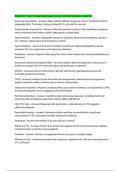
NURS 323 - Exam 3 Study Guide Questions with Verified Solutions Graded A+
Kussmaul respirations - Answers Deep, rapid breathing, no pauses; seen in metabolic acidosis
(especially DKA). The body is trying to blow off CO₂ (an acid) to raise pH.
Cheyne-Stokes respirations - Answers Alternating periods of deep, faster breathing and apnea;
seen in advanced heart failure, stroke, sleep apnea, or brain injury.
Hypoventilation - Answers Inadequate ventilation leading to shallow/slow breathing; results in
CO₂ retention, hypercapnia, and respiratory acidosis.
Hyperventilation - Answers Excessive ventilation resulting in deep/rapid breathing; causes
excessive CO₂ loss, hypocapnia, and respiratory alkalosis.
Orthopnea - Answers Dyspnea when lying flat; seen in heart failure due to blood redistribution to
the thorax.
Paroxysmal Nocturnal Dyspnea (PND) - Answers Sudden night-time episodes of shortness of
breath; associated with left ventricular failure and pulmonary congestion.
Asthma - Answers Chronic inflammatory disorder with airway hyperresponsiveness and
reversible bronchoconstriction.
COPD - Answers Includes chronic bronchitis and emphysema; characterized by progressive,
largely irreversible airflow limitation due to chronic inflammation.
Obstructive disorders - Answers Conditions that cause airflow limitation, such as asthma, COPD,
acute bronchospasm, mucus plugging, and bronchiectasis.
Restrictive disorders - Answers Conditions that reduce lung expansion, including chest wall
restriction, pleural diseases, pulmonary edema, ARDS, and fibrosis.
FEV₁/FVC ratio - Answers Measured with spirometry; a reduced ratio (<0.70) suggests
obstructive disease.
Reversibility testing - Answers Spirometry before and after a bronchodilator; significant
improvement in FEV₁ indicates reversible obstruction (asthma).
Ventilation - Answers Movement of air into and out of alveoli.
Diffusion of O₂ - Answers Occurs from alveoli into capillary blood across the alveolar-capillary
membrane down a partial pressure gradient.
Perfusion - Answers Delivery of oxygenated blood to tissues via cardiac output.
Diffusion of CO₂ - Answers Movement from systemic capillaries into cells; the reverse direction
of O₂ diffusion.
, Ventilation-perfusion (V/Q) ratio - Answers Normal ratio is approximately 0.8; indicates slightly
more perfusion than ventilation.
Capillary hydrostatic pressure (Pc) - Answers Pushes fluid out of capillaries into interstitial
space; increased with high BP or venous obstruction leading to edema.
Plasma oncotic pressure (πc) - Answers Pulls fluid into capillaries, mainly due to albumin; low
albumin decreases oncotic pressure leading to edema.
Interstitial hydrostatic pressure (Pi) - Answers Pushes fluid into capillaries, playing a minor role.
Interstitial oncotic pressure (πi) - Answers Pulls fluid out of capillaries into interstitial space.
Net filtration - Answers (forces pushing out) - (forces pulling in)
Hydrostatic pressure - Answers If hydrostatic > oncotic → fluid leaves capillary (filtration).
Oncotic pressure - Answers If oncotic > hydrostatic → fluid re-enters capillary (reabsorption).
Edema - Answers Disruptions → edema (↑ hydrostatic, ↓ oncotic, ↑ capillary permeability, lymph
obstruction).
Total Body Water (TBW) - Answers Varies by age (higher in pediatrics, lower in older adults).
Intracellular Fluid (ICF) - Answers Fluid inside cells; ~⅔ of TBW. Major cation: K⁺; major anions:
phosphates, proteins.
Extracellular Fluid (ECF) - Answers Fluid outside cells, including interstitial fluid, intravascular
fluid, and transcellular fluids.
Sodium (Na⁺) - Answers Normal: ~135-145 mEq/L.
Hypernatremia - Answers Patho: ↑ Na⁺ → ↑ osmolality → cellular dehydration. S/S: Thirst,
fatigue, weakness, muscle twitching; severe: confusion, seizures, coma.
Hyponatremia - Answers Causes: Vomiting, diarrhea, suction, diuretics, excess water. S/S: Early
N/V, cramping; later confusion, lethargy, seizures, coma.
Na⁺ replacement - Answers NaCl IV (e.g., 0.9% NS) for symptomatic hyponatremia; monitor for
hypernatremia & pulmonary edema.
Potassium (K⁺) - Answers Key role in nerve & muscle function and acid-base balance.
Hyperkalemia - Answers Causes: Renal failure, K⁺-sparing diuretics, acidosis (H⁺ in, K⁺ out).
Treatment: Restrict K⁺, stop K⁺-sparing meds, give insulin + glucose, calcium to protect heart.
Hypokalemia - Answers Causes: High-dose loop diuretics, vomiting, diarrhea. S/S: Dysrhythmias,
muscle weakness, cramps.
Kussmaul respirations - Answers Deep, rapid breathing, no pauses; seen in metabolic acidosis
(especially DKA). The body is trying to blow off CO₂ (an acid) to raise pH.
Cheyne-Stokes respirations - Answers Alternating periods of deep, faster breathing and apnea;
seen in advanced heart failure, stroke, sleep apnea, or brain injury.
Hypoventilation - Answers Inadequate ventilation leading to shallow/slow breathing; results in
CO₂ retention, hypercapnia, and respiratory acidosis.
Hyperventilation - Answers Excessive ventilation resulting in deep/rapid breathing; causes
excessive CO₂ loss, hypocapnia, and respiratory alkalosis.
Orthopnea - Answers Dyspnea when lying flat; seen in heart failure due to blood redistribution to
the thorax.
Paroxysmal Nocturnal Dyspnea (PND) - Answers Sudden night-time episodes of shortness of
breath; associated with left ventricular failure and pulmonary congestion.
Asthma - Answers Chronic inflammatory disorder with airway hyperresponsiveness and
reversible bronchoconstriction.
COPD - Answers Includes chronic bronchitis and emphysema; characterized by progressive,
largely irreversible airflow limitation due to chronic inflammation.
Obstructive disorders - Answers Conditions that cause airflow limitation, such as asthma, COPD,
acute bronchospasm, mucus plugging, and bronchiectasis.
Restrictive disorders - Answers Conditions that reduce lung expansion, including chest wall
restriction, pleural diseases, pulmonary edema, ARDS, and fibrosis.
FEV₁/FVC ratio - Answers Measured with spirometry; a reduced ratio (<0.70) suggests
obstructive disease.
Reversibility testing - Answers Spirometry before and after a bronchodilator; significant
improvement in FEV₁ indicates reversible obstruction (asthma).
Ventilation - Answers Movement of air into and out of alveoli.
Diffusion of O₂ - Answers Occurs from alveoli into capillary blood across the alveolar-capillary
membrane down a partial pressure gradient.
Perfusion - Answers Delivery of oxygenated blood to tissues via cardiac output.
Diffusion of CO₂ - Answers Movement from systemic capillaries into cells; the reverse direction
of O₂ diffusion.
, Ventilation-perfusion (V/Q) ratio - Answers Normal ratio is approximately 0.8; indicates slightly
more perfusion than ventilation.
Capillary hydrostatic pressure (Pc) - Answers Pushes fluid out of capillaries into interstitial
space; increased with high BP or venous obstruction leading to edema.
Plasma oncotic pressure (πc) - Answers Pulls fluid into capillaries, mainly due to albumin; low
albumin decreases oncotic pressure leading to edema.
Interstitial hydrostatic pressure (Pi) - Answers Pushes fluid into capillaries, playing a minor role.
Interstitial oncotic pressure (πi) - Answers Pulls fluid out of capillaries into interstitial space.
Net filtration - Answers (forces pushing out) - (forces pulling in)
Hydrostatic pressure - Answers If hydrostatic > oncotic → fluid leaves capillary (filtration).
Oncotic pressure - Answers If oncotic > hydrostatic → fluid re-enters capillary (reabsorption).
Edema - Answers Disruptions → edema (↑ hydrostatic, ↓ oncotic, ↑ capillary permeability, lymph
obstruction).
Total Body Water (TBW) - Answers Varies by age (higher in pediatrics, lower in older adults).
Intracellular Fluid (ICF) - Answers Fluid inside cells; ~⅔ of TBW. Major cation: K⁺; major anions:
phosphates, proteins.
Extracellular Fluid (ECF) - Answers Fluid outside cells, including interstitial fluid, intravascular
fluid, and transcellular fluids.
Sodium (Na⁺) - Answers Normal: ~135-145 mEq/L.
Hypernatremia - Answers Patho: ↑ Na⁺ → ↑ osmolality → cellular dehydration. S/S: Thirst,
fatigue, weakness, muscle twitching; severe: confusion, seizures, coma.
Hyponatremia - Answers Causes: Vomiting, diarrhea, suction, diuretics, excess water. S/S: Early
N/V, cramping; later confusion, lethargy, seizures, coma.
Na⁺ replacement - Answers NaCl IV (e.g., 0.9% NS) for symptomatic hyponatremia; monitor for
hypernatremia & pulmonary edema.
Potassium (K⁺) - Answers Key role in nerve & muscle function and acid-base balance.
Hyperkalemia - Answers Causes: Renal failure, K⁺-sparing diuretics, acidosis (H⁺ in, K⁺ out).
Treatment: Restrict K⁺, stop K⁺-sparing meds, give insulin + glucose, calcium to protect heart.
Hypokalemia - Answers Causes: High-dose loop diuretics, vomiting, diarrhea. S/S: Dysrhythmias,
muscle weakness, cramps.


