NURS 445 - Exam 2 Review - Cardiac System Overview and Key Concepts with Complete Solutions
NURS 445 - Exam 2 Review - Cardiac System Overview and Key
Concepts with Complete Solutions
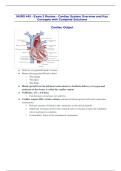
Cardiac Output
● Delivers oxyegnated blood to tissues
● Return deoyxgenated blood to heart
○ The pumps
○ The pipes
○ The fluids
● Blood ejected from the left heart each minute to facilitate delivery of oxygen and
nutrients to the tissues is called the cardiac output
● NORMAL CO = 4-8 liters
○ Can decrease or increase (w/ activity)
● Cardiac output: HR x stroke volume (amount of blood ejected with each ventricular
contraction)
○ Preload: amount of blood in the ventricules at the end of diastole
○ Afterload: resistance to flow the ventricle must overcome to open the semilunar
valves and eject its contents
○ Contractility: Force of the mechanical contraction
NURS 445 - Exam 2 Review - Cardiac System Overview and Key Concepts with Complete Solutions
,NURS 445 - Exam 2 Review - Cardiac System Overview and Key Concepts with Complete Solutions
Vascular System
● Combination of arteries, veins and capillaries
● Veins = deoxygenated blod
● Arteries = oxygenated blood (except pulmonary artery)
Blood Flow Through a Capillary Bed
● Capillary beds are where oxygen and nutrients are delivered to the tissues and cellular waste is
removed
Anatomy of the Heart
NURS 445 - Exam 2 Review - Cardiac System Overview and Key Concepts with Complete Solutions
,NURS 445 - Exam 2 Review - Cardiac System Overview and Key Concepts with Complete Solutions
● Layers- epicardium
○ Outer layer (joins pericardial sac)
○ Middle layer- Myocardium, the muscle of the heart
○ Endocardium, inner lining
● Chambers- 4
○ Right and left atrium
○ Right and left ventricles
● 4 Valves
● AV valves
○ Tricuspid valve - valve been right atrium and ventricle
○ Mitral valve (aka bicuspid valve) - valave btween left artium and ventricle
● Semilunar valves
○ Pulmonary valve - right ventricle and pulmonary artery
○ Aortic valve - left ventricle and aorta
Pathway of Blood
Blood Supply to the Heart- LCA
● Left coronary artery
● Branches
○ Left anterior descending branch
○ Circumflex branch
● Supplies
○ Both ventricles
○ Anterior interventricular septum
○ Anterior wall of heart
○ Left atrium
○ Posterior wall of left ventricle
Blood Supply to the Heart- RCA
● Right coronary artery: supplies the right atrium and sinoatrial node then branches of to
● Branches
○ Right marginal branch
○ Posterior interventricular branch
● Supplies
○ Lateral aspect of right atrium and ventricle
○ Poster aspect of both ventricles and intervetricular septum
Cardiac Conduction system
● Conducted by automaticity, excitability and conductivity
NURS 445 - Exam 2 Review - Cardiac System Overview and Key Concepts with Complete Solutions
, NURS 445 - Exam 2 Review - Cardiac System Overview and Key Concepts with Complete Solutions
● Automaticity:
○ SA node: has an inherent rate of 60-100 bpm
○ In absence of impulse from SA node, AV node can generate impulses at rate
of 40-60bpm.
○ IF BOTH fail, ventricular cells can generat impulses at a rate of 20-40bpm
● Excitiability: ability to respond to a stimulus and generate an impulse
● Conductivity: allows cardiac tissue to transmit the impulses to neighboring connected
cells
Cells of the Eletrical Conduction System
1. Impulse origjnates in SA node - rate of 60-100bom
2. Impulse spreads through the atria through the inernodal pathways to the..
3. AV node, where impulse is delayed to allow for atrial contraction and complete
ventricular filling
4. It leaves the AVD node through the bundle of His and branches off into the..
5. Right and left bundle branches, which travel down the interventricular septum to end in
the..
6. Purkinje fibers, which extend the impulse into the ventricular tissue, facilitation
ventricular contraction
7.
NURS 445 - Exam 2 Review - Cardiac System Overview and Key Concepts with Complete Solutions
NURS 445 - Exam 2 Review - Cardiac System Overview and Key
Concepts with Complete Solutions
Cardiac Output
● Delivers oxyegnated blood to tissues
● Return deoyxgenated blood to heart
○ The pumps
○ The pipes
○ The fluids
● Blood ejected from the left heart each minute to facilitate delivery of oxygen and
nutrients to the tissues is called the cardiac output
● NORMAL CO = 4-8 liters
○ Can decrease or increase (w/ activity)
● Cardiac output: HR x stroke volume (amount of blood ejected with each ventricular
contraction)
○ Preload: amount of blood in the ventricules at the end of diastole
○ Afterload: resistance to flow the ventricle must overcome to open the semilunar
valves and eject its contents
○ Contractility: Force of the mechanical contraction
NURS 445 - Exam 2 Review - Cardiac System Overview and Key Concepts with Complete Solutions
,NURS 445 - Exam 2 Review - Cardiac System Overview and Key Concepts with Complete Solutions
Vascular System
● Combination of arteries, veins and capillaries
● Veins = deoxygenated blod
● Arteries = oxygenated blood (except pulmonary artery)
Blood Flow Through a Capillary Bed
● Capillary beds are where oxygen and nutrients are delivered to the tissues and cellular waste is
removed
Anatomy of the Heart
NURS 445 - Exam 2 Review - Cardiac System Overview and Key Concepts with Complete Solutions
,NURS 445 - Exam 2 Review - Cardiac System Overview and Key Concepts with Complete Solutions
● Layers- epicardium
○ Outer layer (joins pericardial sac)
○ Middle layer- Myocardium, the muscle of the heart
○ Endocardium, inner lining
● Chambers- 4
○ Right and left atrium
○ Right and left ventricles
● 4 Valves
● AV valves
○ Tricuspid valve - valve been right atrium and ventricle
○ Mitral valve (aka bicuspid valve) - valave btween left artium and ventricle
● Semilunar valves
○ Pulmonary valve - right ventricle and pulmonary artery
○ Aortic valve - left ventricle and aorta
Pathway of Blood
Blood Supply to the Heart- LCA
● Left coronary artery
● Branches
○ Left anterior descending branch
○ Circumflex branch
● Supplies
○ Both ventricles
○ Anterior interventricular septum
○ Anterior wall of heart
○ Left atrium
○ Posterior wall of left ventricle
Blood Supply to the Heart- RCA
● Right coronary artery: supplies the right atrium and sinoatrial node then branches of to
● Branches
○ Right marginal branch
○ Posterior interventricular branch
● Supplies
○ Lateral aspect of right atrium and ventricle
○ Poster aspect of both ventricles and intervetricular septum
Cardiac Conduction system
● Conducted by automaticity, excitability and conductivity
NURS 445 - Exam 2 Review - Cardiac System Overview and Key Concepts with Complete Solutions
, NURS 445 - Exam 2 Review - Cardiac System Overview and Key Concepts with Complete Solutions
● Automaticity:
○ SA node: has an inherent rate of 60-100 bpm
○ In absence of impulse from SA node, AV node can generate impulses at rate
of 40-60bpm.
○ IF BOTH fail, ventricular cells can generat impulses at a rate of 20-40bpm
● Excitiability: ability to respond to a stimulus and generate an impulse
● Conductivity: allows cardiac tissue to transmit the impulses to neighboring connected
cells
Cells of the Eletrical Conduction System
1. Impulse origjnates in SA node - rate of 60-100bom
2. Impulse spreads through the atria through the inernodal pathways to the..
3. AV node, where impulse is delayed to allow for atrial contraction and complete
ventricular filling
4. It leaves the AVD node through the bundle of His and branches off into the..
5. Right and left bundle branches, which travel down the interventricular septum to end in
the..
6. Purkinje fibers, which extend the impulse into the ventricular tissue, facilitation
ventricular contraction
7.
NURS 445 - Exam 2 Review - Cardiac System Overview and Key Concepts with Complete Solutions