
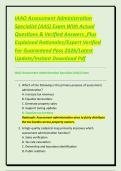
IAAO Assessment Administration
Specialist (AAS) Exam With Actual
Questions & Verified Answers ,Plus
Explained Rationales/Expert Verified
For Guaranteed Pass 2026/Latest
Update/Instant Download Pdf
IAAO Assessment Administration Specialist (AAS) Exam
1. Which of the following is the primary purpose of assessment
administration?
A. Increase tax revenues
B. Equalize tax burdens
C. Generate property sales
D. Support zoning updates
B. Equalize tax burdens
Rationale: Assessment administration aims to fairly distribute
the tax burden across property owners.
2. A high-quality cadastral map primarily improves which
assessment administration function?
A. Sales verification
B. Tax rate calculation
C. Ownership and boundary identification
D. Public relations
, C. Ownership and boundary identification
Rationale: Cadastral maps define parcels, boundaries, and
ownership—critical to assessment accuracy.
3. What is the first step in the assessment cycle?
A. Notification of value
B. Discovery and listing
C. Appeals
D. Tax collection
B. Discovery and listing
Rationale: Discovery and listing of property occur before
valuation or notice steps.
4. Which describes the principle of equity in assessment?
A. Taxes must be stable
B. Properties should be taxed equally regardless of value
C. Similar properties should have similar assessments
D. Assessors must follow all taxpayer suggestions
C. Similar properties should have similar assessments
Rationale: Equity ensures uniform assessments among
comparable properties.
5. A ratio study measures:
A. Number of building permits
B. Level and uniformity of assessments
C. Market activity
D. Appraiser performance satisfaction
B. Level and uniformity of assessments
Rationale: Ratio studies evaluate assessment accuracy using
sale-price ratios.
6. Which assessment office activity is typically mandated by law?
A. Creating videos for taxpayers
, B. Publishing valuation manuals
C. Maintaining assessment records
D. Offering online filing tools
C. Maintaining assessment records
Rationale: Records are legally required for valuation, appeals,
and taxation.
7. The cost approach is most reliable for:
A. Old commercial property
B. New construction
C. Farmland
D. Apartments
B. New construction
Rationale: Cost estimates are most accurate when buildings
are new.
8. Which of the following is a key performance measure in
assessment administration?
A. Average taxpayer age
B. Coefficient of dispersion (COD)
C. Number of parcels per township
D. Size of taxing jurisdictions
B. Coefficient of dispersion (COD)
Rationale: COD measures uniformity of assessments.
9. The term “taxing district” refers to:
A. A geographic area with independent taxing authority
B. A court reviewing tax appeals
C. The office of the assessor
D. The location of delinquent taxpayers
A. A geographic area with independent taxing authority
Specialist (AAS) Exam With Actual
Questions & Verified Answers ,Plus
Explained Rationales/Expert Verified
For Guaranteed Pass 2026/Latest
Update/Instant Download Pdf
IAAO Assessment Administration Specialist (AAS) Exam
1. Which of the following is the primary purpose of assessment
administration?
A. Increase tax revenues
B. Equalize tax burdens
C. Generate property sales
D. Support zoning updates
B. Equalize tax burdens
Rationale: Assessment administration aims to fairly distribute
the tax burden across property owners.
2. A high-quality cadastral map primarily improves which
assessment administration function?
A. Sales verification
B. Tax rate calculation
C. Ownership and boundary identification
D. Public relations
, C. Ownership and boundary identification
Rationale: Cadastral maps define parcels, boundaries, and
ownership—critical to assessment accuracy.
3. What is the first step in the assessment cycle?
A. Notification of value
B. Discovery and listing
C. Appeals
D. Tax collection
B. Discovery and listing
Rationale: Discovery and listing of property occur before
valuation or notice steps.
4. Which describes the principle of equity in assessment?
A. Taxes must be stable
B. Properties should be taxed equally regardless of value
C. Similar properties should have similar assessments
D. Assessors must follow all taxpayer suggestions
C. Similar properties should have similar assessments
Rationale: Equity ensures uniform assessments among
comparable properties.
5. A ratio study measures:
A. Number of building permits
B. Level and uniformity of assessments
C. Market activity
D. Appraiser performance satisfaction
B. Level and uniformity of assessments
Rationale: Ratio studies evaluate assessment accuracy using
sale-price ratios.
6. Which assessment office activity is typically mandated by law?
A. Creating videos for taxpayers
, B. Publishing valuation manuals
C. Maintaining assessment records
D. Offering online filing tools
C. Maintaining assessment records
Rationale: Records are legally required for valuation, appeals,
and taxation.
7. The cost approach is most reliable for:
A. Old commercial property
B. New construction
C. Farmland
D. Apartments
B. New construction
Rationale: Cost estimates are most accurate when buildings
are new.
8. Which of the following is a key performance measure in
assessment administration?
A. Average taxpayer age
B. Coefficient of dispersion (COD)
C. Number of parcels per township
D. Size of taxing jurisdictions
B. Coefficient of dispersion (COD)
Rationale: COD measures uniformity of assessments.
9. The term “taxing district” refers to:
A. A geographic area with independent taxing authority
B. A court reviewing tax appeals
C. The office of the assessor
D. The location of delinquent taxpayers
A. A geographic area with independent taxing authority


