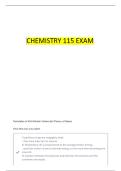
Postulates of KM (Kinetic Molecular) Theory of Gases
Give this one a try later!
1) particles of gas are negligibly small
- they have mass but no volume
2) Temperature (K) is proportional to the average Kinetic Energy
- particles motion is due to thermal energy, so the more thermal energy the
more KE
3) Collision between the particles and between the particles and the
containers are elastic
, - no energy is exchanged
- but none is lost
Ionic bond
Give this one a try later!
electronegativity difference of more than 2.0 (transfer of electrons)
Bonding orbitals do what?
Give this one a try later!
they contribute to the stability
Key points of Valence Bond Theory
Give this one a try later!
- when necessary, then central atoms will mix together, or hybridize, some
or all of their highest E orbitals to create more stable orbitals to hold the
valence electrons
- atoms don't hybridize if they are only bonded to one other atom
- atoms must use all hybrid orbitals for either sigma, pi, or lone pairs
- # of hybrid orbitals formed equals # of atomic orbitals mixed together
Molecular Polarity
Give this one a try later!
1) particles of gas are negligibly small
- they have mass but no volume
2) Temperature (K) is proportional to the average Kinetic Energy
- particles motion is due to thermal energy, so the more thermal energy the
more KE
3) Collision between the particles and between the particles and the
containers are elastic
, - no energy is exchanged
- but none is lost
Ionic bond
Give this one a try later!
electronegativity difference of more than 2.0 (transfer of electrons)
Bonding orbitals do what?
Give this one a try later!
they contribute to the stability
Key points of Valence Bond Theory
Give this one a try later!
- when necessary, then central atoms will mix together, or hybridize, some
or all of their highest E orbitals to create more stable orbitals to hold the
valence electrons
- atoms don't hybridize if they are only bonded to one other atom
- atoms must use all hybrid orbitals for either sigma, pi, or lone pairs
- # of hybrid orbitals formed equals # of atomic orbitals mixed together
Molecular Polarity