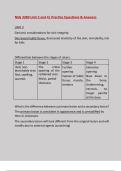
NSG 3280 Unit 3 and 4| Practice Questions & Answers
UNIT 3
Geriatric considerations for skin integrity:
Decreased SubQ tissue, decreased elasticity of the skin, immobility, risk
for falls.
Differentiate between the stages of ulcers:
Stage 1 Stage 2 Stage 3 Stage 4
Red, non- The initial Further Extensive
blanchable area opening of the opening opening
Red, swelling, reddened area
Expose of SubQ Now down to
warmth. Moist, partial tissue, muscle, the bone,
thickness tendons Undermining,
necrosis, no
longer painful
at the base
What is the difference between a primary lesion and a secondary lesion?
The primary lesion is consistent in appearance and is unmodified by
time or processes.
The secondary lesion will look different from the original lesion and will
modify due to external agents (scratching)
, What are the most prominent benign tumors (non-life threatening) and
where do they come from?
Squamous papilloma is BENIGN made from Keratinocytes which
are the cell that makes skin
Lipoma made from Adipose cells
Moles made from melanocytes
Hemangiomas made from blood
vessels Dermatofibroma made from
Fibroblasts
Neuroma made from Nerves
Differentiate between Atopic and Contact Dermatitis:
Atopic Contact
Pathogenesis/ The genetic Sensitivity to
Etiology defect of the agents
epidermal
barrier protein
filaggrin
How is it biopsy Patch test
Diagnosed?
Clinical ALWAYS HAVE Pruritus/ itching,
Manifestations PRURITIS and vesicles
DRY SKIN
Eczema- rash
UNIT 3
Geriatric considerations for skin integrity:
Decreased SubQ tissue, decreased elasticity of the skin, immobility, risk
for falls.
Differentiate between the stages of ulcers:
Stage 1 Stage 2 Stage 3 Stage 4
Red, non- The initial Further Extensive
blanchable area opening of the opening opening
Red, swelling, reddened area
Expose of SubQ Now down to
warmth. Moist, partial tissue, muscle, the bone,
thickness tendons Undermining,
necrosis, no
longer painful
at the base
What is the difference between a primary lesion and a secondary lesion?
The primary lesion is consistent in appearance and is unmodified by
time or processes.
The secondary lesion will look different from the original lesion and will
modify due to external agents (scratching)
, What are the most prominent benign tumors (non-life threatening) and
where do they come from?
Squamous papilloma is BENIGN made from Keratinocytes which
are the cell that makes skin
Lipoma made from Adipose cells
Moles made from melanocytes
Hemangiomas made from blood
vessels Dermatofibroma made from
Fibroblasts
Neuroma made from Nerves
Differentiate between Atopic and Contact Dermatitis:
Atopic Contact
Pathogenesis/ The genetic Sensitivity to
Etiology defect of the agents
epidermal
barrier protein
filaggrin
How is it biopsy Patch test
Diagnosed?
Clinical ALWAYS HAVE Pruritus/ itching,
Manifestations PRURITIS and vesicles
DRY SKIN
Eczema- rash