Nsg 3024 Chapter 34 Quiz | Verified Solution
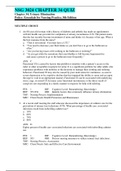
1. An 80-year-old woman with a history of diabetes and arthritis has made an appointment with her health care provider for complaints of urinary incontinence (UI). The patient states that she has recently become incontinent of urine and thinks it is because of her age. What is the best response from the nurse? a. “That is not normal. You must have a UTI.” b. “You need to decrease your fluid intake so you don't have to go to the bathroom as often.” c. “Are you having issues with walking to the bathroom or toileting?” d. “As you get older the sensations that your bladder is full become hypersensitive and cause a person to go to the bathroom more frequently.” At a recent staff meeting the staff educator discussed the importance of catheter care for the prevention of urinary tract infections (UTI). What percentage of health care–associated infections result from indwelling catheter use? a. 10% b. 60% c. 70% d. 80% A 56-year-old patient, who has recently become postmenopausal, made an appointment with her health care provider for symptoms of an UTI. The patient has had three previously diagnosed UTIs in the past 4 months. She asks the nurse if this is a normal occurrence with postmenopausal women. What is the best response from the nurse? a. “Yes, because as women go through menopause, the lining of the urethra becomes more susceptible to infections.” b. “No, but why don’t you ask your health care provider for some antibiotics to keep on hand?” c. “Yes, and this must be frustrating because as we become older our body starts to cause us more problems.” d. “Yes, and this is why I’m not looking forward to going through menopause.” A mother has brought her 3-year-old child to the clinic for an annual well-child checkup. The mother tells the nurse that the child is in the process of being potty trained. The child will state that the need to go to the bathroom, but refuses to go on the toilet. What is the nurse’s best response? a. “This occurs because the child might be frightened of falling in the toilet.” b. “It is recommended that you try putting her in ‘time-out’ if she continues to refuse to sit on the toilet.” c. “Sometimes children at that age see urine and feces as part of themselves.” d. “Stop, your child is too young to worry about potty-training.”
Document information
- Uploaded on
- February 6, 2021
- Number of pages
- 10
- Written in
- 2020/2021
- Type
- Exam (elaborations)
- Contains
- Questions & answers