

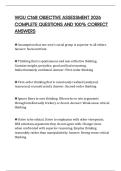
WGU C168 OBJECTIVE ASSESSMENT 2026
COMPLETE QUESTIONS AND 100% CORRECT
ANSWERS
◉ Assumption that one own's social group is superior to all others.
Answer: Sociocentrism
◉ Thinking that is spontaneous and non-reflective thinking.
Contains insight, prejudice, good and bad reasoning.
Indiscriminately combined. Answer: First-order thinking
◉ First-order thinking that is consciously realized (analyzed,
reassessed, reconstructed). Answer: Second-order thinking
◉ Ignore flaws in own thinking. Often tries to win arguments
through intellectually trickery or deceit. Answer: Weak-sense critical
thinking
◉ Strive to be ethical. Strive to emphasize with other viewpoints.
Will entertain arguments they do not agree with. Change views
when confronted with superior reasoning. Employ thinking
reasonably rather than manipulatively. Answer: Strong-sense critical
thinking
, ◉ Commitment to discover the extent of your own ignorance on any
issue. Answer: Intellectual humility
◉ Confronting ideas, viewpoints, or beliefs with fairness, even when
doing so is painful. Answer: Intellectual courage
◉ Inhabiting perspectives of others in order to genuinely
understand them. Answer: Intellectual empathy
◉ Holding oneself to the same rigorous intellectual standards that
one expects others to meet Answer: Intellectual integrity
◉ Working one's way through intellectual complexities despite
frustrations inherent in doing so Answer: Intellectual perseverance
◉ Proceeds from the belief that both the individual's and society's
interests are best served by unfettered reason Answer: Confidence
in reason
◉ Thinking of oneself while adhering to standards of rationality
Answer: Intellectual autonomy
◉ Thinking, feeling, and wanting Answer: Three functions of the
mind
COMPLETE QUESTIONS AND 100% CORRECT
ANSWERS
◉ Assumption that one own's social group is superior to all others.
Answer: Sociocentrism
◉ Thinking that is spontaneous and non-reflective thinking.
Contains insight, prejudice, good and bad reasoning.
Indiscriminately combined. Answer: First-order thinking
◉ First-order thinking that is consciously realized (analyzed,
reassessed, reconstructed). Answer: Second-order thinking
◉ Ignore flaws in own thinking. Often tries to win arguments
through intellectually trickery or deceit. Answer: Weak-sense critical
thinking
◉ Strive to be ethical. Strive to emphasize with other viewpoints.
Will entertain arguments they do not agree with. Change views
when confronted with superior reasoning. Employ thinking
reasonably rather than manipulatively. Answer: Strong-sense critical
thinking
, ◉ Commitment to discover the extent of your own ignorance on any
issue. Answer: Intellectual humility
◉ Confronting ideas, viewpoints, or beliefs with fairness, even when
doing so is painful. Answer: Intellectual courage
◉ Inhabiting perspectives of others in order to genuinely
understand them. Answer: Intellectual empathy
◉ Holding oneself to the same rigorous intellectual standards that
one expects others to meet Answer: Intellectual integrity
◉ Working one's way through intellectual complexities despite
frustrations inherent in doing so Answer: Intellectual perseverance
◉ Proceeds from the belief that both the individual's and society's
interests are best served by unfettered reason Answer: Confidence
in reason
◉ Thinking of oneself while adhering to standards of rationality
Answer: Intellectual autonomy
◉ Thinking, feeling, and wanting Answer: Three functions of the
mind


