
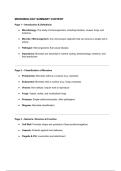
MICROBIOLOGY SUMMARY CONTENT
Page 1 – Introduction & Definitions
● Microbiology: The study of microorganisms, including bacteria, viruses, fungi, and
protozoa.
● Microbe / Microorganism: Any microscopic organism that can exist as a single cell or
colony.
● Pathogen: Microorganisms that cause disease.
● Importance: Microbes are essential in nutrient cycling, biotechnology, medicine, and
food production.
Page 2 – Classification of Microbes
● Prokaryotes: Microbes without a nucleus (e.g., bacteria)
● Eukaryotes: Microbes with a nucleus (e.g., fungi, protozoa)
● Viruses: Non-cellular, require host to reproduce
● Fungi: Yeasts, molds, and multicellular fungi
● Protozoa: Single-celled eukaryotes, often pathogenic
● Diagram: Microbial classification
Page 3 – Bacteria: Structure & Function
● Cell Wall: Provides shape and protection (Gram-positive/negative)
● Capsule: Protects against host defenses
● Flagella & Pili: Locomotion and attachment
Page 1 – Introduction & Definitions
● Microbiology: The study of microorganisms, including bacteria, viruses, fungi, and
protozoa.
● Microbe / Microorganism: Any microscopic organism that can exist as a single cell or
colony.
● Pathogen: Microorganisms that cause disease.
● Importance: Microbes are essential in nutrient cycling, biotechnology, medicine, and
food production.
Page 2 – Classification of Microbes
● Prokaryotes: Microbes without a nucleus (e.g., bacteria)
● Eukaryotes: Microbes with a nucleus (e.g., fungi, protozoa)
● Viruses: Non-cellular, require host to reproduce
● Fungi: Yeasts, molds, and multicellular fungi
● Protozoa: Single-celled eukaryotes, often pathogenic
● Diagram: Microbial classification
Page 3 – Bacteria: Structure & Function
● Cell Wall: Provides shape and protection (Gram-positive/negative)
● Capsule: Protects against host defenses
● Flagella & Pili: Locomotion and attachment


