
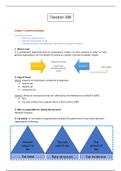
Taxation 388
Chapter 1: General principles
Learning outcomes:
✓ Define & understand tax
✓ Describe components of tax
✓ Evaluate tax policy, by applying the principles of a good tax system
1. What is tax?
It is compulsory payments that are imposed on citizens to raise revenue in order to fund
general expenditure, for the benefit of society as a whole. (schools, hospitals, roads)
Consumer PAY taxes
Goverment Government Consumer Social compact
RETURN Goods and
service
2. Type of taxes:
Direct: imposed on individuals, companies & taxpayers
• Income tax
• Wealth tax
• Corporate tax
Indirect: levied on transactions that are collected by intermediaries on behalf of SARS.
• VAT
• E.g. Spar collects tax on goods which is then send to SARS
3. Who is responsible for setting the tax laws?
National Treasury
4. Tax policy: To formulate an appropriate tax policy the government must make decisions
regarding the following -
Amount The rate The
subject to used to tax amount of
tax tax
Tax base Rate structure Tax incidence
,TAX BASE: amount on which tax is imposed (determined by legislation provisions)
o Look at what is taxable – income, wealth & consumption
o Once tax base is determined a % is attached to determine the tax liability
Includes:
• Income earned/profits generated (Income tax)
• Value of assets or property (Wealth tax)
• Spending on goods and services (Consumption Tax)
TAX RATE STRUCTURE & INCIDENCE: Marginal tax rate: when TB increased by R1.
rate at which amount is taxed Statutory tax rate: TB as determined by legislation.
• Percentage (15%) Average tax rate: Total tax liability / Total tax base
• Amount per unit (sin tax)
• Sliding-scale (individuals)
ETR: effective tax rate TAX LIABILITY
(used to compare the ETL of different taxpayers)
TOTAL PROFIT/INCOME
3 Types of tax structures:
1. Progressive: ETR increases as income increases
2. Proportional: Flat tax rate
3. Regressive: ETR increases as income decreases
Example:
A B C
A: Proportional
Annual Amount % of Amount % of Amount % of (interest rate
Income of Tax Annual of Tax Annual of Tax Annual stays the same)
(R) paid income paid income paid income B: Regressive
50 000 R15 000 30% R15 000 30% 2500 5% (interest rate
decreases)
150 000 R45 000 30% R15 000 10% 15000 10%
C: Progressive
300 000 R90 000 30% R15 000 5% 45000 15% (interest rate
1500 increases)
R450 000 30% R15 000 1% 450000 30%
000
The type of tax structure elected by policymakers would depend on a number of aspects, one which is policy objectives.
If the objective of the government is to achieve wealth redistribution it will usually prefer a progressive tax rate system.
1. Equity principle: tax should be imposed to one’s taxable ability or capacity.
2. Certainty principle: timing, amount and manner of tax payments should be
certain.
3. Convenience principle: taxes should be imposed in a manner or time convenient to TP.
4. Economic efficiency principle: tax should not be designed to unduly influence economic
decision making.
5. Administrative efficiency principle: tax should be designed to not impose an unreasonable
admin burden on TP & revenue authorities.
6. Flexibility principle: a good tax system must be designed in a manner that it can easily adjust
in response to changing economic circumstances.
7. Simplicity principle: tax should be easy to understand and apply.
, Chapter 2: Taxation in South Africa
2.2.3 Current tax legislation
Legislation Tax type Tax base Tax base category Silke chapter
Income Tax Act 58 Normal tax Taxable income Income Main focus in book
of 1962
Income Tax Act 58 Withholding Tax Gross amount Income Chapter 21
of 1962 payable to non-
resident/beneficial
owner
Value-Added Tax VAT Taxable supplies of Consumption Chapter 31
Act 89 of 1991 goods and services
2.4 Interpretation of tax law
Function: collecting taxes and ensuring compliance with tax laws.
Burden of proof lies on the taxpayer to claim an exemption, deduction etc.
- Two most important sources of tax law:
2.4.1 Tax legislation: Page 17
1. Regulations: S107(1) enables the Min. of Finance to make regulations regarding certain
matters.
2. Double tax agreements: S108(2) agreements to avoid the imposition of double tax when
residence of a country transact in another country may be entered into by the governments
of the respective countries.
3. Definitions: S 1 of the Act
4. The interpretation Act: when there is a term not defined in the Act, we look at the
Interpretation Act 33 of 1957 for guidance.
5. Interpretation notes: addition to regulations, SARS publishes interpretation notes that set
out its interpretation of various provisions of the Act. These notes do not form part of tax
legislation, they are used as guidelines.
6. Binding general rulings: used as guidelines.
2.4.2 Judicial decisions
In South Africa judgments of the courts are an important source of tax law.
Constitutional Court
1. Tax board: deals with appeals where >R1 000 000
(CC)
Supreme Court of 2. Party can appeal to the Tax court (not court of law), bound by the decisions
Appeal (SCA) of the Provincial Divisions of the High Court and SCA, not bound by own
Provincial Divisions
of the High Court
decisions. Only binding to parties of the specific case.
Tax 3. Provincial Divisions of the HC: bound by own decisions, but not by decisions
Court of other provincial divisions.
Tax
board 4. SCA: bound only to his own decisions.
Stare Decisis rule: rule of law that establishes that a court should follow their previous judgment as it is binding upon
lower courts, and courts of equal ranking must follow their own previous decisions.
Ratio decidendi = creates precedent (stare decisis)
Could look at international laws.
, 2.4.3 Rules of interpretation: Page 20
1. Strict and literal (‘golden rule of interpretation’):
• Focuses on the literal meaning of words
• Grammatical meaning of words = intention of legislator
Partington v The Attorney General
2. The purposive approach (contextual approach):
• Determines the purpose of the legislation by taking into account all surrounding
circumstances and resources.
• Also considers: history of the provision of a taxing act, its broad objectives, the
constitutional values underlying it and its interrelationship with other provisions
• Courts applying this approach strive to give effect to the purpose with which the
legislator enacted a particular provision.
Anil Development Corporation Ltd v SIR
3. Contra fiscum rule:
• Provides that where more than one meaning is possible, the court must give effect to
the meaning which favours the taxpayer (i.e. against the fiscus)
4. Substance over form rule:
• If problems arise regarding the interpretation of the true meaning of an agreement or
transaction, the courts are concerned with the substance rather than the form of the
transaction.
2.5.1 The incidence (liability) of normal tax (Normal tax is levied on a person)
Includes: trusts, deceased, insolvent estates, CIS, companies, natural persons
Excludes: foreign partnerships
Collection of normal tax is facilitated through:
• PAYE
• Withholding tax
• Provisional tax
2.5.2 Rate structure of normal tax: Varies in accordance with the different persons subject to normal tax.
• Same progressive rate structure is used to calculate the normal tax for the following
subjects, the rate ranges from 18% to 45%.
• Rates are determined annually and announced in budget speech by Min of Finance.
TAX
388 Progressive rate structure Fixed rate structure 28% Fixed rate structure 45%
Natural persons (individuals) Companies Trusts (other than special
and CC’s TAX388 trusts)
Deceased estates
Insolvent estates
Special trusts
Chapter 1: General principles
Learning outcomes:
✓ Define & understand tax
✓ Describe components of tax
✓ Evaluate tax policy, by applying the principles of a good tax system
1. What is tax?
It is compulsory payments that are imposed on citizens to raise revenue in order to fund
general expenditure, for the benefit of society as a whole. (schools, hospitals, roads)
Consumer PAY taxes
Goverment Government Consumer Social compact
RETURN Goods and
service
2. Type of taxes:
Direct: imposed on individuals, companies & taxpayers
• Income tax
• Wealth tax
• Corporate tax
Indirect: levied on transactions that are collected by intermediaries on behalf of SARS.
• VAT
• E.g. Spar collects tax on goods which is then send to SARS
3. Who is responsible for setting the tax laws?
National Treasury
4. Tax policy: To formulate an appropriate tax policy the government must make decisions
regarding the following -
Amount The rate The
subject to used to tax amount of
tax tax
Tax base Rate structure Tax incidence
,TAX BASE: amount on which tax is imposed (determined by legislation provisions)
o Look at what is taxable – income, wealth & consumption
o Once tax base is determined a % is attached to determine the tax liability
Includes:
• Income earned/profits generated (Income tax)
• Value of assets or property (Wealth tax)
• Spending on goods and services (Consumption Tax)
TAX RATE STRUCTURE & INCIDENCE: Marginal tax rate: when TB increased by R1.
rate at which amount is taxed Statutory tax rate: TB as determined by legislation.
• Percentage (15%) Average tax rate: Total tax liability / Total tax base
• Amount per unit (sin tax)
• Sliding-scale (individuals)
ETR: effective tax rate TAX LIABILITY
(used to compare the ETL of different taxpayers)
TOTAL PROFIT/INCOME
3 Types of tax structures:
1. Progressive: ETR increases as income increases
2. Proportional: Flat tax rate
3. Regressive: ETR increases as income decreases
Example:
A B C
A: Proportional
Annual Amount % of Amount % of Amount % of (interest rate
Income of Tax Annual of Tax Annual of Tax Annual stays the same)
(R) paid income paid income paid income B: Regressive
50 000 R15 000 30% R15 000 30% 2500 5% (interest rate
decreases)
150 000 R45 000 30% R15 000 10% 15000 10%
C: Progressive
300 000 R90 000 30% R15 000 5% 45000 15% (interest rate
1500 increases)
R450 000 30% R15 000 1% 450000 30%
000
The type of tax structure elected by policymakers would depend on a number of aspects, one which is policy objectives.
If the objective of the government is to achieve wealth redistribution it will usually prefer a progressive tax rate system.
1. Equity principle: tax should be imposed to one’s taxable ability or capacity.
2. Certainty principle: timing, amount and manner of tax payments should be
certain.
3. Convenience principle: taxes should be imposed in a manner or time convenient to TP.
4. Economic efficiency principle: tax should not be designed to unduly influence economic
decision making.
5. Administrative efficiency principle: tax should be designed to not impose an unreasonable
admin burden on TP & revenue authorities.
6. Flexibility principle: a good tax system must be designed in a manner that it can easily adjust
in response to changing economic circumstances.
7. Simplicity principle: tax should be easy to understand and apply.
, Chapter 2: Taxation in South Africa
2.2.3 Current tax legislation
Legislation Tax type Tax base Tax base category Silke chapter
Income Tax Act 58 Normal tax Taxable income Income Main focus in book
of 1962
Income Tax Act 58 Withholding Tax Gross amount Income Chapter 21
of 1962 payable to non-
resident/beneficial
owner
Value-Added Tax VAT Taxable supplies of Consumption Chapter 31
Act 89 of 1991 goods and services
2.4 Interpretation of tax law
Function: collecting taxes and ensuring compliance with tax laws.
Burden of proof lies on the taxpayer to claim an exemption, deduction etc.
- Two most important sources of tax law:
2.4.1 Tax legislation: Page 17
1. Regulations: S107(1) enables the Min. of Finance to make regulations regarding certain
matters.
2. Double tax agreements: S108(2) agreements to avoid the imposition of double tax when
residence of a country transact in another country may be entered into by the governments
of the respective countries.
3. Definitions: S 1 of the Act
4. The interpretation Act: when there is a term not defined in the Act, we look at the
Interpretation Act 33 of 1957 for guidance.
5. Interpretation notes: addition to regulations, SARS publishes interpretation notes that set
out its interpretation of various provisions of the Act. These notes do not form part of tax
legislation, they are used as guidelines.
6. Binding general rulings: used as guidelines.
2.4.2 Judicial decisions
In South Africa judgments of the courts are an important source of tax law.
Constitutional Court
1. Tax board: deals with appeals where >R1 000 000
(CC)
Supreme Court of 2. Party can appeal to the Tax court (not court of law), bound by the decisions
Appeal (SCA) of the Provincial Divisions of the High Court and SCA, not bound by own
Provincial Divisions
of the High Court
decisions. Only binding to parties of the specific case.
Tax 3. Provincial Divisions of the HC: bound by own decisions, but not by decisions
Court of other provincial divisions.
Tax
board 4. SCA: bound only to his own decisions.
Stare Decisis rule: rule of law that establishes that a court should follow their previous judgment as it is binding upon
lower courts, and courts of equal ranking must follow their own previous decisions.
Ratio decidendi = creates precedent (stare decisis)
Could look at international laws.
, 2.4.3 Rules of interpretation: Page 20
1. Strict and literal (‘golden rule of interpretation’):
• Focuses on the literal meaning of words
• Grammatical meaning of words = intention of legislator
Partington v The Attorney General
2. The purposive approach (contextual approach):
• Determines the purpose of the legislation by taking into account all surrounding
circumstances and resources.
• Also considers: history of the provision of a taxing act, its broad objectives, the
constitutional values underlying it and its interrelationship with other provisions
• Courts applying this approach strive to give effect to the purpose with which the
legislator enacted a particular provision.
Anil Development Corporation Ltd v SIR
3. Contra fiscum rule:
• Provides that where more than one meaning is possible, the court must give effect to
the meaning which favours the taxpayer (i.e. against the fiscus)
4. Substance over form rule:
• If problems arise regarding the interpretation of the true meaning of an agreement or
transaction, the courts are concerned with the substance rather than the form of the
transaction.
2.5.1 The incidence (liability) of normal tax (Normal tax is levied on a person)
Includes: trusts, deceased, insolvent estates, CIS, companies, natural persons
Excludes: foreign partnerships
Collection of normal tax is facilitated through:
• PAYE
• Withholding tax
• Provisional tax
2.5.2 Rate structure of normal tax: Varies in accordance with the different persons subject to normal tax.
• Same progressive rate structure is used to calculate the normal tax for the following
subjects, the rate ranges from 18% to 45%.
• Rates are determined annually and announced in budget speech by Min of Finance.
TAX
388 Progressive rate structure Fixed rate structure 28% Fixed rate structure 45%
Natural persons (individuals) Companies Trusts (other than special
and CC’s TAX388 trusts)
Deceased estates
Insolvent estates
Special trusts



