
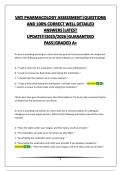
A nurse is providing teaching to a client who has gout and a new prescription for allopurinol.
Which of the following statements by the client indicates an understanding of the teaching?
A. "If I get a rash from this medication, I will take my usual antihistamine."
B. "I need to increase my fluid intake while taking this medication."
C. "I should take this medicine on an empty stomach."
D. "If I get a fever while taking this medication, I will take some aspirin." - ANSWER B.
"I need to increase my fluid intake while taking this medication."
Clients who have gout should increase their fluid intake to 2 to 3L per day to prevent toxicity
of allopurinol and decrease uric acid levels.
A nurse is providing instructions to a client who has a new prescription for sublingual
nitroglycerin to treat angina pectoris. Which of the following instructions should the nurse
include?
A. "Place the tablet under your tongue, and then take a small sip of water."
B. "The medication can take up to 15 minutes to take effect."
C. "Avoid taking the medication prior to exercising."
D. "Stop taking the medication and notify your provider if you develop a headache." -
ANSWER A. "Place the tablet under your tongue, and then take a small sip of water."
1
, A client who takes a sublingual medication should place it under his tongue. A sip of water
can help the medication dissolve. The nurse should tell the client that the medication takes
effect rapidly in 1-3 min. The nurse should tell the client that the medication can be used to
terminate an ongoing anginal attack as well as to prevent anginal pain prior to exertion.
Therefore the client might need the medication prior to exercising. Headache is a common
adverse effect of this medication that often dissipates with prolonged use. The client should
continue to take the medication and take aspirin or acetaminophen for headache.
A nurse is teaching a client who has a new prescription for phenytoin. The nurse should
instruct the client to monitor for and report which of the following adverse effects of this
medication?
A. Metallic taste
B. Diarrhea
C. Skin rash
D. Anxiety - ANSWER C. Skin rash
Phenytoin is an antiepileptic medication used to treat partial seizures and generalized tonic-
clonic seizures. Phenytoin can cause a rash that can progress to Stevens-Johnson syndrome
(SJS) or toxic epidermal necrolysis (TEN). If a rash develops, the client should notify the
provider immediately and stop the use of phenytoin.
Adverse effects of clarithromycin include an altered taste. Phenytoin can cause gingival
hyperplasia. Adverse effects of phenytoin include constipation. Adverse effects of phenytoin
include suicidal tendencies and aggression.
A nurse is caring for a client who has atrial fibrillation and receives digoxin daily. Before
administering this medication, which of the following actions should the nurse take?
A. Offer the client a light snack
B. Measure the client's blood pressure
C. Measure the client's apical pulse
2
Which of the following statements by the client indicates an understanding of the teaching?
A. "If I get a rash from this medication, I will take my usual antihistamine."
B. "I need to increase my fluid intake while taking this medication."
C. "I should take this medicine on an empty stomach."
D. "If I get a fever while taking this medication, I will take some aspirin." - ANSWER B.
"I need to increase my fluid intake while taking this medication."
Clients who have gout should increase their fluid intake to 2 to 3L per day to prevent toxicity
of allopurinol and decrease uric acid levels.
A nurse is providing instructions to a client who has a new prescription for sublingual
nitroglycerin to treat angina pectoris. Which of the following instructions should the nurse
include?
A. "Place the tablet under your tongue, and then take a small sip of water."
B. "The medication can take up to 15 minutes to take effect."
C. "Avoid taking the medication prior to exercising."
D. "Stop taking the medication and notify your provider if you develop a headache." -
ANSWER A. "Place the tablet under your tongue, and then take a small sip of water."
1
, A client who takes a sublingual medication should place it under his tongue. A sip of water
can help the medication dissolve. The nurse should tell the client that the medication takes
effect rapidly in 1-3 min. The nurse should tell the client that the medication can be used to
terminate an ongoing anginal attack as well as to prevent anginal pain prior to exertion.
Therefore the client might need the medication prior to exercising. Headache is a common
adverse effect of this medication that often dissipates with prolonged use. The client should
continue to take the medication and take aspirin or acetaminophen for headache.
A nurse is teaching a client who has a new prescription for phenytoin. The nurse should
instruct the client to monitor for and report which of the following adverse effects of this
medication?
A. Metallic taste
B. Diarrhea
C. Skin rash
D. Anxiety - ANSWER C. Skin rash
Phenytoin is an antiepileptic medication used to treat partial seizures and generalized tonic-
clonic seizures. Phenytoin can cause a rash that can progress to Stevens-Johnson syndrome
(SJS) or toxic epidermal necrolysis (TEN). If a rash develops, the client should notify the
provider immediately and stop the use of phenytoin.
Adverse effects of clarithromycin include an altered taste. Phenytoin can cause gingival
hyperplasia. Adverse effects of phenytoin include constipation. Adverse effects of phenytoin
include suicidal tendencies and aggression.
A nurse is caring for a client who has atrial fibrillation and receives digoxin daily. Before
administering this medication, which of the following actions should the nurse take?
A. Offer the client a light snack
B. Measure the client's blood pressure
C. Measure the client's apical pulse
2


