Phys 118 – Worksheet 2: Electric field.
2025 PHYS 118|PHYS_V 118 – Worksheet 2: Electric field WITH SOLUTIONS University of British
Columbia
Electric Field
A vector field is a function that assigns a vector to every point in space. If a ‘probe’, or ‘test’, charge 𝑞 experiences an
electric force at a point in space, we say that there is an electric field 𝐸� ⃗ at that point causing the force. This electric field
is due to some other (‘source’) charges. The force on a test charge 𝑞 placed in an electric field 𝐸� ⃗ (𝑥, 𝑦, 𝑧) is:
𝐹⃗⃗on 𝑞 at (𝑥, 𝑦, 𝑧) = 𝑞 𝐸� ⃗ (𝑥, 𝑦, 𝑧).
Units of the electric field: N/C. The magnitude (absolute value) 𝐸 of the electric field is called the electric field strength.
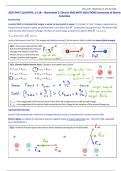
Q2.1. The arrows show electric field a) b)
due to some distribution of source
charges (not shown). Draw the
electric forces on these two test
charges, positive and negative.
Q2.2. Electric field vs electric force. Compare, and explain your choice:
2𝑞 𝑞
A. A.
B. B.
C. C. Charge 1 Charge 2
𝐹⃗1 𝑜𝑛 2 = the magnitude of the electric force, which the first charge exerts on the second charge;
𝐸1 𝑎𝑡 2 = the magnitude of the electric field created by the first charge at the location of the second charge; etc.
Superposition principle
Electric fields produced by a collection of charges add up as vectors, to produce the resultant electric field.
Electric dipole is a system of one positive and one negative charge of equal magnitudes (say, −𝑄𝑄 and +𝑄𝑄), separated
by a small distance 𝑠.
Q2.3. In which direction points the electric field created by this dipole at the black dot?
a) b)
, Phys 118 – Worksheet 2: Electric field.
Q2.4. At which of these points can the electric field of a dipole be zero? Sketch the electric field at these points.
Q2.5. Calculate the electric field of a dipole on x-axis (see figure). Point P is at a distance 𝑥 from the origin.
a) Express 𝑟 using 𝑥 and 𝑦.
b) Draw the two E-field vectors in the diagram.
Write the magnitudes of the electric fields due to each charge:
c) What is the x-component of the electric field at P due to the two charges?
d) What is the y-component of the electric field at P due to the two charges?
e) Write the electric field at P using unit vector notation. This expression defines the strength (magnitude) of the
electric field on the x-axis at a distance 𝑥 from the origin.
, Phys 118 – Worksheet 2: Electric field.
This calculation was relatively easy since we have looked at the electric field of a dipole at a symmetry point: Note that
point P in Q2.5 was chosen on the axis that lays at the same distance from both charges of the dipole. As a result, the
horizontal components of the fields produced by +𝑞 and −𝑞, cancelled, and we got a vertical (one-component) net
field. For an arbitrary (not equidistant from the two charges) point the electric field of a dipole will have two
components, the vertical and the horizontal.
It is a very good exercise to sketch the electric field of a dipole at an arbitrary point by doing vector addition. Do it on
your own in the box below. The answer is provided since this field is important, and you should know it. Basically, this
exercise suggests you to convince yourself that the picture on the right is correct.
Applying superposition principle to more than two charges:
Q2.6. At the position of the dot, the electric field points approximately
Show the superposition of the field vectors due to the three point charges and draw the resultant field vector.
2025 PHYS 118|PHYS_V 118 – Worksheet 2: Electric field WITH SOLUTIONS University of British
Columbia
Electric Field
A vector field is a function that assigns a vector to every point in space. If a ‘probe’, or ‘test’, charge 𝑞 experiences an
electric force at a point in space, we say that there is an electric field 𝐸� ⃗ at that point causing the force. This electric field
is due to some other (‘source’) charges. The force on a test charge 𝑞 placed in an electric field 𝐸� ⃗ (𝑥, 𝑦, 𝑧) is:
𝐹⃗⃗on 𝑞 at (𝑥, 𝑦, 𝑧) = 𝑞 𝐸� ⃗ (𝑥, 𝑦, 𝑧).
Units of the electric field: N/C. The magnitude (absolute value) 𝐸 of the electric field is called the electric field strength.
Q2.1. The arrows show electric field a) b)
due to some distribution of source
charges (not shown). Draw the
electric forces on these two test
charges, positive and negative.
Q2.2. Electric field vs electric force. Compare, and explain your choice:
2𝑞 𝑞
A. A.
B. B.
C. C. Charge 1 Charge 2
𝐹⃗1 𝑜𝑛 2 = the magnitude of the electric force, which the first charge exerts on the second charge;
𝐸1 𝑎𝑡 2 = the magnitude of the electric field created by the first charge at the location of the second charge; etc.
Superposition principle
Electric fields produced by a collection of charges add up as vectors, to produce the resultant electric field.
Electric dipole is a system of one positive and one negative charge of equal magnitudes (say, −𝑄𝑄 and +𝑄𝑄), separated
by a small distance 𝑠.
Q2.3. In which direction points the electric field created by this dipole at the black dot?
a) b)
, Phys 118 – Worksheet 2: Electric field.
Q2.4. At which of these points can the electric field of a dipole be zero? Sketch the electric field at these points.
Q2.5. Calculate the electric field of a dipole on x-axis (see figure). Point P is at a distance 𝑥 from the origin.
a) Express 𝑟 using 𝑥 and 𝑦.
b) Draw the two E-field vectors in the diagram.
Write the magnitudes of the electric fields due to each charge:
c) What is the x-component of the electric field at P due to the two charges?
d) What is the y-component of the electric field at P due to the two charges?
e) Write the electric field at P using unit vector notation. This expression defines the strength (magnitude) of the
electric field on the x-axis at a distance 𝑥 from the origin.
, Phys 118 – Worksheet 2: Electric field.
This calculation was relatively easy since we have looked at the electric field of a dipole at a symmetry point: Note that
point P in Q2.5 was chosen on the axis that lays at the same distance from both charges of the dipole. As a result, the
horizontal components of the fields produced by +𝑞 and −𝑞, cancelled, and we got a vertical (one-component) net
field. For an arbitrary (not equidistant from the two charges) point the electric field of a dipole will have two
components, the vertical and the horizontal.
It is a very good exercise to sketch the electric field of a dipole at an arbitrary point by doing vector addition. Do it on
your own in the box below. The answer is provided since this field is important, and you should know it. Basically, this
exercise suggests you to convince yourself that the picture on the right is correct.
Applying superposition principle to more than two charges:
Q2.6. At the position of the dot, the electric field points approximately
Show the superposition of the field vectors due to the three point charges and draw the resultant field vector.