
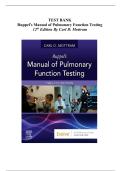
TEST BANK
Ruppel’s Manual of Pulmonary Function Testing
12th Edition By Carl D. Mottram
,Chapter 1: Indications for Pulmonary Function Testing Test
Bank
MULTIPLE CHOICE
1. Who first popularized spirometry for the evaluation of pulmonary function?
a. August and Marie Krogh
b. Alvan Barach
c. John Severinghaus
d. John Hutchinson
ANS: D
Hutchinson popularized the concept of using VC to assess lung function, and the
names he gave to several other lung compartments are still used today.
DIF: 1 REF: p. 2 OBJ: None MSC: NBRC: None
2. Which of the following are indications for performing spirometry?
1. Assess the risk of lung resection.
2. Determine the response to bronchodilator therapy.
3. Assess the severity of restrictive lung disease.
4. Quantify the extent of COPD.
a. 1 and 4
b. 2 and 3
c. 1 , 2, and 4
d. 2 , 3, and 4
ANS: C
Spirometry cannot assess severity of restriction; for that you need to measure
lung volumes ( see Box 1-2, Chapter 1).
DIF: 1 REF: p. 7 OBJ: EL-2 MSC: NBRC: None
3. The main indication for the measurement of lung volumes is to do which of the
following?
a. Diagnose or assess the severity of restriction.
b. Evaluate the severity of pulmonary hypertension.
c. Determine the level of cardiopulmonary fitness.
d. Assess the risk of abdominal surgical procedures.
ANS: A
The most common reason for measuring lung volumes is to identify restrictive
lung disease. DIF: 1 REF: p. 35 OBJ: EL-2 MSC: NBRC: None
4. DLCO measurements may be indicated to evaluate pulmonary involvement in
which of the following systemic diseases?
a. Asthma
b. Sarcoidosis
|
, c. Exertional hypoxemia
d. Guillain-Barré syndrome
ANS: B
Sarcoidosis is the only systemic disease listed that affects gas
exchange. DIF: 1 REF: p. 9 | p. 19 | p. 21 | p. 35 OBJ: EL-2
MSC: NBRC: None
5. Blood gas analysis is used with patients with COPD to do
which of the following?
a. Monitor airway responsiveness.
b. Determine level of cardiopulmonary fitness.
c. Detect pulmonary hypertension.
d. Assess need for supplementary O2.
ANS: D
Blood gas analysis is most commonly used to determine the need for
supplemental oxygen and to manage patients who require ventilatory support.
DIF: 2 REF: p. 15 OBJ: EL-
1 MSC: NBRC: CPFT 2A-2
6. Which of the following cause emphysema?
1. 1- Antitrypsin deficiency
2. Exposure to environmental pollutants
3. Radiation therapy
4. Cigarette smoking
a. 1 and 2
b. 3 and 4
c. 1 , 2, and 4
d. 2 , 3, and 4
ANS: C
Emphysema is caused primarily by cigarette smoking. Some emphysema is
caused by the absence of a protective enzyme. Chronic exposure to environmental
pollutants can also contribute to the development of emphysema.
DIF: 1 REF: p. 11 OBJ: EL-3 | AL-2 MSC: NBRC: None
7. An adult patient complains of chest tightness and cough whenever he jogs in
cold weather. These symptoms are consistent with which of the following?
a. Cystic fibrosis
b. Asthma
c. Pulmonary hypertension
d. Idiopathic pulmonary fibrosis
3
, ANS: B
Agents or events that cause an asthmatic episode are called triggers (see Box
1-7, Chapter 1). Antigens such as animal dander, pollens, and dusts are the
most common triggers. Other common triggers include exposure to air
pollutants and exercise in cold or dry air.
DIF: 2 REF: p. 16 OBJ: EL-3 MSC: NBRC: None
8. Which of the following statements concerning tumors in the upper airway is true?
a. There may be variable or fixed obstruction.
b. Fixed obstruction will be present.
c. Variable obstruction will be present.
d. Small airway obstruction will result.
ANS: A
Tumors involving the upper airway may cause variable or fixed obstruction.
DIF: 2 REF: p. 19 OBJ: EL-
2 MSC: NBRC: CPFT 3C-3
9. Sarcoidosis is a systemic disorder that usually causes which of the following?
a. A restrictive ventilatory defect
b. An obstructive ventilatory defect
c. Hyperreactive airways
d. Primary pulmonary hypertension
ANS: A
Restriction is often associated with the following: interstitial lung diseases,
including idiopathic fibrosis, pneumoconiosis, and sarcoidosis.
DIF: 1 REF: p. 19 | p. 21 OBJ: EL-3 MSC: NBRC: None
10. For which of the following conditions might pulmonary function testing be
contraindicated?
a. Vocal cord dysfunction
b. Untreated pneumothorax
c. Congestive heart failure (CHF)
d. Bronchiolitis obliterans
ANS: B
Pulmonary function tests are usually contraindicated in the presence of
pneumothorax. However, undiagnosed pneumothorax may present a risk if
pulmonary function studies are performed.
DIF: 1 REF: p. 23 OBJ: EL-
4 MSC: NBRC: CPFT 2B-6
|
Ruppel’s Manual of Pulmonary Function Testing
12th Edition By Carl D. Mottram
,Chapter 1: Indications for Pulmonary Function Testing Test
Bank
MULTIPLE CHOICE
1. Who first popularized spirometry for the evaluation of pulmonary function?
a. August and Marie Krogh
b. Alvan Barach
c. John Severinghaus
d. John Hutchinson
ANS: D
Hutchinson popularized the concept of using VC to assess lung function, and the
names he gave to several other lung compartments are still used today.
DIF: 1 REF: p. 2 OBJ: None MSC: NBRC: None
2. Which of the following are indications for performing spirometry?
1. Assess the risk of lung resection.
2. Determine the response to bronchodilator therapy.
3. Assess the severity of restrictive lung disease.
4. Quantify the extent of COPD.
a. 1 and 4
b. 2 and 3
c. 1 , 2, and 4
d. 2 , 3, and 4
ANS: C
Spirometry cannot assess severity of restriction; for that you need to measure
lung volumes ( see Box 1-2, Chapter 1).
DIF: 1 REF: p. 7 OBJ: EL-2 MSC: NBRC: None
3. The main indication for the measurement of lung volumes is to do which of the
following?
a. Diagnose or assess the severity of restriction.
b. Evaluate the severity of pulmonary hypertension.
c. Determine the level of cardiopulmonary fitness.
d. Assess the risk of abdominal surgical procedures.
ANS: A
The most common reason for measuring lung volumes is to identify restrictive
lung disease. DIF: 1 REF: p. 35 OBJ: EL-2 MSC: NBRC: None
4. DLCO measurements may be indicated to evaluate pulmonary involvement in
which of the following systemic diseases?
a. Asthma
b. Sarcoidosis
|
, c. Exertional hypoxemia
d. Guillain-Barré syndrome
ANS: B
Sarcoidosis is the only systemic disease listed that affects gas
exchange. DIF: 1 REF: p. 9 | p. 19 | p. 21 | p. 35 OBJ: EL-2
MSC: NBRC: None
5. Blood gas analysis is used with patients with COPD to do
which of the following?
a. Monitor airway responsiveness.
b. Determine level of cardiopulmonary fitness.
c. Detect pulmonary hypertension.
d. Assess need for supplementary O2.
ANS: D
Blood gas analysis is most commonly used to determine the need for
supplemental oxygen and to manage patients who require ventilatory support.
DIF: 2 REF: p. 15 OBJ: EL-
1 MSC: NBRC: CPFT 2A-2
6. Which of the following cause emphysema?
1. 1- Antitrypsin deficiency
2. Exposure to environmental pollutants
3. Radiation therapy
4. Cigarette smoking
a. 1 and 2
b. 3 and 4
c. 1 , 2, and 4
d. 2 , 3, and 4
ANS: C
Emphysema is caused primarily by cigarette smoking. Some emphysema is
caused by the absence of a protective enzyme. Chronic exposure to environmental
pollutants can also contribute to the development of emphysema.
DIF: 1 REF: p. 11 OBJ: EL-3 | AL-2 MSC: NBRC: None
7. An adult patient complains of chest tightness and cough whenever he jogs in
cold weather. These symptoms are consistent with which of the following?
a. Cystic fibrosis
b. Asthma
c. Pulmonary hypertension
d. Idiopathic pulmonary fibrosis
3
, ANS: B
Agents or events that cause an asthmatic episode are called triggers (see Box
1-7, Chapter 1). Antigens such as animal dander, pollens, and dusts are the
most common triggers. Other common triggers include exposure to air
pollutants and exercise in cold or dry air.
DIF: 2 REF: p. 16 OBJ: EL-3 MSC: NBRC: None
8. Which of the following statements concerning tumors in the upper airway is true?
a. There may be variable or fixed obstruction.
b. Fixed obstruction will be present.
c. Variable obstruction will be present.
d. Small airway obstruction will result.
ANS: A
Tumors involving the upper airway may cause variable or fixed obstruction.
DIF: 2 REF: p. 19 OBJ: EL-
2 MSC: NBRC: CPFT 3C-3
9. Sarcoidosis is a systemic disorder that usually causes which of the following?
a. A restrictive ventilatory defect
b. An obstructive ventilatory defect
c. Hyperreactive airways
d. Primary pulmonary hypertension
ANS: A
Restriction is often associated with the following: interstitial lung diseases,
including idiopathic fibrosis, pneumoconiosis, and sarcoidosis.
DIF: 1 REF: p. 19 | p. 21 OBJ: EL-3 MSC: NBRC: None
10. For which of the following conditions might pulmonary function testing be
contraindicated?
a. Vocal cord dysfunction
b. Untreated pneumothorax
c. Congestive heart failure (CHF)
d. Bronchiolitis obliterans
ANS: B
Pulmonary function tests are usually contraindicated in the presence of
pneumothorax. However, undiagnosed pneumothorax may present a risk if
pulmonary function studies are performed.
DIF: 1 REF: p. 23 OBJ: EL-
4 MSC: NBRC: CPFT 2B-6
|


